COPYRIGHT

All content on this blog is protected by copyright.
Content used elsewhere without attribution constitutes theft of intellectual property and will be prosecuted.

Friday, July 25, 2014

The Second Crusade

The crusader kingdoms were a remarkable achievement that astonished the contemporary world. But less than a half century after the re-capture of Jerusalem by Christian forces, the new crusader states suffered their first set back. In 1144, the Principality of Edessa was captured by Saracen forces. By 1146 the Principality of Antioch was also threatened, and an appeal went out – not to the Byzantine Emperor, who was deemed untrustworthy, but to the West, which had provided the forces that had taken Jerusalem in 1099 and with which the ruling elite retained cultural, linguistic and family ties.

This call for help elicited an enthusiastic response. This time even kings were persuaded to take the cross (i.e., the crusader vow): namely, the King of France, King Louis VII, and the Holy Roman Emperor, Konrad III. Furthermore, Bernard of Clairvaux, one of the most respected clerics of the age and a gifted orator, preached passionately in favor of the new crusade.


The Holy Roman Emperor Konrad raised about 80,000 troops and set out first, but his army was so decimated by cavalry attacks, heat, and hunger after crossing into territory held by the Seljuks that he returned to Nicaea while what remained of his army (approximately 7,000 men) joined forces with the French. Louis’ army (including his wife, Eleanor of Aquitaine) advanced slowly, and despite several serious set-backs and one significant defeat (which will be described in more detail in my next post), eventually reached Jerusalem in the spring of 1148 with an estimated 50,000 men.

There the fateful decision was made to try to seize Damascus, to relieve the pressure on the narrowest part of the crusader foothold at Tyre and Tripoli. Ironically, the Muslim ruler of Damascus was one of the Saracen leaders, who had been willing to compromise and negotiate with the crusader kingdoms in the East. The siege made an enemy of a former ally and pushed him into the arms of the jihadists -- which wouldn't have been disastrous if the campaign had been successful.  However, although a siege was established, squabbles among the leaders and then news that a strong Saracen relief army was on the way spread so much panic among the crusaders that the crusading army disintegrated. They had made a new enemy for nothing and squandered the reinforcements from the West. 

Worst of all, however, this humiliating failure profoundly damaged the entire concept of crusades and crusading in the West.  It demonstrated that “God” was not inherently on the side of the crusaders and that victory was not assured. It also helped restore both unity and confidence among the Saracen leaders.

Sunday, July 20, 2014

"Road from the West" -- A Review

Rosanne Lortz’s “Road from the West” is a well-researched and, on the whole, realistic portrayal of the First Crusade seen through Norman eyes. While it does not white-wash the crusaders or their actions, it does not turn them into monsters either. Indeed, this book makes no attempt at political correctness, and so it is not laden with anachronistic values and perspectives. Instead, the absence of moralizing lends the book a refreshing authenticity.

Like all “road” books, the plot is determined mostly by the progress made, the milestones of the First Crusade itself, but Lortz has done an excellent job of enlivening and rounding out her story by adding characters with slightly different perspectives, such as the camp-follower Alexandra and the priest Bernard.  I particularly liked the inclusion of Alexandra because, as Lortz points out in her Author’s Note, there were in fact thousands of women in Alexandra’s shoes, following along behind the crusaders and suffering with them.

Nevertheless, I thought Lortz was at her strongest in her portrayal of Bohemond and Ademar, two historical figures that she brings effectively to life. I especially liked the relationship she developed between Bohemond and Tancred, while Tancred himself is a strong protagonist throughout most of the novel. I certainly disagree with other reviewers, who object to Lortz inventing Tancred’s motives. The evidence that he was “sadistic” or homosexual is dubious at best, and Lortz is completely within her rights as an author to portray him in a more positive light as long as she sticks to the known facts — which she does.

Yet for all its strengths, this novel is flawed by the introduction of not one but two Muslim women in fantastical (not historical) circumstances. The second encounter is so absurd as to be nothing short of operatic.  Suddenly the sense of reading serious historical fiction was shattered. Within one chapter, the reader was catapulted into a cheap romance with (of course! stunningly beautiful yet exceptionally courageous) female characters behaving in ways unthinkable for their culture and period. A very disappointing end for an initially promising historical biography.

Friday, July 11, 2014

Women in the Kingdom of Jerusalem


The crusader states, established at the beginning of the 12 century, rapidly developed unique political institutions and their own legal traditions. One of the most interesting ways in which they set themselves apart from contemporary societies was the prominent role played by women.  In the surrounding Muslim world, of course, women had neither names nor faces, much less a voice, in public. In the Byzantine Empire, on the other hand, while women enjoyed considerable freedom, wealth, education and influence, they did not directly hold power.  Western Europe the 12th century saw several very powerful female rulers, notably the Empress Matilda and Eleanor of Aquitaine, yet the crusader kingdoms stand out because the high status of women in the Holy Land was more comprehensive and institutionalized than in either the Eastern Empire or the Western Europe.

This high status probably evolved out of the repeated failure of the ruling dynasties to produce male heirs.  A look at the succession in the Kingdom of Jerusalem illustrates this well. When Baldwin II died in 1131, he was succeeded by his daughter, Melisende, who ruled jointly with her husband Fulk of Anjou (grandfather by his first marriage of Henry II of England). When Fulk died in 1143, Melisende remained Queen of Jerusalem, and ruled jointly with her eldest son, Baldwin III.  Although her son eventually side-lined her, it was only after a struggle in which several powerful barons and most of the clergy sided with the Queen. 


At Baldwin III’s death in 1163, his heir was his brother Amalric I, but Amalric’s heir was the ill-fated Baldwin IV, the Leper King, who had no children, making his sisters (and through them, their children and/or husbands) his heirs. As fate would have it, in the century between the death of Baldwin II and the ascension of Friedrich II as consort of a Queen of Jerusalem in 1225, the crown of Jerusalem passed through the female line no less than ten times! Furthermore, the situation in the crusader states and baronies was similar, if not quite so dramatic; that is, the title to baronies repeatedly passed through heiress rather than heirs. This fact alone would have raised the importance of women, but it is significant that these queens (and countesses and ladies) were not passive vessels.

Melisende was Queen in her own right, commanded loyalty and support among her vassals and forced both her husband and later her son to take her political wishes into account.  Sibylla forced upon the kingdom a man patently unsuitable for the kingship and soon detested by her brother, the reigning King, and the majority of the barons.  When her son Baldwin V died, Sibylla – not Guy – was crowned by the patriarch, but she placed the crown on Guy’s head as her consort.  Furthermore, Guy’s vassals viewed their oaths to him absolved the moment Sibylla died – despite Richard of England’s determined support for Guy.  


In the end, even the Lionheart gave up and recognized that without Sibylla, Guy could not be King of Jerusalem. The crown passed to Sibylla’s sister, Isabella. Isabella conferred the crown on three men in succession, Conrad de Montferrat, Henri de Champagne and finally Aimery de Lusignan. Notably, Henri de Champagne, a nephew of both Philip II of France and Richard I of England (his mother was a daughter of Eleanor of Aquitaine by Louis VII), never even called himself King of Jerusalem; he remained Count of Champagne, while Isabella was Queen of Jerusalem. Her daughter’s husband, John of Brienne, also lost his title of King of Jerusalem at his wife’s death, although he acted as regent for his infant daughter until she wed Friedrich II.

The dynastic importance of women was both cause and effect of a uniquely high status for women in the crusader kingdoms that took many other forms. Not only did women act as regents and receive homage from vassals, they enjoyed a freedom of movement and opinion that scandalized the Muslim – and sometimes the Christian – world.  Amalric I’s wife Agnes de Courtney is sometimes accused of being set aside because of her immorality, certainly she was accused of having affairs with a prelate of the church (later the Patriarch of Jerusalem, Heraclius) and with Aimery de Lusignan. Her daughter Sibylla is alleged to have had an affair with Baldwin d’Ibelin before taking Guy de Lusignan to her bed. Certainly a contemporary claimed that Baldwin IV wanted to hang Guy for “debauching” a princess of Jerusalem, but was then persuaded to let his sister marry her lover.  It was behavior such as this that led many in the West to believe Jerusalem had been lost in 1187 because of God’s wrath with the immorality of the Christian rulers.


Yet while the antics of the royal women may indeed have deserved censure, the higher status of women generally meant that widows in the crusader kingdoms exercised far more control over their property and their lives. SIbylla is the most prominent example, but she was not alone in choosing her second husband. Constance of Antioch chose Reynald de Chatillon, and Maria Comnena chose Balian d’Ibelin, just to name two other prominent examples. In short, young girls were married often at very tender ages to boys or men of their parents’ choosing, but widows had the power, property and right to choose their own husbands – and did.

The higher status of women also impacted their daily lives. Upper class women were literate as they could not have otherwise conducted their affairs, and they owned books. Some accounts stress that they rode astride for greater safety in an always precarious environment, something that gave them greater mobility. They did not have to go veiled in public, although women almost certainly covered their faces from the ravaging effects of the summer sun when out of doors.  But perhaps most important, they were entitled to their opinions, free to voice them and often heeded by their male contemporaries.


Compared to their faceless and voiceless sisters in the Muslim world, this was undoubtedly the greatest privilege of all.

Read more about powerful women in the crusader states at: http://defenderofjerusalem.com

Sunday, July 6, 2014

"Walking Corpses" - A Review

Walking Corpses: Leprosy in Byzantium and the Medieval West by Timothy S. Miller and John W. Nesbitt

This is an important scholarly work on the treatment of lepers in the Middle Ages. It covers everything from theories on the causes of leprosy to the administration of leper colonies. The book is well researched and the theses are well presented, argued and documented. 

Given the subject matter, this is not an “easy” read and is intended more for academics than for the general public. Yet it provides very valuable insights into medieval society that would benefit more casual students of the Middle Ages.  For one thing, Miller and Nesbitt effectively debunk the notion that leper colonies were places of punishment or that lepers were consistently and cruelly expelled from society out of moral revulsion.  On the contrary, they convincingly argue “ spiritual leaders [shaped] a new ethical imperative to accept lepers as suffering brothers in Christ, not to reject them as ritually impure or as objects of divine punishment.” In Byzantium, leprosy even came to be called “the Holy Disease” and a number of legends associated lepers with Christ, while service to lepers was viewed as particularly holy.

Nevertheless, the fear of contagion was — understandably — enormous and so civil and responsible ecclesiastical leaders sought to separate lepers from society at large.  Leper colonies were thus generally located outside city walls — but close enough for lepers to engage in trade and receive alms and visits from relatives, friends and patrons.

Because the organization of several important leper colonies is documented, we have insight into how the lepers managed their affairs, and Miller and Nesbitt highlight the fact that most leper colonies were run by the lepers themselves, who appear to have most often elected their own leaders! Furthermore, women lepers took part in the administration of leper colonies on equal footing with men and in some cases even obtained positions of authority. 

This later fact begs the question if only leprous women were deemed the equals of men, or if medieval society wasn’t considerably more respectful of women’s intellect and capabilities than is generally assumed? Or was, as Miller and Nesbitt ask at the very end of their work, the role played by women and the “democratic” nature of leper colonies a reason for increasing suspicion and hostility to lepers at the end of the Middle Ages?


Friday, June 27, 2014

An Elected Kingship

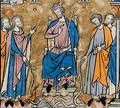
Perhaps the most remarkable thing about the Kings of Jerusalem is the fact that they were elected rather than born. 
\

The tradition started, of course, with the conquest of Jerusalem in 1099. The First Crusade had never had a single leader and there was considerable (often destructive) rivalry between the leading lords that took the cross, notably, Raymond IV Count of Toulouse, Stephan Count of Blois, Robert Count of Flanders, Hugh Count of Vermandois, Bohemond of Taranto and his nephew Tancred, and the brothers Godfrey and Baldwin of Boulogne.  By the time the crusaders reached Jerusalem, Stephan had abandoned the crusade altogether, Baldwin of Boulogne had struck off on his own and captured Edessa, and Bohemond had remained in Antioch to re-establish a Christian state there.  The remaining lords, however, chose Godfrey of Boulogne to rule over Jerusalem.  Godfrey had won the respect of his fellow crusaders by his leadership, and although Raymond of Toulouse probably expected the honor himself, he accepted the choice.  Godfrey reputedly refused to wear “a crown of gold where Christ had worn a crown of thorns” and took the title of “Defender” or “Protector” or possibly just “Ruler” of Jerusalem.  

Just one year later, however, he was dead without an heir. The nascent kingdom was in a more precarious state than ever, since the majority of the surviving crusaders felt they had fulfilled their vow and returned home. Those noblemen remaining in the Holy Land again (not without controversy) selected a successor from among themselves, in this case, Godfrey’s brother Baldwin.  Baldwin did not share his brother’s qualms about calling himself king, and took the title of King Baldwin I. But in 1118 Baldwin I also died without an heir of his body, and the barons of the crusader kingdoms chose for a third time a leader from among their ranks, this time, Baldwin of Bourcq, who thereby became Baldwin II of Jerusalem.

Three such “elections” (with admittedly limited franchise!) set a legal precedent and the Kings of Jerusalem were henceforth always “elected” by the High Court of Jerusalem, the later composed of the leading lords of the realm.  This is the equivalent of the English House of Lords electing the Kings of England!

As the products of European feudalism with strong ties to the ruling houses of England and France, however, the members of the High Court showed a strong bias in favor of blood relatives of the last monarch. Nevertheless, the approval of the High Court was considered a pre-requisite for legitimate rule. Thus every time a king died, there was effectively an interregnum (if not outright crisis) while factions positioned themselves and consensus was established.

Perhaps the most serious succession crisis occurred at the critical period when Saladin had united Islam for the first time in a hundred years and declared his intention to wage jihad against the crusader kingdoms until he had pushed them into the sea. The king at the time, Baldwin IV, suffered from leprosy and was dying limb by limb; he had no children.  His closest male relative was his 8 year old nephew, the son of his sister Sibylla.  To prevent Sibylla’s husband, who the dying king detested and mistrusted, from becoming king, Baldwin IV orchestrated the coronation of his nephew as Baldwin V during his lifetime, thereby ensuring the barons had all sworn their oaths as vassals to the boy.

Recognizing, however, that life was fragile in the Holy Land in the 12th century, Baldwin IV also made his vassals swear to  consult with the Kings of England and France and the Pope before a electing a king to succeed his nephew, if the boy did not survive into adulthood. This elaborate attempt to curtail the sovereignty of the High Court of Jerusalem failed.  

When Baldwin V died less than a year after his uncle, no one had time for such a lengthy process as sending to London, Paris and Rome for advice.  (The English and French kings could be counted on not to agree on anything anyway, since they were at war with one another.) Instead, while the High Court was meeting in Tiberius, Princess Sibylla and her husband staged a coup: they persuaded the Patriarch to crown and anoint Sibylla queen of Jerusalem in the Church of the Holy Sepulcher. She then crowned her husband Guy de Lusignan as her consort.


Sibylla at her coronation as depicted in the film "The Kingdom of Heaven"

Without the consent of the High Court, however, Guy de Lusignan was a usurper.  The bulk of the barons were prepared to oppose him by crowning an alternative candidate, namely the husband of Baldwin IV’s other sister, Isabella. With the enemy almost literally at the gates, however, the High Court’s choice for king, Humphrey de Toron, chose not to contest the kingship and took an oath to Guy de Lusignan instead.  While this act made it politically impossible to oppose Guy de Lusignan, Raymond of Tripoli was legally within his rights to refuse to swear allegiance to Guy.

While the High Court was circumvented by Sibylla and Guy’s coup in 1186, the High Court exerted (and revenged) itself effectively six years later when Sibylla and her daughters by Guy died of fever in 1190.  Guy saw himself as an anointed king and sought the support of his father’s overlord, the most powerful monarch in Christendom and only military commander with a chance of restoring the fortunes of the crusader kingdoms: Richard “the Lionheart” of England. Richard unequivocally supported Guy’s claim to the throne of Jerusalem – but the High Court still refused to acknowledge him because, with Sibylla’s death, Guy’s claim to the kingdom was -- in the eyes of the barons of Outremer -- extinguished.  

Since Humphrey of Toron was unwilling or unable to oppose Guy, the High Court pressured a reluctant Isabella, the last surviving child of King Amalric I, to divorce Humphrey and take a new husband, Conrad of Montferrat. Conrad was then recognized by the High Court as the legitimate king of Jerusalem. Since Jerusalem was still in Saracen hands, no coronation actually took place, but after two years Richard the Lionheart backed down and conceded that without the consent of the High Court even an anointed king could not rule the Kingdom of Jerusalem. 

Sunday, June 22, 2014

"Jerusalem" by Cecilia Holland - A Review

Holland clearly is an experienced writer with considerable competence. She can construct a good scene, build up suspense and her characters are nuanced and complex, yet this book utterly failed to captivate me.


In part it was the constant, minor inaccuracies that nagged at me like flies.  No, it’s not terribly important that Felx isn’t a German name (Felix is) and “Deutschlander” isn’t a word — in any language. No, it’s not important that Nablus belonged to Maria Comnena not Agnes de Courtney, or that Baldwin d’Ibelin wasn’t Balian’s younger, landless brother, but the first born and Baron of Ramla and Mirabelle, one of the richest baronies in the Kingdom. But it rubbed me the wrong way that the author of a book titled “Jerusalem” had obviously never been there. If she had, she would know the Temple Mount is not the highest point in the city and that the David Gate (now Jaffa Gate) faces west not east, among other things. It also set my teeth on edge to have 12th century knights portrayed as earring-wearing dandies with feathers in their caps, while the court scenes read like Versailles in the age of Louis XIV rather than like barons of a Kingdom conquered and held for a hundred years by cagy, clever and astonishingly successful fighting men.

To be sure, Holland wrote her novel before the excellent histories of the period by Bernard Hamilton and Malcolm Barber were released, so she must be forgiven for her inaccurate portrayal of Baldwin IV’s leprosy. And, of course, she is within her rights as a novelist to completely ignore the subsequent Queen of Jerusalem, Isabella, and to make Tripoli a coward on the Litani (although historically he captured Saladin’s nephew), but as a historian the gratuitous changes to the historical record that do not move the plot forward just seem sloppy. Why have Balian d’Ibelin taken captive at both the Litani and Hattin when he was captured at neither? Why refer to Farrukh Shah as Saladin’s brother when he was his nephew?


For readers with no particular interest in accurate history, these errors might seem unimportant, yet it was not just the eclectic mixture of historical fact and sheer fancy that ultimately made me dislike this book: it was the lack of positive characters. Holland’s characters may be complex but only in their layers of unsavoriness. I am repelled by male protagonists for whom “love” manifests itself as the desire to rape, and by female leads that fling themselves at men they hardly know and beg to be debauched. In this book there are no heroes one can really care about: all the Christian lords are either effeminate cowards or brutal barbarians, and even Saladin is portrayed as a vengeful tyrant. There is no nobility or honest kindness and affection in this book, and so it left a sour taste in my mouth: it seemed like an insult to Jerusalem.

Friday, June 13, 2014

Luxury Exports and Religious Tourists: The Urban Economy of the Crusader Kingdoms

It has been estimated that roughly 50% of the Frankish population in the crusader kingdoms was urban. That represents a much higher proportion than in Western Europe at this time, and particularly in the post-Hattin era, the majority of noblemen were dependent on non-agricultural income for their wealth. In short, the degree of urbanization in the Kingdom of Jerusalem, particularly the 13th century Kingdom, resembled the Italian city states more than the large western kingdoms such as England and France. To understand the crusader kingdoms, therefore, it is important to understand the urban economy.


The Medieval cities of the Holy Land had many covered markets similiar to these in 
Acre (left) and Jerusalem (right).

The most obvious source of wealth was the control of the key ports along the coast of the Levant which meant the points at which the “riches of the Orient” were transshipped for export to the increasingly prosperous population of the West. It was in Beirut and Tyre, Acre and Caesarea, Jaffa and Ascalon that Damascus steel and Indian spices, Ethiopian incense and Nubian gold, Persian carpets and Chinese silk, African ivory and Egyptian papyrus were exported to the hungry markets of Italy, and from there onward to the Holy Roman Empire, France, Iberia and far off England and Scandinavia.


The port of Acre was the most important in the crusader states.

In addition to these transshipped items, the crusader kingdoms themselves had a number of export goods that were highly lucrative. While sugar was probably the most important bulk commodity, the export of Holy Relics and souvenirs should not be under-estimated. By some estimates, the population of Jerusalem doubled during the summer pilgrimage (tourist) season, and all of those pilgrims wanted to take some mementos home with them as well as gifts for family and friends, just like modern tourists today.

All those pilgrims also needed a place to stay and food to eat — and not just in Jerusalem. The pilgrimage sites included not just obvious sites such as Bethlehem and Nazareth, but also the site of every moment in Christ’s life as recorded in the Gospels, and places associated with the Virgin Mary, Mary Magdalene, and other saints. There was hardly a place in the entire Kingdom of Jerusalem that could not lay claim to some biblical event of importance, and devout pilgrims, who ventured so far at such cost and risk, generally stayed until the fall sailing season, which meant spending roughly six months in the Holy Land. In short, the pilgrimage “service industry” was in proportion to the population of the time at least as important as tourism is to Israel today.


The Knights Hospitaller provided hostles, hospices and hospitals for the pilgrims. Above the Hospitaller compound in Acre.

Last but not least, a large proportion of the Latin settlers were skilled craftsmen. Serfs could not legally leave their villages and lands (and most probably didn’t want to), so the pilgrims, whether armed and unarmed, were predominantly men of higher status: craftsmen, guildsmen, or merchants. They brought their skills with them, and established themselves in the cities and towns of the crusader kingdoms, where they worked side-by-side with native craftsmen. Here some of the most productive if most prosaic of inter-cultural exchanges took place in the development of dying and cloth-making, leatherworking, gold and silver workmanship, pottery, carpentry, masonry, glass-working, and all the countless other skills essential to survival and a high contemporary standard of living.

Based on the names of the streets alone, it is clear, for example, that Jerusalem had a high concentration of furriers and tanners, but also gold and silver smiths. Pottery from the region, glazed on the inside, is known to have been a particularly popular practical ware, (an early version of Teflon), and that glass-makers and glass-blowers were renowned. The massive construction projects undertaken primarily in the mid-12th century, ensured work for carpenters, masons and sculptors, and the remaining fragments of their work are testimony to the high quality of their workmanship.

At the high-end, Jerusalem also exported illustrated manuscripts from a scriptorium established by the Canons of the Holy Sepulcher. Books produced in such a sacred place had an added value beyond the high quality of the work, and undoubtedly represented one of the luxury goods with the highest margins exported from the crusader kingdoms — albeit, as with all truly valuable, custom made objects, only in very small quantities. 

The crusader kingdom of Jerusalem, far from being a wasteland inhabited by barbarians, was a highly cultured, economically dynamic powerhouse.

Learn more about crusader society at: Balian d'Ibelin and the Kingdom of Jerusalem.

Principal sources:

·         Barber, Malcolm, The Crusader States, Yale University Press, 2012.
·         Hamilton, Bernard, The Leper King and His Heirs: Baldwin IV and the Crusader Kingdom of Jerusalem, Cambridge University Press, 2000.
·         Riley-Smith (ed), The Atlas of the Crusades, Facts on File, 1990.

·         Conder, Claude Reignier, The Latin Kingdom of Jerusalem 1099 to 1291, The Committee of the Palestine Exploration Fund, 1897.