COPYRIGHT

All content on this blog is protected by copyright.
Content used elsewhere without attribution constitutes theft of intellectual property and will be prosecuted.

Wednesday, March 28, 2018

Aimery de Lusignan Part I: The Elder Brother


Guy de Lusignan is rightly remembered as the king who lost the Kingdom of Jerusalem by his incompetent leadership in 1186-1187. He has accordingly received considerable attention in both serious histories of the crusader kingdoms and fictional accounts of the period. But Guy was not the only Lusignan to make his fortune in the Holy Land. On the contrary, he was following in the footsteps of his older brother Aimery, and it was Aimery, not the feckless Guy, who founded a dynasty. 
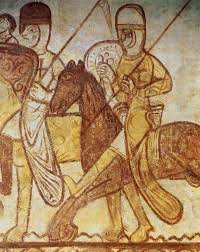


Aimery de Lusignan was the third son of Poitevan nobleman, Hugh VIII de Lusignan, a troublesome vassal of the Dukes of Aquitaine. The Lusignans had been lords of Lusignan since the early 10th century and Counts of La Marche since 1091, but in 1166 they were in revolt against their liege lord (Eleanor of Aquitaine) and siding with the Capets against the Plantagenets. It was in this period that the “Lusignan brothers” — some sources say Geoffrey and Guy, the second and fourth sons of Hugh VIII — attacked and killed the Earl of Salisbury while he was escorting Eleanor of Aquitaine. Since Salisbury was unarmed, unarmored and stabbed in the back, it was a notorious act, which according to some sources forced Guy to flee the continent as persona non grata. Curiously, Aimery’s name is never linked to the murder of Salisbury, yet it was Aimery who first went to the Holy Land.


Aimery was following in the footsteps of generations of young noblemen who sought their fortune “overseas” — in Outremer, but especially in the tradition of his own family, which had a distinguished crusading record. Hugh VI had come to the Holy Land in 1101 and died at the Battle of Ramla a year later.  Hugh VII took part in Louis VII’s Second Crusade, and Aimery’s own father, Hugh VIII, had made a pilgrimage to the Holy Land in 1163, taken part in the Battle of Harim, been captured by Nur ad-Din and died in a Muslim prison. In short, Aimery would have heard a great deal about the Kingdom of Jerusalem from his family and their retainers long before he ever set out. Very likely, there were also many men in Outremer who would have remembered his father and grandfather.


Sometime before 1174, Aimery de Lusignan arrived in the Kingdom of Jerusalem and, like his father before him, promptly got himself captured by the Saracens. Fortunately for him, King Amalric was prepared to pay his ransom.  This suggests either that the King felt responsible for the young nobleman – or perhaps just badly that his father had died in prison.  It also suggests that Aimery was an agreeable enough young man, who had made friends among the knights and barons of Jerusalem.


This assessment is reinforced by the fact that, despite being a younger (third) son, he soon succeeded in marrying into one of the most important and influential of the local baronial families, the Ibelins.  This was not the usual case of a Western adventurer seducing a widow as his bride. His wife Eschiva was probably only a young girl at the time, and the marriage was arranged by her father.  Furthermore, although at the time of this marriage Eschiva was not yet her father’s heir, the marriage would have been considered advantageous nevertheless as it made Aimery brother-in-law to the Baron of Ramla, Ibelin and Mirabel, a combined barony holding 80-some knights’ fiefs.


By 1180, Aimery had been named to the immensely powerful and important post of Constable of Jerusalem, succeeding the important local baron Humphrey II of Toron, who had died of wounds received at the Battle on the Litani in 1179. This promotion occurred in the reign of Baldwin IV and according to the Chronicle of Ernoul was attributable to the influence of Agnes de Courtney, the king’s mother, with whom — again according to Ernoul — Aimery was having an affair. If Aimery was married to a child, there would have been nothing so unusual about him having an affair with an older woman, but this was also the year in which his younger brother Guy arrived in Jerusalem and married Princess Sibylla in great haste.


There are a number of versions of Guy’s marriage to Sibylla. One of which, incidentally,  includes Aimery travelling to France to fetch Guy for the purpose of seducing Sibylla. This can be dismissed as nonsense simply because at the time of Aimery’s alleged trip, Sibylla was betrothed to the Duke of Burgundy — not the kind of man a Lusignan would risk alienating. Alternatively, Baldwin IV married his sister to the wholly unsuitable Guy to forestall a coup d’etat planned by Raymond of Tripoli, Bohemond of Antioch and Baldwin d’Ibelin, an equally implausible thesis, in my opinion, because it imputes treasonous intentions to three barons who repeatedly risked their lives as vassals of Baldwin IV and had many other opportunities to conduct a “coup,” if that had been their intentions. The most plausible explanation of Sibylla’s wedding is quite simply that she fell in love with/was seduced by Guy, and her brother King Baldwin didn’t have the heart to punish her and her lover. Instead he let them marry despite the fact that in alienated many of his vassals. With Guy married to the heir to the throne, however, Aimery’s future appeared secure, and it is most probable that he was appointed constable due to the influence of his brother rather than that of Agnes de Courtney — whether he was her lover or not.


Regardless of how he came to the post, Aimery acquitted himself well as constable. He would have been the effective commander of the feudal army at the Battle of La Forbelet, because Baldwin IV was by this time confined to a litter. In short, although the King was “in command” and making the strategic decisions, it was his Constable, Aimery de Lusignan, that rode with the royal banner and actually led, rallied, held, inspired and corralled the royal forces. We know he did this effectively because the Christians forced the Saracens to withdraw after La Forbelet — and any failure on Aimery’s part would have been duly noted.


One year later, during Saladin’s invasion of 1183, when his brother Guy managed to earn the enmity and contempt of the entire feudal leadership of his future kingdom, Aimery was the only commander who successfully engaged the Saracens. When Saladin tried to seize control of the important springs of La Tubanie, Aimery — supported by the Ibelins — successfully beat-off the attack. It is notable, that the Ibelin brothers, who were inveterate opponents of Guy de Lusignan, are seen here cooperating closely with Aimery. Aimery was, Guy or no Guy, still Baldwin d’Ibelin’s son-in-law and ties of blood and marriage were very strong in this period.


Unsurprisingly, Aimery is listed as one of his brother’s closest allies and supporters during Guy and Sibylla’s coup d’etat in 1186.  It was in his interest to support their usurpation of the throne and any other behavior would have been highly abnormal. It does not imply, however, that he thought highly of his brother or his brother’s leadership. This was simply a matter of family loyalty and self-interest.


And it took him to the Horns of Hattin, humiliating defeat and captivity.  He was with his brother when King Guy surrendered, and went with him into Saracen captivity. As the Lusignan brothers and most of the other barons of Jerusalem moldered in a Saracen prison, the entire Kingdom of Jerusalem fell city by city and castle by castle to Saladin until only the city of Tyre and isolated castles still held out. There was now no kingdom from which to raise a ransom, and Aimery’s wife had also lost her inheritance to Saladin’s forces.


As 1188 dawned, Aimery de Lusignan must have expected he would suffer his father’s fate and die in Saracen captivity. It would have been very hard for him to envisage that one day he would be a king and found a dynasty that would last roughly 300 years. (Aimery’s story will be continued in next week.)

Aimery de Lusignan's life as Guy's brother is a secondary plot in my award-winning Jerusalem trilogy:
 

       Buy now!                                       Buy now!                                         Buy now!


Dr. Helena P. Schrader holds a PhD in History.
She is the Chief Editor of the Real Crusades History Blog.
She is an award-winning novelist and author of numerous books both fiction and non-fiction. Her three-part biography of Balian d'Ibelin won a total of 14 literary accolades. Her most recent release is a novel about the founding of the crusader Kingdom of Cyprus. You can find out more at: http://crusaderkingdoms.com

Thursday, March 8, 2018

Saracen Society in the 12th Century Middle East

Now that the lengthy excursion on the role of the Knights Templar has concluded, Dr. Schrader returns to the main focus of this blog: the crusader states. A short essay on the world surrounding the crusader states seemed like a good transition back to the main topic. Today's entry is based primarily upon the article "Arab Culture in the Twelfth Century" by Nabih Amin Faris of the American University of Beirut.*

By the time the first crusaders arrived in the Middle East to re-take Jerusalem and re-establish Christian rule over the territories know in the West as "the Holy Land," Arab domination of the Levant had lasted roughly 450 years.  More important, driven by religious fervor, the Arabs had conquered North Africa, most of the Iberian peninsula, the islands of the Mediterranean, and had spread Islam to the Caucuses and Persia as well. (For a timeline of Muslim conquests see: Jerusalem Forgotten?)

Alongside these military victories, Arab elites adopted and spread a new Islamic culture.  This culture awakened a surge of creativity and produced great works of art, literature, mathematics, astronomy, and medicine. In urban centers such as Baghdad, Cairo, and Damascus there were centers of learning and education, as well as great hospitals, including teaching hospitals where medical practitioners were trained. Great mosques, palaces, fortresses, and markets were built. Indeed, the 9th and 10th centuries are often viewed as a "golden age" of Islamic culture.

In the 11th and 12th centuries, however, a number of factors had begun to undermine and shatter that Arab dominance and with it the confidence that had fostered the flourishing of intellectual and artistic achievements. Indeed, the diversity of peoples now united in the Dar al-Islam make the crusader term "Saracen" (which literally just means "easterner") a justifiable description of their foes. Faris notes that "the crusaders, in spite of their various origins, were more homogeneous than the [Saracens], who were deeply divided racially, linguistically, and culturally....The Arab elements...had already lost their hegemony, and were bitterly pitted against such neo-Moslems as the Turks, Persians, and Kurds."

Arguably even more disruptive to Islamic society of the twelfth century was the dangerous strength of two Shia states in the heart of the Middle East.  The largest and most successful was the Fatimid Caliphate, established in Cairo in 969, which had rapidly spread its influence across North Africa and the Levant. The Turks, recent converts to Islam, pushed the Fatimids back into Africa -- but at the price of seizing political control of the Caliphate of Baghdad. Thereafter and for the next two hundred years, the Caliphs of Baghdad were virtual prisoners of their protectors. Meanwhile, a smaller and more fanatical Shia sect established itself in the mountains of what is now Lebanon: the Assassins. Sunni Muslim leaders felt actively threatened by both of these Shia states, and wars against the Shia generally commanded more popular support than wars against the Christians, the former being heretics, the later simply misguided.

Yet this was not the only threat or conflict of the period. Faris summarizes the situation like this: 
The twelfth century witnessed struggles between Moslems and Franks, between Sunnites and Shiites, between Sunnite caliph and Sunnite sultan, between Sunnite princes in the various urban centers and those in the outlying districts, between ambitious dynasts and predatory viziers, and between the mass of the population, mostly Arabs, and the foreign elements, mostly Turks. Each of these struggles was sufficient to disrupt the normal course of life and to ravage the general good of society. Together, they wrought havoc throughout the empire, rendered communications unsafe, increased lawlessness and gave rise to various forms of brigandage. (p. 4)

Indeed, Faris notes further that when in when in AD 1111 the sultan of Baghdad, at last, answered the pleas for assistance from the Moslem states facing Frankish incursions, "his troops, in the words of a Moslem chronicler, 'spread havoc and destruction throughout the land, far exceeding anything which the Franks were wont to do.'"

The constant conflicts shattered the economy and disrupted trade. Trade with the Far East stagnated and declined at the same time that the Mediterranean came increasingly under Christian domination.  Not surprisingly, declining security and prosperity had an impact on intellectual and artistic development as well.  Faris characterizes the period as one of "preservation rather than innovation, compilation rather than creation." (p. 19) Meanwhile, the threat of the Shia heresy resulted in a more rigid orthodoxy among the majority Sunnis. The space for theological discourse and discussion narrowed, and these states, being theocracies, conflated heresy and treason.

The trends toward greater orthodoxy and intellectual stagnation which affected the elites had an arguably even more profound impact on the most vulnerable segments of society. According to Faris (p. 16), "...Arab women had lost the greater part of their freedom and dignity. ....[and] the system of total segregation of the sexes and stringent seclusion of women had become general" even before the 12th century, but it was in the 12th century that, feeling threatened, non-Muslim communities became subjected to increased discrimination.  Non-Muslims were expelled from government employment, including employment in hospitals, and forced to wear distinctive clothing. It is important to remember that non-Muslims still represented a very large minority in those parts of the Middle East that had been part of the Byzantine Empire before the Muslim invasions of the 7th century. Historians now estimate that maybe as much as 50% of the population in these areas were still Christian. Certainly, Christians represented at least 30% of the population.

Added to all these man-made difficulties, the 12th century also saw repeated epidemics of small-pox, plague, and malaria, as well as earthquakes and famines that affected the Muslim world at least, if not more, dramatically than the crusader states. In fact, visitors from Muslim Spain reported that the Muslim subjects of the crusader kings were, on the whole, better off than their brothers in the Muslim states around them. Food for thought.

Discover the more about the crusader states at: http://crusaderkingdoms.com and in Dr. Schrader's novels.


       Buy now!                                       Buy now!                                         Buy now!


Dr. Helena P. Schrader holds a PhD in History.
She is the Chief Editor of the Real Crusades History Blog.
She is an award-winning novelist and author of numerous books both fiction and non-fiction. Her three-part biography of Balian d'Ibelin won a total of 14 literary accolades. Her most recent release is a novel about the founding of the crusader Kingdom of Cyprus. You can find out more at: http://crusaderkingdoms.com

* Faris, Nabih Amin. "Arab Culture in the Twelth Century" in Zacour, Norman P. and Harry W. Hazard. A History of the Crusades Volume Five: The Impact of the Crusades on the Near East. University of Wisconsin Press, 1985.

Thursday, March 1, 2018

Review: "The English Templar"

Despite what you might think after suffering through "Knightfall" there is actually some very good fiction that depicts the destruction of the Knights Templar without inventing fairy stories. In fact, one of the first novels I ever published was an account of this historical event -- with a love-story thrown in. The book is still available on amazon, albeit only in paperback: "The English Templar"


Below is a review by novelist Michael Schmicker 

Philip IV was one greedy royal.

Le Roi de fer (the “Iron King”) ruled France with an iron fist, financing his costly, incessant wars by shaking down the Church, Jews, bankers, and the Knights Templar. When Pope Boniface VIII protested His Royal Highness’s heavy tax on the clergy, Philip accused him of heresy and set up a French anti-pope, Clement V, under his thumb. When Lombard bankers who financed his fight with England demanded repayment of their loans, he expelled them from France and seized their properties. In 1306, he drove the Jews from France, then forced their debtors to pay the Crown instead. In 1307, he turned his avaricious eye on the assets of the Poor Fellow Soldiers of Christ and the Temple of Solomon (aka the Knights Templar) – a militant, monastic order created in 1120 to do good by protecting Christian pilgrims visiting the Holy Land. The poor soldiers did very well indeed over the following two centuries; by the time Philip moved against them, the Order owned valuable properties and assets throughout Christendom, including France.

On Friday the 13th October, 1307, Philip fell on them like a falcon on a rabbit.

"The English Templar" is a captivating fictional account of this shameful event, and its disastrous effects on a noble French family brave enough to hide Sir Percival de Lacy, an English Templar caught in Poitiers when Philip pounces.

Author and historian Helena Schrader knows her century and her subject; two of her novels – "Knight of Jerusalem" and "St. Louis' Knight" – were recently named Finalists for the 2014 Chaucer Award for Historical Fiction. They’re among a suite of well-received novels Schrader sets in the so-called “Age of Chivalry.” Barbara Tuchman’s National Book Award-winning work, "A Distant Mirror," exposed the sour truth of a medieval age wracked by senseless, unending warfare that spared no one. Schrader’s "English Templar" echoes the coarse brutality of this calamitous era, while shining a harsh light on a corrupt, morally-compromised, pre-Reformation Church complicit with Philip in applying the dreaded tortures of the Inquisition to destroy the Templars. She wisely balances the horrors of the day with a sweet love story. Young Felice de Preuthune falls slowly but inexorably for the outlaw Sir Percy, and vice-versa. Standing in the way is Umberto di Sante, an ambitious, unscrupulous, young cleric, determined to enjoy Felice as his concubine. The Pope has one; why shouldn’t he?

The Knights Templar have fascinated novelists as far back as Sir Water Scott. "Ivanhoe" (1820) showcased a Templar Knight as villain. More recently, Italian author Umberto Eco ("Foucault’s Pendulum") and writer Dan Brown ("The Da Vinci Code") profitably wove the legenday fraternity into best-sellers. Schrader successfully mines the same literary gold, crafting a compelling, expertly researched, and provocative tale of her own.

If the Middle Ages are your dish, don’t miss this delicious literary feast.

Wednesday, February 21, 2018

The Templars and Edward II of England


As an epilogue to this series on the Knights Templar, Dr. Schrader provides the story of the surprising stand of Edward II of England at the time of Philip IV's brutal attack on the Knights Templars.
 
The Effigy of Edward II on his Tomb in Gloucester Cathedral

Edward II has not gone down in history as one of Britain’s greater monarchs.  He lacked the military effectiveness of his brutal father and suffered the humiliating defeat at Bannockburn. He was openly homosexual in an age when this was widely despised, illegal and a cardinal sin. He indulged his favorites and lavished favors on them – to the outrage of the magnates of the realm, who expected to be the recipients of royal favor. And, of course, he ended his reign ignominiously, abandoned by the bulk of his vassals and subjects, and forced to flee before the invading forces of his estranged queen, her lover, and his fourteen-year-old son.  But, for all his weaknesses and errors of judgment, he was not entirely unscrupulous or heartless, and he should be remembered with respect for his stance concerning the Knights Templar.

On the night of Friday, October 13, 1307, King Philip IV of France’s men broke into the commandaries of the Knights Templar throughout France and arrested everyone they found, whether knights, sergeants or lay-brothers.  The Templars were accused of a catalog of heinous crimes from idolatry to sodomy. They were alleged to have cremated the bodies of their comrades (a sin in the medieval church) and then consumed their ashes. They were said to have roasted infants alive and eaten them as well.  Compared to these charges, the accusations of devil worship, blasphemy, corruption and deflowering virgins were almost child’s play.

Modern historians agree that the charges were trumped up and motivated by Philip IV’s empty coffers. Philip IV used similar charges to justify confiscation of the property of the Jews and to remove Pope Benedict the XI.  Further evidence that he did not believe the vile charges against the Templars was Philip IV’s close association with them prior to their arrest.  Indeed, the day before the mass arrests, the Grand Marshal of the Templars was given a place of honor as pallbearer to the deceased wife of Charles of Valois, the king’s brother -- hardly the place for a man sincerely suspected of devil worship, cannibalism, and sodomy, but Philip IV was nothing if not cold-blooded.


All those arrested, including the very men King Philip had treated as friends and advisors only months, days and even hours before, were subjected to brutal torture until they confessed to the catalog of crimes the French King had concocted. The tortures employed included tearing out men’s teeth, burning the soles off their feet (crippling many), suspending men by their wrists after tying their hands behind their backs, tearing off fingernails etc. etc. Between torture sessions, the arrested monks were held in dungeons with little (if any) light or air, given poor rations, and no access to sanitary facilities, so that many became ill, weakening their ability to withstand the torture further. The treatment was so brutal that no less than 36 Templars died under torture in the first week after the arrests. Most of those that did not die, however, eventually confessed to one or more of the charges against them. Only a few held out, while fifty-four Templars, who had the courage to retract the confessions torn from them under torture, were burned at the stake as “relapsed heretics.”

While this was all going on in France, the rest of Christendom was dumbstruck and amazed. Since the Templars were an international organization owing allegiance only to the pope, it was important for Philip IV to gain papal support for his actions, and to convince his fellow monarchs to follow his lead. Tragically, the Pope at the time lived in terror of King Philip IV, who had deposed his predecessor with accusations almost identical to those leveled against the Templars. He preferred to sacrifice the Templars rather than risk confrontation with King Philip. (The pope resided in Avignon at this time and was widely viewed as a prisoner or puppet of the French king.)

Enter Edward II of England, the son-in-law of Philip IV. A month after the arrests in France, Edward’s “dear” father-in-law sent a special envoy to him laden with documents that purported to prove the guilt of the Templars.  Edward’s reaction was to write to the Kings of Portugal, Castile, Aragon, and Sicily, denouncing the King of France. Edward rejected the charges against the Templars as monstrous lies, and reminded his fellow monarchs of the Templars service in the Holy Land and their “becoming devotion to God.” He urged the recipients of his letter to turn a deaf ear “to the slanders of ill-natured men.”

Edward also wrote to the pope urging him to open an independent inquiry, but the pope responded by ordering the arrest of the Templars.  Edward II received these papal instructions on December 15, 1307, but he delayed arresting the Templars until January 7.  This three-week delay enabled many English Templars to “disappear,” – and possibly some of their portable wealth with them. But most “wealth” in medieval England was, of course, land and Edward II now made a virtue out of necessity and seized all Templar properties for the crown. One can hardly blame him. 

What I find remarkable and noteworthy is that even now he did not entirely abandon the Templars. When the pope insisted that the arrested Templars (those like the Master of England William de la More, who was determined to defend his Order, or those too old and feeble to escape) be tortured to force confessions, Edward of England blandly replied that torture was not part of English jurisprudence, adding that he didn’t have anyone in the kingdom experienced in such skills. (The English crown had resolutely refused to allow the Dominicans to introduce the Inquisition into England.)

For three years (!), Edward continued to resist demands that the Templars be tortured until the pope threatened him with excommunication – and sent ten of his best torturers to help the backward English crown. (Today we call it "capacity building.")  Edward caved in, but in a last gesture of loyalty, he told the torture team they were not to mutilate their victims, leave permanent injuries or cause violent effusions of blood. 

Edward of England enriched himself from the Templars, but, to the extent that he was able, he spared them from cruel and inhuman treatment. It is perhaps only a footnote in an otherwise sad and unlucky reign, but I think Edward still deserves to be honored for his stance on this issue. 

The last Grand Master and Marshal of the Knights Templar, Jacques de Molay, and Geoffrey de Charney respectively, were burned at the stake for retracting their confessions, in the presence of King Philip, on March 18, 1314. 


In 2007 the Vatican officially declared the Templars’ innocent based on the evidence still in the Papal archives.

Sources:

Barber, Malcolm. The New Knighthood. Cambridge, 1994.
Howarth, Stephen. The Knights Templar. New York, 1984.
Robinson. John. The Knights Templar in the Crusades. London, 1991.
Sanello, Frank. The Knights Templar: God’s Warriors, The Devil’s Bankers. New York, 2003.

Dr. Schrader's novel The English Templar is set against the background of the destruction of the Knights Templar.


BUY NOW!


Dr. Helena P. Schrader holds a PhD in History.
She is the Chief Editor of the Real Crusades History Blog.
She is an award-winning novelist and author of numerous books both fiction and non-fiction. Her three-part biography of Balian d'Ibelin won a total of 14 literary accolades. Her most recent release is a novel about the founding of the crusader Kingdom of Cyprus. You can find out more at: http://crusaderkingdoms.com