COPYRIGHT

All content on this blog is protected by copyright.
Content used elsewhere without attribution constitutes theft of intellectual property and will be prosecuted.

Thursday, October 17, 2019

Greeks in Crusader Cyprus

The last crusader kingdom, Cyprus, was significantly different in character from the crusader states founded on the mainland of the Levant. One key difference lay in the demography. Whereas the crusader states in Syria/Palestine were inhabited by a patchwork of minorities adhering to a variety of different faiths, the Kingdom of Cyprus at the time of the crusader conquest was a homogenous state inhabited almost completely by Greeks. Rather than a polyglot country where Arabic, Syriac, Greek, and Armenian were all spoken by large minorities, Greek was the only language of significance on Cyprus.  Likewise, in place of Christians adhering to diverse Christian rites living alongside large populations of Jews, Samaritans and Muslims, the population of Cyprus was overwhelmingly Greek Orthodox. This posed different challenges for the Frankish elite. Today I look at the Greek population and how it fared under Frankish rule. 


 Above the Greek Church in the Castle of St. Hilarion


As described in an earlier entry, Richard I of England conquered Cyprus from the Byzantine despot and self-proclaimed "Emperor" Isaac Comnenus.  Byzantine and local Cypriot sources attest to Isaac's harsh, arbitrary and rapacious regime. Isaac's policies had particularly targeted the aristocracy on the island; he "confiscated their property, and abolished privileges they had been granted by Manuel I Comnenos."[1] The resulting alienation of the Cypriot aristocracy caused many aristocratic families to either emigrate or cooperate with Richard the Lionheart. Richard secured much support from the Cypriot elite by promising a restoration of the laws and customs they had enjoyed under Manuel I in exchange for 50% of the revenues of the island. 


Unfortunately for the Cypriots, Richard had no interest in retaining control of the island and sold it to the Knights Templar. Either he "forgot" to tell them about the deal he had cut with the Cypriot aristocracy, or the Templars did not feel bound by it. Within a very short period of time, the population was in rebellion -- led by members of the remaining elites. Although the Templars soon recognized that they did not have the capacity to pacify the island, historians believe that the unrest contributed to more emigration on the part of the aristocratic families, something continued during the early years of Lusignan rule, a period which may well have been characterized by continued unrest and violence. (See: https://defendingcrusaderkingdoms.blogspot.com/2018/11/the-creation-of-kingdom-of-cyprus.html) 


Yet, sometime before the turn of the 12th/13th century, the Lusignans (probably the savvy Aimery rather than the ever-incompetent Guy) recognized the need to co-opt the native population to their regime. While the tale about Guy asking Saladin for advice belongs in the realm of fantasy, there can be no question that the Lusignans gave away fiefs in order to create a feudal structure on the island. According to one version of the Continuation of William of Tyre, fiefs were given to both native Greeks on the island and to Latin knights. Other sources, however, highlight that Greeks were neither vassals of the king nor represented in the High Court. The best explanation of the apparent contradiction is that while Greek lords who were prepared to swear allegiance to the Lusignans were allowed to retain their land-holdings (i.e. their wealth), they were not expected to perform military service for those hands and so did not belong to the feudal elite. Meanwhile, however, the majority of the Greek aristocratic families appear to have returned to the Metropolis, Constantinople, leaving behind a population of predominantly peasants.

The peasants of Cyprus were divided into two categories in accordance with Byzantine practice. There were paroikoi, unfree peasants tied to the land similar to serfs in Western Europe, and francomati, free tenant farmers. The status of these lower classes was not substantially altered under Lusignan rule. Instead, the Lusignans strove for continuity. To this end, the new Frankish landowners, for the most part, employed Greek stewards on their estates and also drew on the services of Greek "jurats," who represented the interests of the communities, analogous to the "rais" that represented the Muslim peasants in the Kingdom of Jerusalem.


Furthermore, the Greek population enjoyed a high degree of judicial autonomy. Family law, for example, was from the start completely under the jurisdiction of the Greek Orthodox church, and with time the Greek ecclesiastical courts became a "kind of arbitration tribunal for every kind of litigation between Greeks."[2] Despite the stratification of society described in detail in the Assizes and the legal treatises of the 13th-century legal scholars such as Philip de Novare and John d'Ibelin of Jaffa, the royal bans -- that reflect everyday reality more than legal treatises do -- often treat Franks and Greeks equally.[3] Last but not least, there is no evidence that taxes or duties were increased under the Lusignans. 
 
Between these extremes (the aristocrats who for the most part chose to leave, and the peasants who had no choice but to remain and adapt) was a small middle-class of merchants and above all educated elites who had administered the island for Constantinople ever since the Arabs had been expelled in the tenth century. These bureaucrats were often members of the Orthodox clergy and sometimes belonged to ecclesiastical families (Greek priests could marry and so a career in the church was often a family tradition) with generations of government service. Others were well-educated secular professionals: lawyers and financial experts.

Such men were invaluable to the Lusignans -- who had the sense not only to employ them but to retain the very institutions that the Byzantines had used to administer the island: the sekreton (σεκρετον) and the kommerkion (κομμερκιον). The former was transformed in Latin to the "secrete" and the later "comerc." The Secrete was the government department that kept records of land ownership and taxes and evolved into the central financial office of the Lusignan government responsible for revenue collection and government expenditure. The Comerc was the royal department responsible for duties on imports and exports and market duties for the sale of merchandise. 

Nor was this reliance on Greek bureaucrats a temporary measure. Far from disappearing as the years passed, the Greek administrative class evolved into a new Greek "aristocracy of the pen." By the fifteenth century, some members of this wealthy Greek elite had been accepted into the Frankish nobility as well, although the rank of vassal required conversion to Latin Christianity. 

As in Latin Syria, however, the native -- in this case Greek -- elites contributed to the defense of the realm by providing the vitally important horse archers of the Cypriot army, the misleadingly named "turcopoles." Turcopoles evolved from Byzantine traditions and made up an estimated 50% of the cavalry of the army of Jerusalem. Although the evidence in Cyprus is more scanty, records of Turcopoles with clearly Greek names exist.


Culturally and socially, the Greeks remained dominant. Significantly, although a Latin church hierarchy was established on the island, the Orthodox Church retained its own hierarchy and clergy. The Latin church siphoned off income in the form of land and tithes from the Latin landlords, but the Greek church retained enough wealthy patrons to prosper throughout the Lusignan period as well. There was only one incident of persecution of Orthodox clergy in the entire Lusignan era -- and that was during a civil war in which the ruling king was a minor and probably not in control -- and possibly not present on the island at all.

There was, furthermore, no segregation based on religion or ethnicity; Greeks and Latins lived side-by-side. Indeed, despite attempts by the pope to prevent inter-marriage celebrated according to the Greek rites, by the 14th century such marriages were so common that the Latin Archbishop of Nicosia could only attempt to impose some restrictions over them. 


Two famous inter-faith marriages. 
Left: Manuel I and Marie of Antioch, 
Richt: Amalaric I and Maria Comnena


Likewise, although Latin remained the language of the High Court, Greek was the language of the streets and much of the diplomatic correspondence as well. While the Greeks learned French and Latin to advance their careers in the Lusignan bureaucracy, the Franks learned Greek in order to conduct business on their estates, engage in trade and commerce, and participate in the cultural activities around them. In the course of time, a unique Cypriot dialect, which borrowed many words from French, evolved and became the language of the island.

The overall fairness of Lusignan rule was reflected in the contentment of a population that did not once rise up in rebellion after the Lusignans were established. This was not due to "passivity" on the part of an oppressed population. After all, there had been two uprisings in the year between the departure of Richard I and the arrival of the Lusignans.  An even more telling comparison, however, is with Crete. Here there were seven major rebellions against Latin (Venetian) rule in the 13th-century, and another three in the 14th-century, while unrest continued into the 16th century. In contrast to the Venetians, however, Lusignan rule was not designed to exploit a colony for the benefit of the distant power. The Lusignans lived on Cyprus among their people and identified with them. In retrospect, the period of Lusignan rule would be looked back on as the "golden age" of Cypriot independence and prosperity. 


(1) Angel Nicolaou-Konnari, "Greeks," in Cyprus: Society and Culture, ed. Angel Nicolaou-Konnari and Chris Schabel [Boston: Brill, 2005] 41.
(2) Nicolaou-Konnari, 25. 
(3) Noclaou-Konnari, 23.


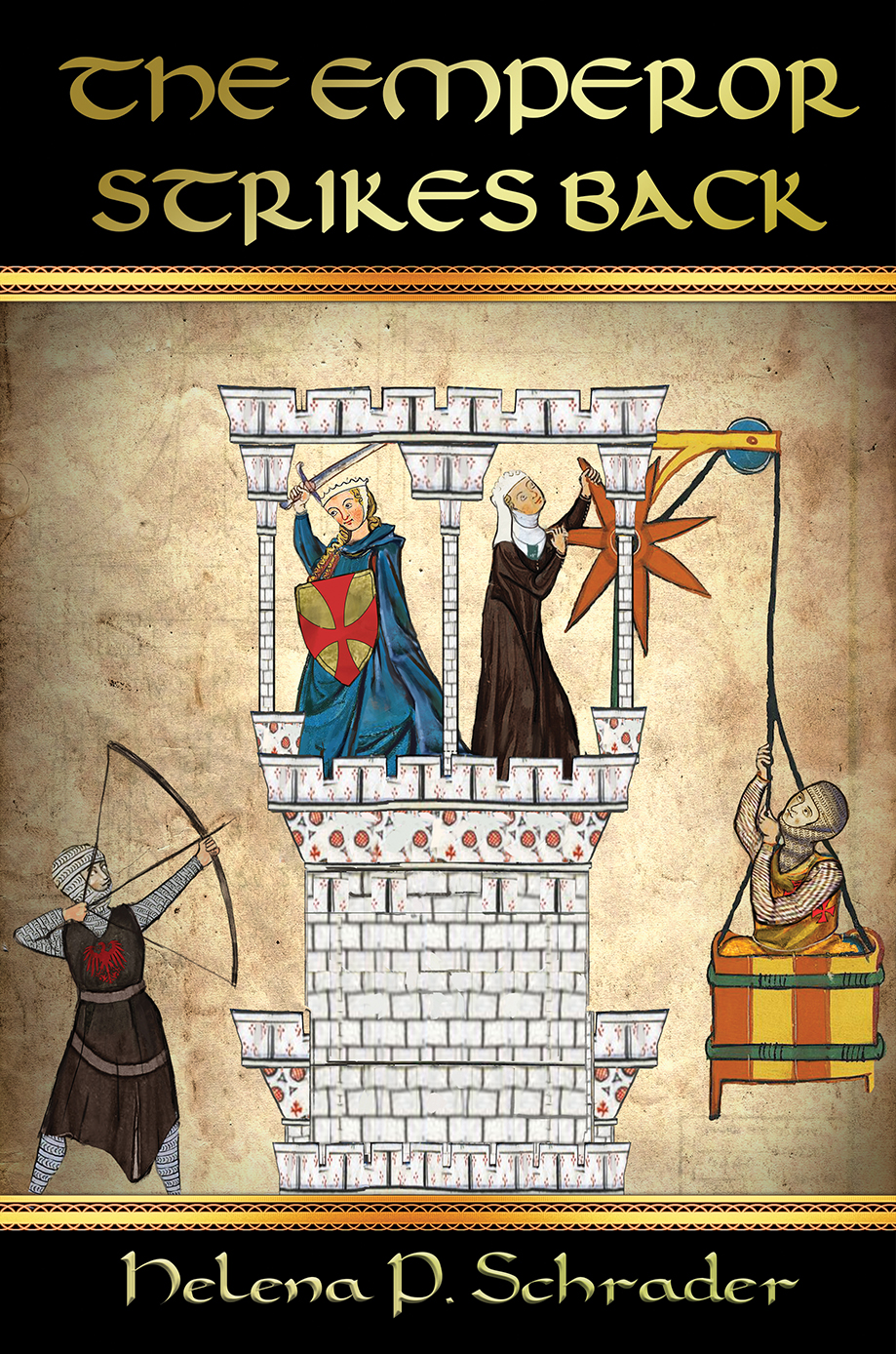
The Greeks on Cyprus play a significant role in The Emperor Strikes Back, a novel set in both Cyprus and the Kingdom of Jerusalem in the early 13th century.
BUY NOW!

Dr. Helena P. Schrader holds a PhD in History.

She is the Chief Editor of the Real Crusades History Blog.
She is an award-winning novelist and author of numerous books both fiction and non-fiction. Her three-part biography of Balian d'Ibelin won a total of 14 literary accolades. Her current series describes the civil war in Outremer between Emperor Frederick andthe barons led by John d'Ibelin the Lord of Beirut. Dr. Schrader is also working on a non-fiction book describing the crusader kingdoms. You can find out more at: http://crusaderkingdoms.com

Thursday, October 10, 2019

Forgotten Heroes of the Middle Ages

When I bestride him, I soar,
I am a hawk;
he trots the air; 
the earth sings when he touches it...
He is pure air and fire
 (Henry V, Act III, Scene 7)


If any one image is associated in the popular mind with the Middle Ages then it is the knight in shining armor on a (usually) white horse. 


Nor is the image entirely misleading.  Throughout the age of chivalry, the mounted knight dominated both the battlefield and popular culture. Yet, as I will explain, it was not the warhorse (destrier) alone that made the horse the true hero of the Middle Ages.

A 13th-century encyclopedia of animals written by the Dominican scholar and bishop Albertus Magnus lists four kinds of horses: warhorses (destriers), riding horses (palfreys), racehorses, and workhorses. Of these, riding horses and racehorses can be said to vary little from the horses of today, at least in terms of function, with the caveat that "riding horses" of the Middle Ages had to travel long distances in often difficult terrain and all weathers. Their role in medieval society and economy were not exceptional, however, being the same as it had been for thousands of years before and hundreds yet to come. Warhorses and draft horses, on the other hand, were fundamental in shaping medieval society in unique ways.

Starting with the more obvious, a knight could not fulfill his military function without a warhorse.  From Hastings to Bannockburn, the charge of heavy cavalry (knights) was the dominant offensive tactic of the age. Although a cavalry charge could rarely lift a siege and never secure a castle, when enemies confronted one another across a battlefield, knights clashed on horseback. Furthermore, a  well-timed, well-led charge was almost invincible.


In order to be able to deliver such a knock-out blow, however, knights trained for years to master horsemanship, mounted combat, and fighting in teams/units. So did their horses.

Not every horse could cope with the noise, the sudden movements, the flash of sunlight on metal, the blows, the crush of horses, and the smell of blood. Not every horse had the strength or stamina to carry an armored knight for hours, or the agility to respond to sudden changes of direction, the need to spin about or sidestep. This meant that warhorses had to be carefully selected -- and trained. Ultimately, man and horse had to respond as one being if they were to be an effective fighting machine with a chance of survival. 

It was to train for mounted combat -- particularly in small units as teams -- that tournaments developed. Historian Andrea Hopkins in her excellent work Knights [London: Collins & Brown, 1990] notes: “it is hardly possible to overestimate the importance of the tournament to the culture of medieval knights.” She notes that in addition to being “a crucial training ground in which young knights could practice the handling of their horses and weapons, tactics of attack and defence, and of co-ordinating their actions with a team of companions," the tournament also: 
  ...provided an arena for the display of all important knightly virtues: prouesse in combat, courtoisie to the watching and judging ladies, largesse to crowds of minstrels, heralds, armourers, squires and other assorted hangers on, and qualities such as the franchise and debonairete with which a knight should conduct himself in triumph and disaster (the qualities which later developed into the European gentleman's sense of fair play), and the pite which he should exercise to his defeated opponents. (p. 108) 


Indeed, over the centuries, tournaments were transformed from training events very similar to genuine combat into sporting and social events quite divorced from the reality of war. By the 16th and 17th century they were little more than pageants  -- but that was after the end of the Middle Ages. In the High Middle Ages, they retained their value as training while also providing entertainment.

In the world of the tournament, a knight's destrier was not only a tool of war in training with him but a part of his persona. Like his armor, his coat of arms, and his crest, his horse formed a component part of his image and identity. A beautiful horse made a good impression on the ladies, but an exceptionally responsive, fast or determined horse might make the difference between victory and defeat. The death or injury to a good mount, on the other hand, could destroy a knight's prospects -- and his financial position as well because warhorses were extremely expensive. 

It was a measure of just how important good warhorses were that a knight forfeit his destrier along with his armor in a tournament defeat. Successful tournament champions could opt to retain a captured mount -- or sell it back to the owner at a handsome fee. (Or, if inclined, show pity and largess by restoring it without charge or for only a nominal fee.) Likewise, inadequate reserves of good warhorses could have an impact on the outcome of battles. One can only imagine what might have happened at Jaffa, for example, if Richard the Lionheart had disembarked with his warhorses!

While the warhorse was not a specific breed as we know today, it was the product of centuries of horse breeding in the Early Middle Ages that had systematically produced larger horses than those of previous centuries and other regions, i.e. the horses of the Greeks and Romans or contemporary Mongols and the Arabs. Significantly, medieval horses were strong enough to carry a fully armored knight, but that does not mean that they were similar to draft horses in other ways. 


Furthermore, what defined them was not size and strength alone, but rather temperament and character. For a start, in order to keep them aggressive and spirited, they were not castrated. Albertus Magnus further claims: "It is a trait of these [war]horses to delight in musical sounds, to be excited by the sounds of arms, and to gather together with other chargers. They also leap and burst into battle lines by biting and striking with their hooves." (On Animals: A Medieval Summa Zoologica, translated by Kenneth F. Kitchell Jr. and Irven Michael Resnick [Baltimore: John Hopkins University Press, 1999]) 

Shakespeare captured this aspect of warhorse character in the opening of Henry V, Act IV, when he writes: "Steed threatens steed, in high and boastful neighs."


It is hardly surprising given how much time a knight spent training with his destrier -- and how dependent he was on the horse for his success and survival -- that strong bonds often developed between a knight and his charger. There is one recorded incident of a horse defending his unseated knight during judicial combat, preventing the opposing knight from delivering the coup de grace by repeatedly imposing his equine body between the human combatants. 

Albertus Magnus also writes:  "They sometimes care so much about their masters and grooms that, if [the latter] are killed, they grow sad and pine away, even to the point of death." The grief of knights for a good horse was also recorded in various texts. The images below of knights sleeping beside their grazing horses seem a lovely tribute to this close and trustful relationship.


Yet it was arguably the medieval workhorse that made the greater contribution to medieval society. The evolution of larger, stronger horses was critical to the agricultural revolution that greatly increased production and improved the nutritional intake of the common people dramatically. The stronger horses and tack designed to harness them to advanced plows enabled medieval peasants to not only scratch the soil but to turn it over, turning up more nutrients. The horses were faster too, plowing roughly twice as much in a day as the alternative draft animal, oxen -- much less human drawn plows. 

With more land under cultivation and greater productivity per acre, peasants could afford to leave one-third of their land fallow -- rotating crops and leaving land fallow to regenerate every third year. This further increased productivity and so diet as well. It has been argued that this agricultural revolution enabled human beings to reach their full genetic potential for size and strength for the first time in human history. Certainly, it resulted in human beings who were on average taller and stronger than people in other parts of the world in the same period.


Nor was it the plow horse alone who made such a dramatic contribution to the medieval economy. More powerful draft horses could also be employed in transport. The ability to transport heavy materials such as timber and stone was crucial to construction and ship-building. The more powerful draft horses could also be used to transport other commodities and finished products in larger quantities, thereby contributing to commerce and overall economic growth particularly inland, away from the waterways that had been the lifelines in the past. Unfortunately, the mundane, if essential work, of transport horses rarely captured the imagination or attention of medieval artists. The best I can do is a medieval "carriage."


Last but not least, draft horses also played a role in war, transporting heavy siege equipment, baggage and the wounded.  The ability to transport heavy equipment was cited by crusade historian John France as one of the West's significant advantages vis-a-vis their Saracen opponents.


 Horses play a role -- with names and personalities -- in all my crusades era novels:

                                                                                                         Best Biography 2017

 Buy now!                                       Buy now!                                               Buy now!


                                                    Best Christian Historical Fiction 2019
                                                                   
         Buy Now!                                                   Buy Now!                                             Buy Now!


Dr. Helena P. Schrader holds a PhD in History.

She is the Chief Editor of the Real Crusades History Blog.
She is an award-winning novelist and author of numerous books both fiction and non-fiction. Her three-part biography of Balian d'Ibelin won a total of 14 literary accolades. Her current series describes the civil war in Outremer between Emperor Frederick and the barons led by John d'Ibelin the Lord of Beirut. Dr. Schrader is also working on a non-fiction book describing the crusader kingdoms. You can find out more at: http://crusaderkingdoms.com

Thursday, October 3, 2019

Ibelins on Cyprus - A New Theory

In the past, I've challenged the common myth about the peaceful reception of Guy de Lusignan on Cyprus. There is, however, another “myth” which needs re-examination: namely the late arrival of the Ibelins on Cyprus.  Throughout the 13th Century, the Ibelins were the dominant family in Outremer, challenging the Holy Roman Emperor on both the mainland and on Cyprus. Significantly, they consistently enjoyed the favor of the Lusignan kings. I believe there is a reason for that, albeit one which cannot be proven given the scanty documentary evidence. Below is a summary.


Historians such as Edbury posit that the Ibelins were inveterate opponents of the Lusignans until the early 13th century. They note that there is no record of Ibelins setting foot on the island of Cyprus before 1210 and insist that it is “certain” they were not among the early settlers―while admitting that it is impossible to draw up a complete list of the early settlers. Edbury, furthermore, admits that “it is not possible to trace [the Ibelin’s] rise in detail” yet argues it was based on close ties to King Hugh I. 

Hugh, however, was only the son of a cousin. In a medieval society where almost everyone in the ruling class was related in some way or another, that tie does not seem compelling.

Even more difficult to understand in the conventional version of events is that the Ibelins became so powerful and entrenched that within just seven years (1217) of their supposed “first appearance” on Cyprus.  It was in that year that an Ibelin was elected regent of Cyprus by the Cypriot High Court--that is the barons and bishops of the island who had supposedly been on the island "far" longer. The appointment furthermore jumped over closer relatives. This hardly seems credible if the Ibelins were not recognized as a "leading" family on Cyprus.


My thesis and the basis of my novel The Last Crusader Kingdom is that while the second generation of Ibelins (that is, Baldwin and Balian d’Ibelin) were inveterate opponents of Guy de Lusignan, they were on friendly terms with Aimery de Lusignan.  Aimery was, for a start, married to Baldwin’s daughter, Eschiva.  We have references, furthermore, to them “supporting” Aimery as late as Saladin’s invasion of 1183. I think the Ibelins were very capable of distinguishing between the two Lusignan brothers, and judging Aimery for his own strengths rather than condemning him for his brother’s weaknesses.

Furthermore, the conventional argument that Balian d’Ibelin died in late 1193 because he disappears from the charters of the Kingdom of Jerusalem at that date is reasonable -- but not definitive. The fact that Balian d’Ibelin disappears from the records of the Kingdom of Jerusalem in 1193 may mean that he died, but it could just as easily mean that he was occupied elsewhere. The Ibelin brothers of the next generation, John and Philip, for example, "disappear" from the records of Jerusalem from 1210 to 1217 too, but they were very much alive, active and powerful -- one in Beirut and the other apparently on Cyprus.

In short, Balian's disappearance from the records of Jerusalem could also have been because he busy on Cyprus. The lack of documentary proof for his presence on Cyprus is not grounds for dismissing the possibility of his presence because 1) the Kingdom of Cyprus did not yet exist so there was no chancery and no elaborate system for keeping records, writs and charters etc., and 2) those who would soon make Cyprus a kingdom were probably busy fighting 100,000 outraged Orthodox Greeks on the island!

But why would Balian d’Ibelin go to Cyprus at this time?

Because his wife, Maria Comnena, was a Byzantine princess. Not just that, she was related to the last Greek “emperor” of the island, Isaac Comnenus.  She spoke Greek, understood the mentality of the population, and probably had good ties (or could forge them) to the Greek/Orthodox elites, secular and ecclesiastical, on the island. She had the means to help Aimery pacify his unruly realm, and Balian was a proven diplomat par excellence, who would also have been a great asset to Aimery.


If one accepts that Guy de Lusignan failed to pacify the island in his short time as lord, then what would have been more natural than for his successor, Aimery, to appeal to his wife’s kin for help in getting a grip on his unruly inheritance?

If Balian d’Ibelin and Maria Comnena played a role in helping Aimery establish his authority on Cyprus, it is nearly certain they would have been richly rewarded with  lands/fiefs on the island once the situation settled down. Such feudal holdings would have given the Ibelins a seat on the High Court of Cyprus, which explains their influence on it. Furthermore, these Cypriot estates would most likely have fallen to their younger son, Philip, because their first born son, John, was heir to their holdings in the Kingdom of Jerusalem.  John was first Constable of Jerusalem, then Lord of the hugely important and wealthy lordship of Beirut, and finally, after King Aimery’s death, regent of the Kingdom of Jerusalem for his niece.  Philip, on the other hand, was constable of Cyprus and later regent of Cyprus for Henry I ― notably despite the fact that his elder brother was still alive at the time.


The role of the Ibelins -- particularly Maria Comnena -- needs to be re-thought and re-analyzed. In the absence of hard evidence, however, Dr. Schrader has done so in the form of a novel.

Read the story in:

Buy Now!

Dr. Helena P. Schrader holds a PhD in History.

She is the Chief Editor of the Real Crusades History Blog.

She is an award-winning novelist and author of numerous books both fiction and non-fiction. Her three-part biography of Balian d'Ibelin won a total of 14 literary accolades. Her current series describes the civil war in Outremer between Emperor Frederick andthe barons led by John d'Ibelin the Lord of Beirut. Dr. Schrader is also working on a non-fiction book describing the crusader kingdoms. You can find out more at: http://crusaderkingdoms.com