COPYRIGHT

All content on this blog is protected by copyright.
Content used elsewhere without attribution constitutes theft of intellectual property and will be prosecuted.
Showing posts with label Crusader Armies. Show all posts

Friday, July 1, 2016

The Battle of Hattin: Disaster on the Horns of Hattin


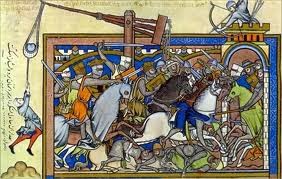
Medieval Depiction of the Battle of Hattin, July 4, 1187

The devastating defeat of the combined Christian army at the Battle of Hattin on July 4, 1187, was one of the most significant disasters in medieval military history.  Christian casualties at the battle were so enormous, that the defense of the rest of the Kingdom of Jerusalem became impossible, and so the defeat at Hattin led directly to the loss of the entire kingdom including Jerusalem itself. The loss of the Holy City, led to the Third Crusade, and so to the death of the Holy Roman Emperor Friedrich I “Barbarossa”, and extended absence from his domains of Richard I “the Lionheart.” Both circumstances had a profound impact on the balance of power in Western Europe. Meanwhile the role of the critical of Pisan and Genoese fleets in supplying the only city left in Christian hands, Tyre, and in supporting Richard I’s land army resulted in trading privileges that led to the establishment of powerful trading centers in the Levant. These in turn fostered the exchange of goods and ideas that led historian Claude Reignier Condor to write at the end of the 19th Century that: “…the result of the Crusades was the Renaissance.” (The Latin Kingdom of Jerusalem 1099 to 1291 AD, The Committee of Palestine Exploration Fund, 1897, p. 163.)


The importance of Hattin to contemporaries was not just the magnitude of the defeat, but the unexpectedness of it.  In retrospect, the victory seems inevitable. Muslim states had always surrounded the crusader kingdom (as they hem in Israel today) and the Muslim rulers had always been able to call on much larger military forces than their Christian opponents.  In the early years of Latin presence in the Holy Land, the divisions among the Muslim leaders, most especially the rivalry and hatred between Shiite Caliphate of Cairo and the Sunni Caliphate of Baghdad, had played into Christian hands.  However, once Saladin had managed to unite Syria and Egypt under a single, charismatic leader the balance of power clearly tipped to the Muslims.


However, Christian armies under Baldwin IV of Jerusalem and Richard I of England defeated Saladin on the battlefield more than once.  Saladin was a powerful, charismatic and clever commander, who knew how to deploy his forces effectively and use terrain to his advantage — but he was not invincible. Indeed, he was dealt a defeat every bit as devastating as Hattin in November 1177 at the Battle of Montgisard. His invading army was annihilated, and he himself had to flee on the back of a pack-camel. In July 1182, the Christian army under Baldwin IV stopped another full-scale invasion by Saladin, forcing him to withdraw across the Jordan with comparatively few Christian losses. In June the following year, 1183, the Christian army confronted yet another invasion on an even larger force and again forced Saladin to withdraw — this time without even engaging in an all-out battle.


Despite these apparent successes, it was clear to the King of Jerusalem that Saladin was getting stronger with each new invasion attempt.  Saladin had increased his own power base from Cairo and Damascus to Aleppo, Homs and Mosul, while the Christians had no new infusions of blood, territory or income. In consequence, in 1184 Baldwin IV sent a frantic plea to the West, begging for a new crusade and offering the Western leader — whoever he might be — the keys to the kingdom. The lack of response reflected Western complacency about the threat to Jerusalem and implicit confidence in the ability of Baldwin and his barons to continue to defeat Saladin’s attempts to push the Christian kingdom into the sea.


It was because of Baldwin’s earlier successes against Saladin, that the news of Hattin and the loss of Jerusalem shocked the West, allegedly causing the immediate death of Pope Urban III. How was it possible that a young and vigorous king, Guy I, could lead the same army to defeat that a youth suffering from leprosy (and only commanding his armies from a liter) had led to victory again and again?  


Rarely in human history has a defeat been so wholly attributable to poor generalship on the losing side as at Hattin. To be sure, Saladin set a trap for the Christian armies. The bait was the citizens and garrison of Tiberius under the command of the Countess of Tripoli, who were besieged in the citadel after the fall of the city on July 2.  The Christian army was mustered at Sephorie, only some 15 miles to the west. The pleas for help from the Countess and Tiberius naturally evoked a response from the Christian army, most notably her four grown sons.  But the Count of Tripoli himself warned that it was a trap and opposed the decision to go to the aid of his wife and Tiberius. Tripoli’s reasoning convinced the majority of his peers and the council of war composed of the leading barons agreed to stay where they were and force Saladin to come to them. However, the Grand Master of the Temple went separately and secretly to King Guy after the council dispersed and convinced him to order the advance for the following day. In short, although warned, King Guy took the bait.


To relieve Tiberius, the Christian army had to cross territory that was at this time of year devoid of fodder for the horses and where water sources were widely dispersed. With Saladin’s forces already occupying the springs at Cafarsset, on the southern route from Sephorie to Tiberias, the Christian had no choice but to follow the northern track, which led via the springs of Turan. Intense heat and harassment by the enemy slowed the Christian march to a crawl, and by noon on July 3, the Christian army had advanced only six miles to the springs of Turan.  With nine miles more to go, it was clear the army could not reach Tiberius before nightfall and prudence alone should have dictated a halt at Turan, where men and horse could rest and drink. Instead, King Guy against all reason ordered the advance to continue. Immediately, Saladin sent his troops to occupy Turan, thereby not-only blocking the Christian retreat but harassing the Christian rear-guard and further slowing the rate of advance.


A depiction of the Christian army advancing toward Hattin carrying the “True Cross”
from the film “The Kingdom of Heaven”


When darkness fell on July 3, the Christian army was still six miles short of its objective and forced to camp in an open field completely surrounded by enemy forces.  The Christians had been marching and fighting for hours without water in the intense heat of a Palestinian summer. Men and horses were exhausted and further demoralized by the sound of Saracen drums surrounding them and the countless campfires advertising the enemy’s strength. 


By morning, those fires were brush-fires intentionally set ablaze to windward of the Christian army in a maneuver that dried their already parched throats further while half-blinding them with smoke. Out of the smoke came volleys of arrows, and again “some of the Christian lords” urged King Guy to charge Saladin’s position at once, in an attempt to win the battle by killing the Sultan.  King Guy instead chose to try to march the entire army toward the springs of Hattin, still some three miles away and cut off by one wing of Saladin’s army.


While the Frankish cavalry tried to drive off the Saracens in a series of charges and counter-charges, the infantry stumbled forward until, half-blinded by smoke, constantly attacked by the enemy and near dying of thirst, their morale broke.  As casualties mounted, some of the infantry retreated up the slopes of the “horns” of Hattin, two steep hills that flanked the plane on which the army had camped and now marched and refused to fight any more. 


Meanwhile, the Count of Tripoli with his knights and Lord Reginald of Sidon finally broke-through the surrounding enemy, charging east toward the Lake of Tiberius.  The Christian infantry that had not fled up the slopes tried to follow in the wake of the cavalry, but the Saracens under the command of one of Saladin’s nephews stepped aside to let the armored knights through and then closed ranks again, cutting off the Christian infantry that was cut down or taken captive.


By now it was late afternoon, and with the infantry either already slaughtered or refusing to come down from the hilltop, King Guy ordered his knights to retreat up the slope as well. At this stage, many of the knights were fighting on foot because their horses became vulnerable once the infantry cover was withdraw.  It was probably at point in the battle that the relic, believed to be a piece of the cross on which Christ was crucified, was lost. The Bishop of Acre, who had been carrying it, was killed. The loss of this most precious relic — believed to have brought victory in dozens of earlier battles -- was devastating to Christian morale.


The final stages of the Battle of Hattin as depicted in the film “The Kingdom of Heaven”


But still King Guy did not surrender.  What few knights were still mounted made one (or two) last desperate charge(s) to try to kill Saladin, who was mounted and clearly identifiable among his troops.  One of these charges was probably lead by Balian d’Ibelin. While the charge came close enough to Saladin for him to have to shout encouragement to his men, like Tripoli before him, once Ibelin was through the enemy, he had no chance of fighting his way back up-hill through the ever thickening ranks of the enemy closing in on their prey. Within minutes, King Guy’s last position was over-run and he along with most of his barons were taken prisoner.


Of the roughly 20,000 Christian soldiers who had set out from Sephorie, only an estimated 3,000 infantry managed somehow to escape into the surrounding countryside and eventually take refuge in the castles and walled towns then still in Frankish hands. Of the 1,200 knights and barons that mustered for the battle, only four barons, Tripoli, Sidon, Edessa and Ibelin, escaped capture along with maybe 100 - 200 knights. The remainder including the King of Jerusalem, the Masters of the Temple and Hospital, the Constable Aimery de Lusignan, the Lords of Oultrajourdain, Toron, Gibelet, and others — effectively the entire nobility of the Kingdom of Jerusalem -- were taken captive. While the majority of these lords and knights were held for ransom, the 230 Templars and Hospitallers that survived the battle were executed at Saladin’s orders.


Medieval painting of prisoners being led away (here by a Christian king)


Hattin is a major episode in the second book of my Balian d'Ibelin trilogy, "Defender of Jerusalem." The ebook is on sale for just $4.99 through July 4, 2016Buy Now!


Friday, April 29, 2016

The Army of Jerusalem


For the nearly ninety years between the founding of the Kingdom of Jerusalem and the defeat of the Christian army at Hattin in July 1187, the Kingdom of Jerusalem fielded troops for both defensive and offensive warfare that were surprisingly effective. Yet like that of their opponents, their composition was far more complex than is commonly understood. In addition to the feudal contingents and mercenaries common at this time, they also included “armed pilgrims,” contingents of militant monks (i.e. Knights Templar and Hospitaller) and types of fighting men completely unknown in the West: Sergeants and Turcopoles. Also exceptional in the Kingdom of Jerusalem was the "arriere ban" that enabled the King to keep his army in the field up to one year in contrast to the 40 days feudal service of his contemporaries in the West. 

Below is a short description of the key components of the Army of Jerusalem in the 12th Century.

Barons and Knights


As in the West, the backbone of the Army of Jerusalem was the feudal host composed of the “knights” which the “tenants-in-chief” of the king owed in exchange for their fiefs. Tenants-in-chief might be secular lords (barons) or ecclesiastical lords (bishops and independent abbots).  

The baronies of Outremer could be very substantial or almost insignificant. Jonathan Riley-Smith in his Atlas of the Crusades, for example, lists the baronies of Sidon, Galilee, and Jaffa/Ascalon as all owing 100 knights, while according to the incomplete records of John d’Ibelin, the Bishops of Nazareth and Lydda owed 6 and 10 knights respectively.  (John d’Ibelin, Count of Jaffa and Ascalon, was writing in the mid-13th century but attempting to catalogue military service owed to the King of Jerusalem at the time of his grandfather Balian d’Ibelin.)

It is important to remember that the term “knight” does not refer to a single man but rather to a fighting-unit consisting of a knight and his warhorse (destrier), one or more mounted squires, a riding horse (palfrey) and one more pack-horses.  Knights were expected to be armed and armored, which means that throughout the 12th century they would be expected to provide their own chainmail hauberk, coif and mittens, and chainmail chausses for their legs. In addition, they would need a helmet, a sword, dagger and optionally a mace or ax. Lances, on the other hand, were relatively cheap, “throwaway” weapons that the lord would provide or could be purchased as needed.

However, the fighting power that a baron brought to the battlefield generally exceeded the minimum set by feudal obligations. Barons would have been supported by younger brothers and adult sons, if they had them, and by “household knights,” i.e. men without land holdings of their own who served the baron (i.e. were “retained”) in exchange for an annual salary (that would include payments in-kind such as meals, cloaks, and in some cases horses). Peter Edbury’s analysis of the John d’Ibelin’s catalogue suggests that the ratio of “retained” knights to “vassals” (knights who owed their service by right of holding land from the lord) ranged anywhere from 1:2 to 3:2, making it clear that the knights fielded in the feudal army due to feudal obligation made up perhaps no more than half of the total host!

So far, all is as it would have been in the West, including the large number of “household” or mercenary knights. However, the Kingdom of Jerusalem was unique in that activities and income sources not usually associated with feudal service were also often subject to military service obligations. Thus, for example, Baldwin d’Ibelin owed four knights service to the crown in exchange for the right to rent out grazing land to the Bedouins.  More common, income from customs duties, tariffs and other royal sources of income could be “enfeoffed” on a nobleman/knight in exchange for feudal service.  In the prosperous coastal towns of Outremer, there were many such “money-fiefs” with a military obligation.

While great lords, like Baldwin d’Ibelin, might hold multiple fiefs, they could only personally fulfill the obligation for one knight, which meant that a lord enjoying the income of a fief — whether from grazing Bedouins or customs duties — had to spend some of his income to hire as many trained and fully equipped “knights” (think fighting unit) as he owed. These knights would be drawn from the younger sons and brothers of fellow barons or from landless armed pilgrims, willing to stay in the Holy Land, but would like his landed knights be viewed as “vassals.”

Armed Pilgrims


The Holy Land, unlike the West, benefited from the fact that at any one time — and particularly during the “pilgrim season” between roughly April and October — there would be tens of thousands of pilgrims in the kingdom, a portion of whom would have been knights capable of rendering military service in an emergency. Sometimes barons brought small private armies of retainers and volunteers with them to the crusader states explicitly for the purpose of fighting in defense of the Holy Land. A good example of this is Philip Count of Flanders, who arrived at Acre in 1177 at the head of what Bernard Hamilton describes as “a sizeable army.” His army even included the English Earls of Essex and Meath. More common were individual knights and lords who came to the Holy Land as genuine pilgrims, only to be sucked into the fighting by military necessity. One such example is Hugh VIII de Lusignan, Count of the March, who came in 1165 and ended up dying in a Saracen prison. Another example is William Marshal, who came in 1184 to fulfill a crusader vow taken by his liege, Henry the Young King. It is impossible to know how many “armed pilgrims” — and not just knights! — took part in musters and engagements between the forces of the Kingdom of Jerusalem and its enemies at any time.

Fighting Monks


Another anomaly of the armies of Outremer were, of course, the large contingents of fighting monks — most famously Templars and Hospitallers, but also Knights of St. Lazarus and later Teutonic Knights as well. The major “militant” orders of the 12th Century were founded in Jerusalem with the explicit mandate to protect the Holy Land and Christian residents in and pilgrims to it. While the Templars started with just nine knights and the Hospitallers did not officially have “brother knights” until the 13th century, contemporary descriptions suggest that both orders fielded hundreds of knights by the end of the 12th century. David Nicolle in his book on the Battle of Hattin suggests that by 1180 the Templars had 300 knights deployed in the Holy Land and the Hospitallers 500 knights, but many of these knights would have been scattered about the country garrisoning castles. Undisputed is the fact that 230 Templars and Hospitallers survived the Battle of Hattin to be executed on Saladin’s orders on July 6, 1187. Given the intense, two-day long nature of the Battle of Hattin, it seems reasonable to hypothesize that both militant orders, known for their fanaticism and willingness to die, had suffered significant casualties before the battle ended. It is likely, therefore, that close to 500 Hospitallers and Templars were in the field with royal army and this seems a good “ball-park” figure for the kind of resources the militant orders could contribute to the army of Outremer in the latter part of the 12th century generally.

Infantry
It is often forgotten in modern depictions of medieval warfare that the knights were the smallest contingent of medieval armies. The infantry made up the bulk of any feudal force and, far from being superfluous, the infantry was vitally important to success. But whereas in the West the infantry in the 12th century was largely composed of peasant levees (plus mercenaries), in the crusader states the infantry consisted of free “burghers” (citizens) -- plus mercenaries, of course.

Mercenaries


If prostitution is the oldest profession on earth than mercenaries must belong to the second oldest profession. Mercenaries are recorded in ancient Greece and only my own ignorance prevents me from asserting with confidence that they were known in ancient Egypt as well. Certainly, in the Middle Ages mercenaries were a vital component of warfare precisely because feudal levies in the West were only obligated to serve for 40 days at a stretch, but most kings and nobles needed fighting men who could serve whenever and for as long as needed.  Furthermore, certain military skills such as firing cross-bows, or building and manning siege engines, required a great deal of expertise and practice, making them unsuited to amateur armies composed of farmers. Mercenaries were everywhere on medieval battlefields. They were found in Outremer as well and, given the resources of the kingdom, were probably more prevalent there than in the West. But we have no clear numbers. 

Citizen Soldiers -- Sergeants


Sergeants
A far more interesting and unusual feature of the armies in the crusader states were the “sergeants.” Because the “peasants” of Outremer were a polyglot mixture of Orthodox Christians and Muslims,  the Kings of Jerusalem were not inclined to rely upon these men for offensive warfare. On the other hand, as much as one-fifth of the population (ca 140,000 inhabitants) were Latin Christian settlers. All settlers were freemen and whether they settled in the cities as merchants and tradesmen or in agricultural settlements on royal and ecclesiastical domains, they were classed as “burghers” — not serfs or peasants. These freemen who had voluntarily immigrated to the crusader states were subject to military service, and when they served they were classed as “sergeants.”

The term “sergeant” in the context of Outremer appears to be a term similar to “man-at-arms” during the Hundred Years War. In short, it implies the financial means to outfit oneself with some form of body armor (just as padded linen “aketons,” or quilted “gambesons,” or in rare-cases leather, or chainmail) and a helmet of some kind (usually on open-faced “kettle” helm or later a crevelliere), and some kind of infantry weapon such as a spear, short sword, ax or sling.

With perhaps as much as half the settlers living in cities, it is not surprising that sergeants, along with the native Christians, bore the brunt of the burden of providing garrisons for the cities, but according to John d’Ibelin’s records sergeants from the rural settlements in the royal domain and ecclesiastical fiefs were required to muster with the royal army.  We also know that both the Templars and Hospitallers maintained significant forces of “sergeants,” and these were — notably — mounted fighting men. Although not as well equipped as the knights themselves, they were entitled to two horses and one squire! It is not clear, however, whether the “sergeants” of the king and the ecclesiastical lords were also mounted.

Turcopoles
Perhaps the most exotic component of the armies of Outremer were the so-called “Turcopoles.” These are not, as their name misleadingly suggests, Muslim converts nor the children of mixed marriages. Rather, these were mounted archers drawn predominantly from the native Christian population. The Armenians, for example, had a long history of independence and military prowess and Armenians made up a significant portion of the population in the Kingdom of Jerusalem, having their own quarter there and their own cathedral. Other Syrian Christians were by this time Arabic speakers and may have looked like “Arabs” and “Turks” to visitors from the West, but as Christians, they were reliable troops. There were also Greek, Coptic, Maronite and Ethiopian Christians resident in the crusader states, all of whom were, as freemen, theoretically subject to military service and as Christians native to the region probably some of the most willing fighting men. They, after all, had memories or personal experience with the taxes, insults and oppression of Turkish rule. 

The number of Turcopoles deployed were remarkably high, averaging 50% of the mounted forces and sometimes as much as 80%. There are also recorded incidents of them operating independently. As light cavalry, they were particularly effective in reconnaissance, skirmishing, and hit-and-run harassment of enemy troops.

Arriere Ban

Last but not least, the Kings of Jerusalem had the right to issue the “arriere ban” which obligated every free man to come to the defense of the kingdom. This was in effect an early form of the “levee en masse” of the French Revolution. Significantly, the King of Jerusalem could command the service of his vassals for a full year, not just 40 days as in the West, but such service was intended for the defense of the realm.  If the king took his army outside the borders on an offensive expedition, he was required to pay for the services of his subjects.

Feudal warfare in the Kingdom of Jerusalem was an unavoidable feature of a nobleman's life as described in my three-part biography of Balian Baron of Ibelin.


 Buy now!                                       Buy now!                                   Buy now (paperback)
                                                                                                                or Kindle!

Saturday, April 9, 2016

"Crusading Warfare 1097-1193" by R. C. Smail


Although first published sixty years ago, this is still a valuable book for those interested in the crusades and the crusader states. It is logically organized looking first at the strategic framework, the composition of the armies of both Christians and Muslims, then finally at the tactics employed.  By avoiding a chronological narrative, Smail highlights how certain features of warfare remained the same — or changed — over time. 

The book provides adequate footnotes for scholars, but the text itself does not often become bogged down in arguments with fellow scholars about details of little interest to the general reader. The book also provides some useful sketches and photos of some of the crusader castles. While the reader may not agree with all of Smail’s theses (more recent research casts doubt on his assumptions about the hostility of the native population, for example), his arguments are cogent and stimulate further thought an analysis.

Friday, January 23, 2015

The Armies of Outremer in the 12th Century


For the nearly ninety years between the founding of the Kingdom of Jerusalem and the defeat of the Christian army at Hattin in July 1187, the armies of “Outremer” were substantial, surprisingly effective and nominally feudal. Yet their composition was far more complex than the term “feudal” implies.  They always included “armed pilgrims,” for example, and contingents of militant monks (i.e. Knights Templar and Hospitaller) became increasingly important. Most unusual, however, they were characterized by types of fighting men completely unknown in the West: Sergeants and Turcopoles, and the arriere ban enabled the King of Jerusalem to keep his army in the field up to one year. 

Below is a short description of the key components of the armies of Outremer in the 12th Century.

Barons and Knights


As in the West, the backbone of the Army of Jerusalem was the feudal host composed of the “knights” which the “tenants-in-chief” of the king owed in exchange for their fiefs. Tenants-in-chief might be secular lords (barons) or ecclesiastical lords (bishops and independent abbots).  

The baronies of Outremer could be very substantial or almost insignificant. Jonathan Riley-Smith in his Atlas of the Crusades, for example, lists the baronies of Sidon, Galilee, and Jaffa/Ascalon as all owing 100 knights, while according to the incomplete records of John d’Ibelin, the Bishops of Nazareth and Lydda owed 6 and 10 knights respectively.  (John d’Ibelin, Count of Jaffa and Ascalon, was writing in the mid-13th century but attempting to catalogue military service owed to the King of Jerusalem at the time of his grandfather Balian d’Ibelin.)

It is important to remember that the term “knight” does not refer to a single man but rather to a fighting-unit consisting of a knight and his warhorse (destrier), one or more mounted squires, a riding horse (palfrey) and one more pack-horses.  Knights were expected to be armed and armored, which means that throughout the 12th century they would be expected to provide their own chainmail hauberk, coif and mittens, and chainmail chausses for their legs. In addition, they would need a helmet, a sword, dagger and optionally a mace or axe. Lances, on the other hand, were relatively cheap, “throw away” weapons that the lord would provide.

The knights owed by each baron to the crown based on his fief's obligation would not, however, have been the total extent of fighting power that a baron brought to the battlefield. Barons would have been supported by younger brothers and adult sons, if they had them, and by “household knights,” i.e. men without land holdings of their own who served the baron (were “retained”) in exchange for an annual salary (that would include payments in-kind such as meals, cloaks, and in some cases horses). Peter Edbury’s analysis of the John d’Ibelin’s catalogue suggests that the ratio of “retained” knights to “vassals” (knights who owed their service by right of holding land from the lord) ranged anywhere from 1:2 to 3:2, making it clear that the knights fielded in the feudal army due to feudal obligation made up maybe no more than half of the total host!

So far, all is as it would have been in the West, including the large number of “household” or mercenary knights. However, the Kingdom of Jerusalem was unique in that activities and income sources not usually associated with feudal service were also often subject to military service obligations. Thus, for example, Baldwin d’Ibelin owed four knights service to the crown in exchange for the right to rent out grazing land to the Bedouins.  More common, income from customs duties, tariffs and other royal sources of income could be “enfeoffed” on a nobleman/knight in exchange for feudal service.  In the prosperous coastal towns of Outremer, there were many such “money-fiefs” with a military obligation.

While great lords, like Baldwin d’Ibelin, might hold multiple fiefs, they could only personally fulfill the obligation for one knight, which meant that a lord enjoying the income of a fief — whether from grazing Bedouins or customs duties — had to spend some of his income to hire as many trained and fully equipped “knights” (think fighting unit) as he owed. These knights would be drawn from the younger sons and brothers of fellow barons or from landless armed pilgrims, willing to stay in the Holy Land, but would like his landed knights be viewed as “vassals.”

Armed Pilgrims


The Holy Land, unlike the West, benefitted from the fact that at any one time — and particularly during the “pilgrim season” between roughly April and October — there would be tens of thousands of pilgrims in the kingdom, a portion of whom would have been knights capable of rendering military service in an emergency. Sometimes barons brought small private armies of retainers and volunteers with them to the crusader states explicitly for the purpose of fighting in defense of the Holy Land. A good example of this is Count Philip of Flanders, who arrived at Acre in 1177 at the head of what Bernard Hamilton describes as “a sizeable army.” His army even included the English Earls of Essex and Meath. More common were individual knights and lords who came to the Holy Land as genuine pilgrims, only to be sucked into the fighting by military necessity. One such example is Hugh VIII de Lusignan, Count de la March, who came in 1165 and ended up dying in a Saracen prison. Another example is William Marshal, who came in 1184 to fulfill a crusader vow taken by his liege, Henry the Young King. It is impossible to know how many “armed pilgrims” — and not just knights! — took part in musters and engagements between the forces of the Kingdom of Jerusalem and its enemies at any time.

Fighting Monks


Another anomaly of the armies of Outremer were, of course, the large contingents of fighting monks — most famously Templars and Hospitallers, but also Knights of St. Lazarus and later Teutonic Knights as well. The major “militant” orders of the 12th Century were founded in Jerusalem with the explicit mandate to protect the Holy Land and Christian residents in and pilgrims to it. While the Templars started with just nine knights and the Hospitallers did not officially have “brother knights” until the 13th century, contemporary descriptions suggest that both orders fielded hundreds of knights by the end of the 12th century. David Nicolle in his book on the Battle of Hattin suggests that by 1180 the Templars had 300 knights deployed in the Holy Land and the Hospitallers 500 knights, but many of these knights would have been scattered about the country garrisoning castles. Undisputed, is the fact that 230 Templars and Hospitallers survived the Battle of Hattin to be executed on Saladin’s orders on July 6, 1187. Given the intense, two-day long nature of the Battle of Hattin, it seems reasonable to hypothesize that both militant orders, known for their fanaticism and willingness to die, had suffered significant casualties before the battle ended. It is likely, therefore, that close to 400 Hospitallers and Templars were in the field with royal army and this seems a good “ball-park” figure for the kind of resources the militant orders could contribute to the army of Outremer in the latter part of the 12th century generally.

Infantry
It is often forgotten in modern depictions of medieval warfare that the knights were the smallest contingent of medieval armies. The infantry made up the bulk of any feudal force and, far from being superfluous, the infantry was vitally important to success. But whereas in the West the infantry in the 12th century was largely composed of peasant levees (plus mercenaries), in the crusader states the infantry consisted of free “burghers” (plus mercenaries).

Mercenaries


If prostitution is the oldest profession on earth, than mercenaries must belong to the second oldest profession. (Mercenaries are recorded in ancient Greece and only my own ignorance prevents me from asserting with confidence that they were known in ancient Egypt as well; I feel almost certain that they were there too and in ancient Persia and would welcome comment on this point by those more knowledgeable than myself.) Certainly in the Middle Ages mercenaries were a vital component of warfare precisely because feudal levies in the West were only obligated to serve for 40 days at a stretch, but most kings and nobles needed fighting men who could serve whenever and for as long as needed.  Furthermore, certain military skills such as firing cross-bows, or building and manning siege engines, required a great deal of expertise and practice, making them unsuited to amateur armies composed of farmers. Mercenaries were everywhere on medieval battlefields. They were found in Outremer as well and, given the resources of the kingdom, were probably more prevalent there than in the West. But we have no clear numbers. 

Sergeants


A far more interesting and unusual feature of the armies in the crusader states were the “sergeants.” Because the “peasants” of Outremer were largely Arabic speaking Muslims,  the Kings of Jerusalem were not inclined to rely upon these men to fight their battles. On the other hand, as much as one-fifth of the population (ca 120,000 inhabitants) were Latin Christian settlers. All settlers were freemen and whether they settled in the cities as merchants and tradesmen or in agricultural settlements on royal and ecclesiastical domains, they were classed as “burghers” — not serfs or peasants. These freemen who had voluntarily immigrated to the crusader states were subject to military service, and when they served they were classed as “sergeants.”

The term “sergeant” in the context of Outremer appears to be a term similar to “man-at-arms” during the Hundred Years War. In short, it implies the financial means to outfit oneself with some form of body armor (most commonly padded linen “aketons,” or quilted “gambesons,” in rare-cases leather, or even chainmail) and a helmet of some kind (usually on open-faced “kettle” helm or later a crevelliere), and some kind of infantry weapon such as a spear, short sword, ax or sling.  

With half the settlers living in cities, it is not surprising that sergeants bore the brunt of the burden of providing garrisons for the cities, but according to John d’Ibelin’s records sergeants from the rural settlements in the royal domain and ecclesiastical fiefs were required to muster with the royal army.  We also know that both the Templars and Hospitallers maintained significant forces of “sergeants,” and these were — notably — mounted fighting men. Although not as well equipped as the knights themselves, they were entitled to two horses and one squire! It is not clear, however, whether the “sergeants” of the king and the ecclesiastical lords were also mounted.

Turcopoles


Perhaps the most exotic component of the armies of Outremer were the so-called “Turcopoles.” There are frequent references to these troops in contemporary records and they clearly played a significant role in the armed forces of the crusader states, but there is no unambiguous definition of who and what they were. They were clearly “native” troops, but the idea that they were mostly converted Muslims is off the mark.  Roughly half the population in the crusader states were non-Latin Christians, and it is from this segment of society that “native” troops were predominantly drawn.  The Armenians, for example, had a strong history of independent states and military prowess, and Armenians made up a significant portion of the population in the Kingdom of Jerusalem, having their own quarter there and their own cathedral. Syrian Christians were by this time Arabic speakers and would have looked like “Arabs” and “Turks” to visitors from the West, but as Christians they were reliable troops. There were also Greek, Coptic, Maronite and Ethiopian Christians resident in the crusader states, all of whom were, as freemen, theoretically subject to military service and as Christians native to the region probably some of the most willing fighting men. They, after all, had memories or personal experience with the taxes, insults and oppression of Turkish rule.  

Arriere Ban

Last but not least, the Kings of Jerusalem had the right to issue the “arriere ban” which obligated every free man to come to the defense of the kingdom. This was in effect an early form of the “levee en masse” of the French Revolution. Significantly, the King of Jerusalem could command the service of his vassals for a full year, not just 40 days as in the West, but such service was intended for the defense of the realm.  If the king took his army outside the borders on an offensive expedition, he was required to pay for the services of his subjects. 


Balian d'Ibelin served in the feudal armies of Outremer and the defense of the crusader kingdoms during his lifetime is the central theme of the three part biography that starts with:


 Buy now!                                       Buy now!                                   Buy now (paperback)
                                                                                                                or Kindle!