COPYRIGHT

All content on this blog is protected by copyright.
Content used elsewhere without attribution constitutes theft of intellectual property and will be prosecuted.

Saturday, December 20, 2025

Knights Hospitaller - The Oldest Military Order

Of the many "militant orders," the Knights Hospitaller, were the oldest and the most enduring.  Today I pay a tribute to them with a short summary of their history. 


The roots of the Knights of St. John of Jerusalem go back before the First Crusade. In about 1070, a hospice for pilgrims was established near the Church of the Holy Sepulcher with funds from Italian merchants and staffed by Benedictine monks and nuns. Although the Benedictines were expelled from Jerusalem before the arrival of the first crusaders, they returned after Jerusalem was in Christian hands, and with help from the Christian secular authorities, re-established a hospital. Soon, further grants of money and land from the Christian lords enabled the monks to establish a chain of hospitals throughout the Holy Land and to set up hospices at the embarkation ports for pilgrims setting out from Europe or returning from Outremer. The monks and nuns running these hospitals and hospices soon became known as the “Hospitallers.”

In 1113, the monks of the Hospital (also referred to as the Brothers of St. John and the Brothers of the Holy Sepulcher) requested and received from the Pope the right to become an order in their own right. This new order, as with the Templars a decade later, was made directly subordinate to the Pope, and in or about 1130 it adopted the Augustine Rule. Meanwhile, this new order was rapidly acquiring significant donations in land and treasure in both the West and in the Holy Land, a reflection of the undiminished support for a Christian-controlled Holy Land.

The "Hospital" in Acre is still massive and impressive; the Hospital in Jerusalem was much larger.
Photo by H. Schrader 
Nevertheless, the Hospital of St. John remained a traditional monastic order. Although it had been granted the explicit right to defend its properties and pilgrims, members of the Order were prohibited from bearing arms. As a result, throughout the 12th century the Hospital was dependent for its protection on knights who owed feudal duty to the Hospital via their landholdings, voluntarily offered their services, or were hired mercenaries. These defensive forces, whatever their source, must have been substantial, however, because the Hospital was given very powerful fortresses, notably the most impressive crusader castle of them all: Krak des Chevaliers.

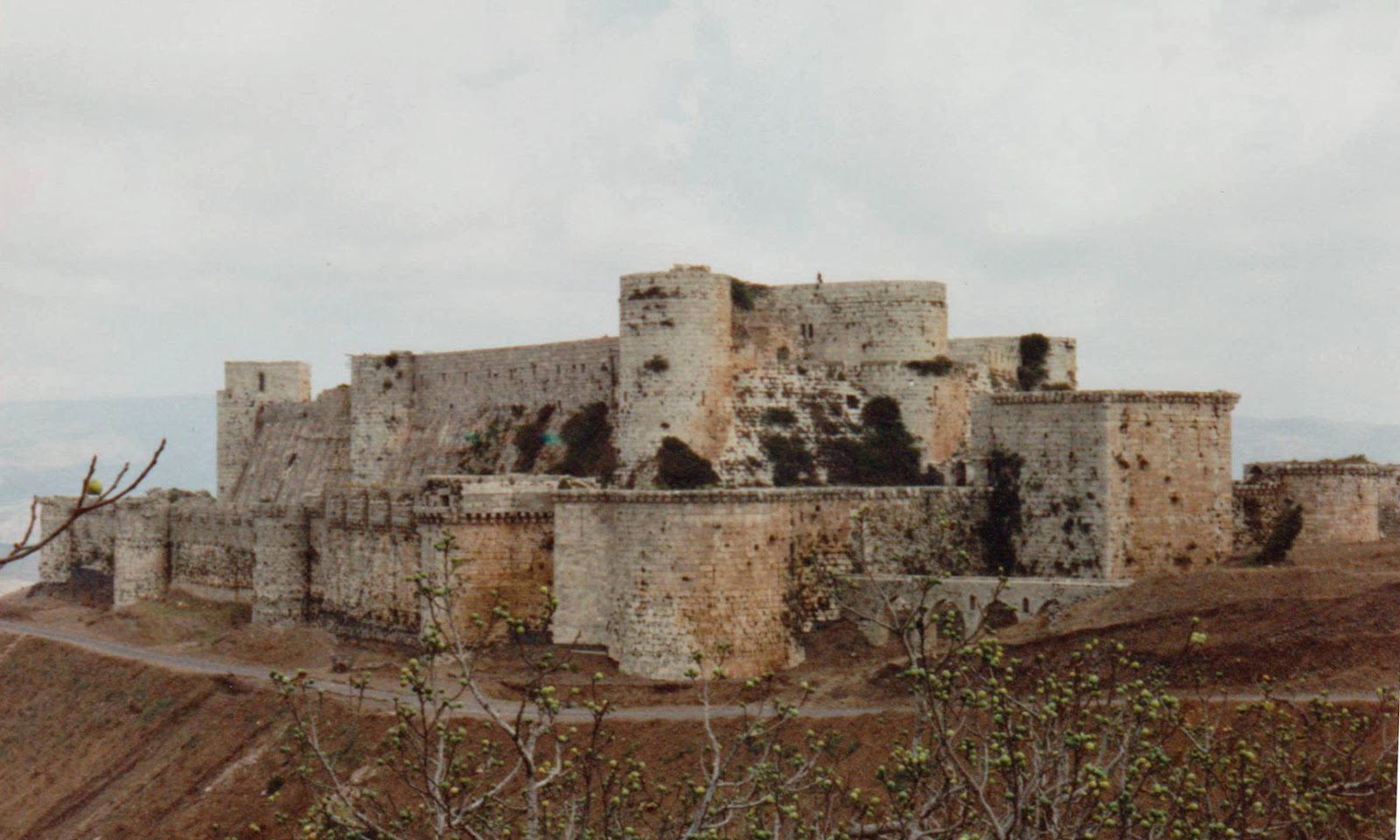
Krak de Chevaliers in Modern Day Syria. Photo by H Schrader
It would have been pointless to turn over such vitally important military resources to an order incapable of maintaining and defending them, but the exact status of the Hospital’s fighting men remains obscure until 1206 when the Hospitaller Rule was changed to allow for fighting monks. Thereafter, the Hospitallers began to recruit fighting men, probably starting with those who were already associated with it in some way, and like the Templars, they had both knights (men of noble birth) and sergeants. Within a very short time, the knights dominated the Order. The Hospitallers, however, continued to have priests, monks, and nuns devoted solely to the care of the sick, and the network of hospitals was not abandoned. At about this time, the entire Order adopted black robes (reminiscent of their Benedictine origins) adorned with a white cross. One notable difference with the Templars, however, was that there was no distinction in dress between the knights and the sergeants of the Hospital.

The Hospitallers, like the Templars, warned new recruits that “… when you desire to eat, it will be necessary for you to fast, and when you would wish to fast, you will have to eat. And when you would desire to sleep, it will be necessary for you to keep watch, and when you would like to stand on watch, you will have to sleep. And you will be sent this side of the sea and beyond, to places which will not please you, and you will have to go there. It will be necessary for you, therefore, to abandon all your desires to fulfill those of another and to endure other hardships in the Order, more than I can describe to you.” (Barber, Richard, The Knight and Chivalry, p. 275) Like the Templars, the Hospitallers vowed poverty and chastity as well as obedience.

Austere Monastic Accommodation; in this case the Cistercian Monastery of Fontfroid
The similarity between the two powerful militant orders led to open rivalry between them for recruits, resources, and power in the first half of the 13th century. This led on occasion to open fighting between members of the orders on the streets of Acre and Tripoli, but more often to subtle maneuvering behind the scenes. For decades, the Hospitallers and Templars consistently backed rival claimants to the throne of Jerusalem and rival Italian trading communities. As the end of Christian Palestine neared, however, the Hospitallers and Templars put aside their differences and jealousies to rally to the now lost cause. In the last decades of Christian Palestine, Hospitallers and Templars fought side by side, ferociously and futilely, at Antioch, Tripoli, and finally Acre.

After the fall of Acre, the Hospital also relocated its headquarters to Cyprus, but conflict with the King of Cyprus convinced the leadership of the Hospital (evidently more flexible, imaginative, and analytical than the tragic Jacques de Molay) of the necessity for independence from secular authority. The Hospitallers undertook the capture of the island of Rhodes from Turkish forces in 1306, finally seizing the capital city in 1309. With this move, the Hospitallers removed themselves, and the bulk of their movable treasure, from the grasp of Philip IV – or any king inclined to follow his example. Even more important, however, from this island base the Hospitallers built up a powerful fleet capable of challenging the naval power of the Turks and of launching hit-and-run raids into Saracen territory. The Hospitallers had “reinvented” themselves and had found a new justification for their existence.

Hospitaller Castle at Kolossi, Cyprus. Photo by H. Schrader
The Hospitaller fleet remained a significant force protecting Christian shipping and commerce throughout the next two and a half centuries. The base of this fleet on Rhodes, so close to the Turkish coast, was a constant provocation to Turkish, rulers. Numerous attempts were made to capture Rhodes, notably in 1440, 1444, 1480, and 1522. During the first 3 sieges, the Hospitallers withstood vastly superior numbers, in one case (1444) driving off the enemy with a daring sortie from within the city. On the other two occasions, they were rescued by the timely arrival of a relieving fleet from the West. In 1522, an army allegedly 100,000 strong attacked a force of just 600 knights and 4,500 local auxiliaries. After 2 months of bombardment a breach in the landward wall was made, yet 3 assaults through the breach, carried out with complete disregard for casualties, failed. Sultan Suleiman called off the costly assaults and settled down for a long siege, cutting Rhodes off from all relief. Recognizing the hopelessness of their situation, the surviving Hospitallers, now more commonly called Knights of St. John, surrendered on honorable terms.


When the Hospitallers withdrew on their ships from Rhodes, they were effectively homeless, but Emperor Charles V offered them the island of Malta as their new headquarters. From here they continued to operate their fleet so effectively that Sultan Suleiman decided he had to dislodge them from their new home. In 1565 he again assembled a large siege force. The Knights of St. John had 500 knights of the Order and 10,000 other troops. The Turks launched their first attack in May and after a month of fighting captured an outlying fort, slaughtered the garrison, and floated their mutilated bodies across the harbor to the main fortress as a warning of what was to come. The Hospitallers replied by executing Turkish prisoners and catapulting their heads into the Turkish camp. A Turkish assault on the main fortifications was undertaken on July 15, and a breach in the walls effected by August 7. Yet two assaults through the breach, on August 19 and 23, both failed. On September 7 a Spanish fleet arrived from the West and scattered the demoralized Turkish forces. The defense of Malta had cost the Hospitallers half their knights and 6,000 of the other defenders.

A dramatic 19th century of the Hospitaller defense of Malta.

Thereafter, the Knights of St. John focused again on making the seaways of the Mediterranean safe for Christian shipping, a task that became increasingly easy as Turkish naval power declined. But this victory, like the defeat in Acre 300 years earlier, robbed them of their raison d’ĂȘtre. The Knights of St. John, now commonly known as the Knights of Malta, slid into a slow decline. They became more involved in commerce than warfare, and their fortresses turned into palaces. When Napoleon laid siege to Malta in 1798, the last frail remnants of the once mighty Hospitaller Order surrendered in just two days.


The Hospitallers played an important role in the Holy Land in the 12th century and so also figure in my biographical novel about Balian d'Ibelin and the fall of the Kingdom of Jerusalem. 


  Buy now!                                                                  Buy now!                                                             Buy now!
 

"The Tale of the English Templar" is a fictional work that depicts the destruction of the Knight's Templar. 


An escaped Templar, an intrepid, old crusader, and a discarded bride
embark on a quest for justice in the face of tyranny. 
 
 
"St. Louis Knight" is a novel set against the backdrop of the Seventh Crusade and St. Louis' sojourn in the Holy  Land. It is now available in audiobook as well as paperback and ebook:

 
 A crusader in search of faith --
A lame lady in search of revenge --
And a King who would be saint.

St. Louis' Knight takes you to the Holy Land in the 13th century, and a world filled with knights, nobles, prophets -- and assassins. 
(Available in Audiobook)


Saturday, December 13, 2025

St. Louis and the Seventh Crusade

On a dark December day in 1244 the French King, Louis IX, lay dying. On his deathbed he promised God that if he were granted a few more years of life, he would liberate Jerusalem from Muslim rule . Miraculously, Louis recovered, and despite the best efforts of his mother and other advisers to convince him his vow had been made in a moment of madness,  Louis remained undeterred. He began preparations for a new crusade immediately.


Louis' crusade that would come to be known as "the Seventh" was predominantly a French affair, not only because it was the brainchild of a French king, but also because the struggle between the papacy and the Holy Roman emperor had reached a state of open warfare. The pope had declared Frederick II ‘deposed’ and called for a ‘crusade’ to enforce his ruling. This effectively precluded German and Italian participation. Nevertheless, France was so wealthy and Louis’ position so strong that with his own resources he was able to launch one of the best organised and financed crusades of the entire era. 

Between 15,000 and 18,000 thousand fighting men were involved; of which as many as 2,800 were knights. Louis systematically collected funds and chartered large numbers of ships, including long-distance horse transports and shallow-draught landing craft, the latter contributing decisively to the capture of Damietta. He also pre-positioned supplies of wine and grain in massive dumps on Cyprus. Louis personally took an active and intense interest in every aspect of the preparations for his crusade. 

On 25 August 1248, King Louis embarked at Aigues Mortes, accompanied by three of his brothers and his queen. He adopted the same strategy as the Fifth Crusade, namely attacking Egypt, expecting that a decisive victory over the Ayyubids in their powerbase would force concessions in the Holy Land. The crusaders wintered in Cyprus, where they enjoyed the hospitality of King Henry and restored the health of their horses while awaiting additional contingents. 

In May 1249, King Louis sailed for Damietta with an army reinforced by numerous Cypriot contingents under the command of the Constable and Seneschal of Cyprus, Guy and Baldwin d’Ibelin, respectively. After a dangerous storm, the fleet arrived off Damietta on 4 June; the next day, Louis undertook a dangerous amphibious landing against armed opposition. Jean de Joinville, the Seneschal of France and participant in this landing, tells the following story in his biography of King Louis:

When the king heard that the standard of Saint Denis was on shore he … refused to be parted from the emblem of his sovereignty, and leapt into the sea, where the water came up to his armpits. He went on, with his shield hung from his neck, his helmet on his head, and lance in hand, ‘till he had joined his people on the shore… . [Here] he put his lance under his armpit, and holding his shield before him, would have charged right in among [the Saracens] if certain sagacious men who were standing around him had allowed it.[i]
Despite multiple attacks by Saracen cavalry, the crusaders held on to their bridgehead on the sands before the city while their horses were brought up in the second wave of landing ships. As night fell, the crusaders prepared to besiege Damietta as the Fifth Crusade had done for a year-and-a-half. They were astonished to learn the entire city had been deserted. The sultan’s troops had retreated upriver, and the garrison and population — feeling abandoned — had fled after them.
 
This was a stroke of luck that allowed the army to take control of a walled city containing ample food, water and shelter, without casualties. Ironically, because the crusaders had expected a long siege, their attack had been launched while the Nile was still flooded. This meant they could not follow-up their surprise victory because they had to wait for the floodwaters to recede. This had the added benefit of allowing temperatures to drop to more tolerable levels for marching and fighting and enabling reinforcements to arrive under Louis’s brother, the Count of Poitiers
 
In due time, a war council discussed strategy. The majority favored an attack on Alexandria to facilitate a diplomatic deal benefitting the crusader states. In contrast, Louis’ brother, the Count of Artois forcefully argued that the way to kill a snake was to crush its head: i.e., an assault on Cairo. Louis accepted this advice, and on 20 November 1249, led his army out of Damietta to advance up the Nile towards Cairo. 
 
Meanwhile, the Sultan al-Sahil Ayyub had died and been succeeded by his son, Turan Shah. Because the latter was not present in Egypt, so the sultan’s Mamluks assumed temporary command of the Egyptian army. They concentrated at Mansourah while the crusaders made slow but steady progress marching up the Nile. Throughout the march, King Louis’ fleet kept his army well supplied and held open the lines of communication to Damietta, where the Queen of France remained with a substantial garrison. At Mansourah, a well-fortified town positioned strategically at the junction of two branches of the Nile, progress ground to a halt. 
 
The crusaders could not advance on Cairo without first crossing over one branch of the Nile and taking Mansourah. All attempts to bridge the river failed. Then on 8 February 1250, an Egyptian traitor revealed a ford to the crusaders, and King Louis’ army started crossing the Nile. Unfortunately, the advance guard was placed under the command of Louis’ impetuous brother Robert, Count of Artois. He rushed ahead against the King’s explicit orders. Artois succeeded in overrunning the Saracen camp outside the city walls but foolishly followed the fleeing Saracen troops into the city itself, where the French were trapped in the narrow, irregular streets and set upon by the entire population. Not one of them escaped, and the Count of Artois’ body was hung from the walls in triumph. With the main body of troops, King Louis was able to withstand a counterattack and fight his way forward to successfully occupy the camp vacated by the Saracens, but the city remained firmly in Saracen hands.
 
This bloody, indecisive and bitter victory was the turning point in the crusade. While the crusaders remained encamped before Mansourah, the Saracens transported disassembled ships by camel and reassembled them upriver. These Saracen warships systematically started to systematically intercept Louis’ supply ships. By April, Louis’ army was starving and diseased. Both scurvy and dysentery had decimated the ranks. Louis, himself desperately ill, gave the order to retreat. The Saracens harassed the crusaders every step of the way, until Louis, no longer able to ride or stand, surrendered. 

The first thing the sultan did was to order the execution of all the sick and wounded among the poor; only those well enough to be enslaved were spared. The nobles were held for ransom, and the bargaining began. With threats of torture, including showing Louis the instruments of torture to be employed, the sultan attempted to force the king to surrender the formidable castles of the crusader kingdoms still in Frankish hands. Louis replied that the sultan could do with him as he pleased, but he could not surrender the fortresses because he did not control them. The sultan eventually settled for the return of Damietta as the king’s ransom and payment of 800,000 bezants for all the other prisoners. Although the sultan was then assassinated by his Mamluks, the terms of the treaty were respected, and Louis and most of the high-ranking nobles were released upon the return of Damietta and payment of half the ransom. 

The bulk of those released had had enough crusading and returned home at once, but King Louis sailed for Acre instead. He was determined to remain in the Holy Land until the last of the prisoners had been returned. He also set about strengthening the defences of the Kingdom of Jerusalem. He accomplished the latter by extensively refortifying Acre, Caesarea, Jaffa and Sidon at his own expense. He also arranged for a permanent garrison of 100 French knights at Acre supported by appropriate, if unnamed, numbers of sergeants, archers and support troops, bringing the total commitment close to 1,000 men. Meanwhile, Louis tenaciously and sagely negotiated with the Muslim states, who were again at war with one another and willing to court the Franks. 

Ultimately, Louis signed a truce with the new rulers of Egypt, the Mamluks, because they still held thousands of captives. He concluded a treaty with them in 1252 that secured the release of the remaining prisoners and cancelled his outstanding debt of 400,000 bezants. In 1254 he signed a truce with Damascus and Aleppo as well. These treaties secured a comprehensive if temporary peace for the Kingdom of Jerusalem. On 24 April 1254, Louis sailed for home. Despite the tragic end of his crusade, he left the Kingdom of Jerusalem stronger than before. As Thomas Madden put it: ‘The contrast between Louis IX and Frederick II could not have been more stark’.[ii]


[i] Jean Joinville, The Life of Saint Louis, trans. M.R.B. Shaw (London: Penguin Classics, 1963), 204.

 The bulk of this entry is an excerpt from Dr. Schrader's comprehensive study of the crusader states.


"St. Louis Knight" is a novel set against the backdrop of the Seventh Crusade and St. Louis' sojourn in the Holy  Land. A Templar novice and King Louis are the central characters. 
It is now available in audiobook as well as paperback and ebook.

 
 A crusader in search of faith --
A lame lady in search of revenge --
And a King who would be saint.

St. Louis' Knight takes you to the Holy Land in the 13th century, and a world filled with knights, nobles, prophets -- and assassins. 
(Available in Audiobook)
 

Dr. Helena P. Schrader is also the author of six books set in the Holy Land in the Era of the Crusades.


           Buy Now!                                                  Buy Now!                                                    Buy Now!
 

          Buy Now!                                               Buy Now!                                                      Buy Now!

"The Tale of the English Templar" is a fictional work that depicts the destruction of the Knight's Templar. 


An escaped Templar, an intrepid, old crusader, and a discarded bride
embark on a quest for justice in the face of tyranny.