COPYRIGHT

All content on this blog is protected by copyright.
Content used elsewhere without attribution constitutes theft of intellectual property and will be prosecuted.

Saturday, March 14, 2026

The Italian Communes in the Crusader States

The Italian maritime powers played a critical role in establishing Frankish rule over the coastal cities of the Levant and contributed materially to the viability of the crusader states. In exchange for their help, these quintessentially commercial states obtained huge economic concessions. The Italian merchant states evinced the rapaciousness so often attributed to all crusaders, and they consistently placed commercial advantage above the interests of both crusading and the crusader states.


As early as 1000, just one year after the capture of Jerusalem, the Venetians obtained a treaty that set a pattern for all future agreements with the maritime cities. This granted to Venice a church, market and one-third of the booty of any city captured by the Franks if captured in the period during which their fleet was present — whether the Venetians participated or not. By 1124, the Venetians had negotiated a church, street, square and oven in every royal and baronial city in the kingdom, as well as the privilege to try all lawsuits involving Venetian citizens before Venetian courts. They had also obtained control of one-third of the cities of Tyre and Ascalon and were exempt from all taxes.

Despite these grandiose privileges and rights, the Italian presence in the early years of the Latin East amounted to little more than trading outposts with communal lodgings and warehouses. The so-called ‘palazzos’ of the Italian merchant communes consisted of warehouse and shop space on the ground floor (that individual merchants could rent out by the square foot), and lodgings on the upper floors, rented out by the week or month. In between were the offices, courts and reception rooms for the commune’s administrative bodies. Rather than grand residences, the ‘palazzos’ were the practical consolidation of functional space needed by a transient population of merchants, agents, sea-captains and sailors. These men came only briefly to conduct business and returned ‘home’ ― to Pisa, Genoa or Venice ― as soon as possible. Their families remained in the home city, and in the ‘off-season’, the Italian quarters were practically deserted.

Only gradually did some of the less prominent members of this essentially transient community start to linger in the East. Only very exceptionally, such as in the case of the Embriachi family of Genoa, did prominent, aristocratic families establish a permanent presence in Outremer. Yet, men of lesser standing at home sometimes found it advantageous to settle, marry and acquire personal property in Outremer. As a result, by the end of the thirteenth century, there were some members of the Italian communes who were third or fourth-generation residents of Outremer. Despite this fact, they remained legally and emotionally the subjects of their home cities rather than the Kingdom of Jerusalem.

The Italians failed to develop any strong emotional tie to the cause of crusading or the Holy Land, being as happy to attack Christian cities (e.g. Zara and Constantinople) or obtain trading privileges in Muslim ones (e.g. Alexandria). Their primary concern was ‘dominating the lines of communication and commerce between the eastern shores of the Mediterranean and Europe’.[i] This set them apart from the other residents, both native and immigrant. Certainly, the Italian communes retained their aloofness from the rest of crusader society. The right to their own courts was fiercely defended, as were their other privileges, particularly immunity from royal taxes and service. They remained enclaves of foreigners, rather like diplomatic or colonial enclaves in later centuries, living by their own laws, speaking their native language — and retaining their rivalries. 


[i] See note 16, Prawer, ‘Social Classes in the Crusader States’, 174.


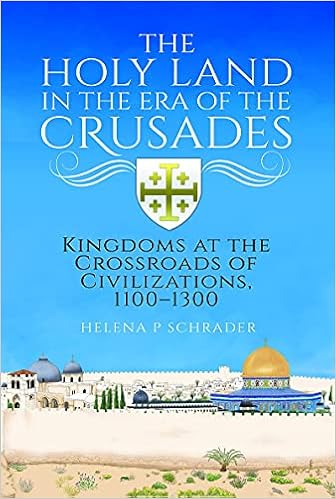
The bulk of this entry is an excerpt from Dr. Schrader's comprehensive study of the crusader states.
Dr. Helena P. Schrader is also the author of six books set in the Holy Land in the Era of the Crusades.


           Buy Now!                                                  Buy Now!                                                    Buy Now!
 

          Buy Now!                                               Buy Now!                                                      Buy Now!


Saturday, March 7, 2026

Settlers and Poulains -- the New Citizens of the Latin East

  The character of the crusader states was defined not by the natives who had been there before and adapted to many conquerors, nor by the transients who came and went, but by the men and women of Western origin and Latin faith who made the Holy Land their home. In the beginning, their numbers were tiny. Only an estimated 15 per cent of the surviving crusaders, or as few as 2,000 to 4,000 men, remained in the East at the end of the First Crusade. However, immigration to the Holy Land began almost at once, so that by the end of King Baldwin IV’s reign, an estimated 140,000 to 150,000 Western European immigrants had settled in Outremer, making up as much as 25% of the population.


At the apex of Frankish society were the nobles and knights, the feudal elite drawn from the second or third tier of the European nobility, mostly from France, Normandy, and the Holy Roman Empire. Kings, Dukes and Counts came on crusade, but rarely did they stay in the Holy Land. Their vassals, on the other hand, often did. Some of these men came from landowning families with regional influence and reputation, such as Godfrey de Bouillon, Raymond de Toulouse, Henri de Champagne and John de Brienne. Many others were the younger sons and brothers, or the castellans and stewards and household officials of the hereditary lords. Similarly, the majority of Outremer’s knights, i.e. the knights that remained in the East, had not been fief-holders at home but rather household knights or freelancers; men without either land or livery.

Frankish society also had an exceptionally large clerical component. The Latin Church maintained two patriarchs (Jerusalem and Antioch), six archbishops, and twenty-three bishops in the crusader states — all with their respective cannons and clerical support apparatus. These clerics, however, represented only the tip of the iceberg. The Holy Land naturally attracted men with a religious vocation, and all the various monastic orders hastened to establish houses near the important shrines of Christianity. Thus, in addition to the militant orders, there were Augustine, Benedictine, Premonstratensian, Cistercian, Carmelite, Dominican and Franciscan houses operating in Frankish states by the end of the era. Altogether, 121 different monastic sites have been identified in the former Kingdom of Jerusalem. Also, 360 Latin churches have been discovered, roughly evenly divided between rural and urban locations.[i] In the immediate vicinity of Jerusalem, it is believed that approximately 50 per cent of the Frankish population was composed of churchmen.

The rest of the Frankish population, the commoners, were all freemen; there were no serfs in the crusader states — not even among the native populace in rural villages. Outremer’s peasant farmers did not owe feudal services but instead paid fixed (and comparatively low) rents. Unlike Europe, where the ‘commons’ or ‘Third Estate’ was fractured, merchants and tradesmen consciously viewing themselves as superior to peasants, the non-noble Frankish population of the crusader states appears to have enjoyed a common identity as ‘burgesses’. They were recognised as a separate and distinct ‘order’ as early as 1110. Furthermore, the burgesses, whether urban or rural, were integrated into Frankish society and government to an astonishing degree. Their presence and consent was considered necessary ‘not only when the bourgeois were directly concerned’.[ii] For example, the coronation ceremony of the Lusignan kings, which was probably modeled on that of the kings of Jerusalem, required the officiating prelate to ask the ‘prelates, barons, knights, liegemen, burgesses and representatives of the people who were present for their approval’ before anointing the monarch.[iii] Prominent burgesses were also included on the witness lists of kings and nobles, something not usual at this time in Western Europe.

The notably higher status for the bourgeois is probably attributable to the fact that the origins of the class lay in the foot soldiers of the First Crusade; they had been the comrades-in-arms of the nobles who founded the crusader states. Those who came later as settlers constituted the yeoman class that contributed sergeants of the Frankish armies.  They manned the garrisons of cities and castles and provided archers and pikemen to the feudal host. As will be discussed later under military institutions, the nature of warfare in the Near East in the twelfth century made knights exceptionally dependent on the infantry for survival and success. They could not afford to alienate men who were essential to their military survival and consequently accorded them an exceptional degree of respect.

In the countryside, the Franks founded hundreds of new settlements with distinctive features that distinguished them from the settlements of the natives. The architecture of these rural Frankish settlements was closer to the urban middle-class architecture of the same period in Western Europe. They were mostly multistorey structures constructed of stone, sometimes with undercrofts and staircases, usually with rooftop water collection and cisterns fed by piping, plastered interior walls, and often with chimney fireplaces. These features made them luxurious by European standards of the period and highlighted the affluence and self-esteem of the burgesses of Outremer.

Significantly, rural Frankish settlements were far more common than previously assumed. For more than a century, it was assumed that the Latin settlers were concentrated in the urban centres, predominantly on the coast of the Levant. The traditional nineteenth- and twentieth-century interpretation of Frankish society in the Holy Land hypothesised a decadent urban elite, collecting rents from oppressed native farmers. According to historians of the last century, the Franks were afraid to venture into the hostile environment of the countryside, not only because of an ‘ever-present’ Saracen threat but also because they were hated by their tenants and subjects. Some historians such as Joshua Prawer did not hesitate to draw parallels between Frankish rule in Palestine/Syria and apartheid in South Africa. 

However, in his seminal work, ‘Frankish Rural Settlement in the Latin Kingdom of Jerusalem’ (Cambridge University Press, 1998), Professor Ronnie Ellenblum catalogued and collated findings to present a radically different picture. Ellenblum’s work has since been complemented by additional studies, surveys and research on the part of a new generation of scholars. Together, this research confirms that the Frankish rural presence was much more widespread than had been previously assumed. More than 700 Frankish towns and villages have been identified, making it impossible to characterise Frankish society in the twelfth century as urban.

Furthermore, the bulk of these smaller towns and villages had no walls or fortifications of any kind, a clear indication that the Franks did not feel threatened. Far from fearing invasions, much less riots or violence on the part of their neighbours, the Franks felt secure enough to make major long-term investments. Alongside the hundreds of parish churches, manors and farmhouses were mills, irrigation, terracing and roads.

Equally important, contemporary research shows the Frankish settlers did not displace the local inhabitants, expelling them from their land and houses. They did not deprive them of their land, livelihood or status. On the contrary, the documentary evidence demonstrates that the Franks were fastidious in recording and respecting the rights of the native inhabitants. Rather than displacing the locals, they built villages and towns in abandoned, previously unsettled areas or, more commonly, beside existing towns. The native pattern of settlement was to locate towns and villages in valleys, whereas the Franks built a castle/manor on hills or heights. Frankish farmers settled at the foot of this administrative centre. The older towns and villages were left intact, along with the ownership of the land cultivated by the native inhabitants. This meant the Frankish settlers were integrated with the native Christian population, often sharing churches as well as markets, ovens, mills and wine and oil presses. That, combined with the fact that there is no evidence whatsoever of residential segregation based on nationality or religion in the nineteen large cities in which the Franks lived, discredits Prawer’s thesis of an apartheid society.

Regarding the inhabitants of these villages, documents show that a high proportion of the Frankish settlers in these rural areas were skilled tradesmen. This is probably because most peasants (not to mention serfs) felt a strong bond to the land and little interest in emigration. In the Holy Land, the building trades such as carpenters, masons and blacksmiths, appear to be particularly well represented, but the data sample is too small to make sweeping generalizations. Certainly, a wide range of trades was embodied. In addition to the building trades, these included silversmiths, bakers, butchers, vintners, drovers and herdsmen, cobblers and (former) servants. Whatever these men had been in the past, in Outremer, they leased out farms and become free peasant farmers, except for those tradesmen such as the baker, butcher and tavern keeper, who supplied services to the local community.

The national origin of the settlers was nearly as diverse as their professions. French settlers, mainly from Southern France but also from Burgundy, Champagne and the Isle de France, were most numerous, and a northern dialect of French became the lingua franca of the mainland crusader states. However, documents show there were also significant numbers of immigrants from Italy and Spain as well as settlers from Scotland, England, Bohemia, Bulgaria and Hungary. Whatever their background, the immigrants to Outremer adopted for themselves the term first used by the Byzantines and Saracens to describe them. That is, ‘Frangoi’ (Greek) or ‘al-Ifranj’ (Arabic). The settlers translated these terms into Latin as ‘Franci’ and into French as ‘Franc’ and used it to describe themselves.

More modern waves of voluntary emigration to America, Australia and South Africa demonstrate that emigrants who choose to go to a ‘new’ country usually do so with a psychological willingness to create a new identity. In the case of the settlers in the Holy Land, integration and intermarriage with the local population further contributed to the creation of a new identity at an astonishing rate. Writing no later than 1127, the cleric, Fulcher of Chartres wrote:

We who were occidentals have now become orientals… . We have already forgotten the places of our birth… . Some have taken wives not only of their own people but Syrians or Armenians or even Saracens who have obtained the grace of baptism… . Words of different languages have become common property known to each nationality, and mutual faith unites those who are ignorant of their descent… . He who was born a stranger is now as one born here; he who was born an alien has become a native.[iv]

 The children of these settlers, especially the children of mixed marriages, were no longer Europeans or crusaders. They considered themselves Franks. Later generations of crusaders referred to them by the derogatory term ‘poulains’, which is best translated as ‘half-breeds’; it certainly held racist connotations. The racism of the Europeans remained a distinguishing feature of the transient population, yet it was strikingly not a characteristic of the Franks of Outremer.


[i] Denys Pringle, ‘Churches and Settlement in Crusader Palestine’, in The Experience of Crusading: Defining the Crusader Kingdom, eds. Peter Edbury and Jonathan Phillips (Cambridge: Cambridge University Press, 2003), 177.

[ii] Hans Eberhard Mayer, ‘Latins, Muslims and Greeks in the Latin Kingdom of Jerusalem’ in Probleme des lateinischen Koenigreichs Jerusalem (London: Variorum Reprints, 1983), VI-176.

[iii] Chris Schabel, Cyprus: Society and Culture 1191-1374, eds. Angel Nicolaou-Konnari and Chris Schabel (Leiden: Brill, 2005), 181.

[iv] Fulcher of Chartes in The Crusades: A Reader, eds. S.J. Allen and Emilie Amt (Toronto: University of Toronto Press, 2014), 88-89.


The bulk of this entry is an excerpt from Dr. Schrader's comprehensive study of the crusader states.

Dr. Helena P. Schrader is also the author of six books set in the Holy Land in the Era of the Crusades.


           Buy Now!                                                  Buy Now!                                                    Buy Now!
 

          Buy Now!                                               Buy Now!                                                      Buy Now!