COPYRIGHT

All content on this blog is protected by copyright.
Content used elsewhere without attribution constitutes theft of intellectual property and will be prosecuted.
Showing posts with label First Crusade. Show all posts

Thursday, July 9, 2020

The Sack of Jerusalem - Revisited

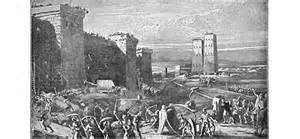
On July 15, 1099, after a month long siege, the forces of the first crusade successfully broke through the defenses of the Egyptian garrison, crossed over the walls of Jerusalem and entered the Holy City. What followed has gone down in history as an atrocity of biblical proportions.  It is used to this day as a shorthand for all things vile and unjustified, and was cited an excuse for centuries of jihad, including the attacks of 9/11. It is even trotted out as evidence that Christianity itself is not a religion of peace.
Let's look at what happened -- and put it in context.


After two years of marching and fighting across 2,000 miles, only one in five of the men who had set out on a great armed pilgrimage to liberate Jerusalem from Saracen occupation reached Jerusalem. That is, four out of five crusaders had already given their lives through disease, starvation, cold, wounds or in combat. These roughly 10,000 survivors, of whom roughly 1,200 were knights, were insufficient to surround the city and cut it off from reinforcement and supply. In short, a siege which forced the city to surrender on terms, was virtually impossible.

Furthermore, a large Egyptian relief army was already on the way -- and the Egyptian garrison in Jerusalem knew about it. They had, therefore, no incentive to negotiate terms. They were not short of water, food or other supplies. Reinforcements were already on the way. All they had to do was wait two or three months, and then they could help obliterate the pathetic force camped outside the walls.

The only option available to the crusaders was to assault the city and hope to take it before the Egyptian field army fell on them. A first attempt on June 13 failed miserably with high casualties due to lack of ladders and siege engines. By a stroke of luck, shortly afterwards six Genoese and English vessels arrived in Jaffa carrying building materials. These and the ships themselves were used to construct siege engines outside Jerusalem. With great difficulty and in the face of fierce opposition, the siege engines were rolled into position against the walls of Jerusalem on July 14, 1099, but it was not until the following morning that troops under the leadership of Godfrey de Bouillon gained a foothold on the northern wall. His men then fought their way into the city and opened one of the gates from the inside, allowing the rest of the crusaders to flood in.

According to exultant Christian accounts, a massacre followed. The Gesta Francorum speaks, for example, of a slaughter so great that "our men waded in blood up to their ankles." Raymond of Aguilers is even more over the top writing: "men rode in blood up to their knees and bridle reins."

Yet the very absurdity of such a claim -- a claim ludicrous in its impossibility -- ought to alert even the most gullible reader that the account is not factual. Medieval readers, unlike modern readers, recognized that the image is taken directly from the biblical account of the apocalypse and was not intended to be taken literally. In short, the Christian accounts of the sack of Jerusalem do not even attempt to be factual.

On the one hand, these accounts, mostly written by clerics who had accompanied the crusaders, were written to make their patrons (the crusade's leaders) the heroes of the decisive conflict of their age. They were consciously reinforcing the self-image of men who saw themselves as the soldiers of God delivering victory over the forces of evil. In short, they eulogies of the victors -- a medieval literary form that had little relationship to reality in any context. On the other hand, the Christian accounts of the capture of Jerusalem were also intended to be symbolic. Their purpose was to conjure up images of Armageddon and suggest that the Saracens had met their Armageddon at Jerusalem on July 15, 1099.

In other words, the Christian sources are next to worthless in attempting to discover what really happened in Jerusalem on July 15, 1099. So let's turn to the Muslim sources. The most striking thing about these is that none of these are contemporaneous, or even nearly contemporaneous, with the event. That is, an assault and sack was was allegedly exceptionally, horrifically, unfathomably dreadful, unusual and unprecedented, didn't even rate a mention. There were appeals to the Caliph and other Muslim leaders to assist in reconquering Jerusalem, but these stressed the fact that Jerusalem had changed hands, that it was now controlled by "infidels" and "non-believers." The fact that Jerusalem was lost excited outrage, but not the manner in which it fell. Not a word was wasted on that.

The first Muslim accounts devoted to any kind of comprehensive treatment of the crusades were not written until half a century later and, like their Christian counterparts, are more religious tracts than histories. Nial Christie in his excellent study Muslims and Crusaders: Christianity's Wars in the Middle East 1095-1382, From the Islamic Sources concludes: "...later writers, many of whom were religious scholars, used their works as a means by which to teach moral lessons....[I]t is difficult to tell to what extent facts have been skewed to fit the writer's agenda...." (1)

In consequence, modern scholars of the crusades have looked beyond the chronicles of both the crusaders and their enemies to find other clues to what happened. For example, Jewish records from Alexandria provide proof that Jews from Jerusalem were ransomed. Dead men are not ransomed, so all allegations that the entire Jewish population of Jerusalem was massacred by the crusaders are false. There are also records of ransom negotiations for Muslim prisoners. So ends the legend that "all Muslims" were slaughtered by the crusaders. As for native Christians, these were expelled from Jerusalem before the crusaders even invested the city because the Fatimid garrison feared the native Christians might aid the crusaders. Based on the fragmentary evidence of these other sources, serious crusades scholars nowadays estimate that between 3,000 and 5,000 people (including the Egyptian garrison, i.e. troops) were slaughtered by the crusaders in their initial assault.(2)

The slaughter of three to five thousand people certainly qualifies as a massacre and an atrocity in the twenty-first century. Yet before we let our outrage carry us away, it is useful to put things into perspective. First, the right of a victorious army to put the inhabitants of a city taken by storm "to the sword" is as old as the Iliad -- if not older. Second, this was hardly the first time the Holy City of Jerusalem had been subjected to such a fate. In 614, for example, the Persians captured Jerusalem from the Byzantines after a 21 day siege and then massacred 26,500 men and enslaved 35,000 women and children.  In 1077, the emir Atsiz ibn Uvaq slaughtered "the entire population" of Jerusalem as punishment for an insurrection. Furthermore, in the thirty years before the crusaders' arrival, Jerusalem changed hands violently four times between Seljuks and Fatimids.

Other points of comparison are the sack of Baghdad by the Mongols in 1258. This was characterized not only by slaughter and plunder, but by the wanton destruction of priceless cultural monuments and treasures including mosques, palaces, hospitals and no less than thirty-six libraries. The Mongols are said to have turned books into shoes. The number of civilians slaughtered is estimated at 100,000 -- and possibly twice that -- leaving the city shattered and depopulated for generations.

Likewise, the savage sack of Antioch by Baybars provides perspective on the crusader assault on Jerusalem in 1099. In 1268, the Mamluk general ordered the gates of the city closed while his troops slaughtered every living thing inside -- and then he sent a letter bragging about his brutality to the Prince of Antioch, who had not been present. Below an excerpt:

The churches themselves were razed from the face of the earth, every house met with disaster, the dead were piled up on the seashore like islands of corpses…You would have seen your knights prostrate beneath the horses’ hooves…your women sold four at a time and bought for a dinar of your own money… your Muslim enemy trampling on the place where you celebrate mass, cutting the throats of monks, priests and deacons upon the altars…your palace lying unrecognizable…. (3)

The scale of destruction shocked the world, including the Muslim world, and was recognized at the time as the worst massacre in crusading history. It too destroyed the economic prosperity of the city, turning it into a ghost-town for generations to come. To this day it has not recovered its prominence as a cultural, intellectual, political and economic center. 

The slaughter of the garrison and civilians during the conquest of Jerusalem in 1099 besmirches the reputation of crusaders, but it was not unprecedented, exceptional or extraordinary either in its scale or violence.


(1) Niall Christie, Muslims and Crusaders: Christianity's Wars in the Middle East, 1095-1382, From the Isalmic Sources [New York: Routledge, 2014] 21.

(2) Thomas F. Madden, The Concise History of the Crusades [New York: Rowman & Littlefield, 2014] 32. Also Andrew Jotischky, Crusading and the Crusader States [New York: Pearson Longman, 2004] 60.

(3) Baybars letter translated by Francesco Gabrieli in Arab Historians of the Crusades [Berkeley: University of California Press, 1957] 311.


Friday, February 24, 2017

The "Conquest" of Edessa: Crusader Adaptation and Assimilation


The establishment of the crusader “county” of Edessa is often ― at least implicitly ― treated as a “conquest.” The impression conveyed is that the crusaders (or Franks) invaded, seized control of territory by force, and established a state (in this case styled a “County”) that was controlled by Latin elites. But Baldwin of Boulogne was accompanied by just sixty knights when he followed an invitation from a local warlord, Thoros, to go to Edessa. As Christopher MacEvitt makes clear in his meticulous study The Crusades and the Christian World of the East: Rough Tolerance, the crusader County of Edessa was more a complex network of local alliances than an invasion ― much less a colony.


The story of the crusader presence in Edessa, as indicated above, started with an “invitation” from a local warlord, and was legalized by an official adoption. Edessa was an ancient and wealthy city that at this time rivaled Antioch and Aleppo in importance. When in 1098 the First Crusade reached northern Syria, Edessa was in the hands of a Greek Christian warlord, the most recent “strongman” in a long line of short-lived warlords, who came to power by murder or popular acclaim ― only to lose favor rapidly and themselves be murdered or flee. Thoros fearing the fate of his predecessors if he could not fight off the ever present Turkish threat, sought help from the most recent military force to arrive on the scene: the crusaders. MacEvitt suggests convincingly that Thoros was making the same mistake that the Byzantine Emperor Alexios I Comnenus had made, namely, of conflating crusaders with Frankish/Norman mercenaries. Thoros wanted the evidently effective commander Baldwin of Boulogne to come fight his battles for him; he never really thought he was inviting in a successor.


Baldwin, however, was not a mercenary. He rejected mere material gifts such as gold, silver and horses, in a bid for something more important still: power and control. When Thoros refused, Baldwin threatened to leave, and “the people” (by which one presumes the chroniclers mean the elites) insisted that Thoros give way. Thoros formally adopted Baldwin in a ceremony (telling) using Armenian relics and customs. Unfortunately for Thoros, this proved insufficient to placate an evidently unruly population. Within a month of Baldwin’s adoption, the mob had turned on Thoros, murdering him, his wife and his children mercilessly. Once Thoros was dead, the citizens jubilantly proclaimed his "son" (Baldwin) doux” ― a Greek title that usually implied subordination to the Emperor in Constantinople. Although he benefited from Thoros' murder, there is no evidence that Baldwin was behind it, and the fact that he was neither well connected with local elites nor yet conversant with Armenian politics speaks against his complicity.


Furthermore, despite the title awarded him, Baldwin of Boulogne was no vassal of Constantinople. But he was not a conqueror in control of invaded territory either. He still had only 60 knights of his own and he owed his elevation to the local, predominantly Armenian population. MacEvitt makes the point that from the point of view of the Edessans they had not helped establish a “Frankish” or “Latin”  or “crusader” state at all; they had (as so often in the past) simply replaced one “strong man with vague Byzantine ties” with another. 


Furthermore, Baldwin’s career would certainly have been as short-lived and as forgettable as that of the previous half-dozen “rulers” of Edessa, had he not proved astonishingly adept at building alliances with surrounding warlords, nobles and elites. That process started with the simple expedient of leaving the Armenian administration of the city undisturbed. Baldwin also adopted Armenian symbols and rituals, and he rapidly married into the Armenian aristocracy as well.


Still he faced not so much opposition as indifference on the part of all the other petty Armenian warlords in the surrounding countryside because the “County” of Edessa was not a unified territory at all, but rather a patchwork quilt of minor princlings and lords, who each ruled their individual towns and castles by force. This was a land of “robber barons,” each jealously guarding their own territory and always on the alert to weaken or take advantage of the weakness of a neighbor. The Armenian warlords also rapidly set to work pitting one crusader lord against another, in what (in retrospect) seems like an almost playful experiment of seeing just how far they could go. The crusaders, significantly, after some initial squabbling eventually countered these attempts by closing ranks against the Armenians and eliminating the worst trouble-makers.


More dangerous to Baldwin in Edessa, however, was that as soon as he started to exert his authority there, the very citizens who had “elected” him, decided to depose him ― just as they had all his predecessors. Baldwin was lucky. One of the “councilors” turned traitor, told him what was afoot, and Baldwin struck first. He arrested the councilors, threw them in a dungeon, extracted ransom payments from them and then released them ― without noses, hands and feet or blinded in the case of the ringleaders. All were expelled from the city. Notably, this punishment, particularly the blinding of opponents and rivals, has a long tradition in the Eastern Roman Empire, but none at all in northern France. In short, even in his rage, Baldwin of Boulogne had adapted the customs of his adopted father.


Nor did his “brutality” provoke outrage or rebellion. On the contrary, the chronicles record with what amounts to approval that Baldwin was now “feared.” The Armenian church and population appears to have welcomed the restoration of a really strong strongman, capable (they hoped) of ending the fragmentation and lawlessness in the region that had followed the defeat of the Byzantine army at Manzikert.


Baldwin of Boulogne had no chance to prove himself further. He was called away to Jerusalem to take up his elder brother’s mantle. He was crowned King of Jerusalem in the Church of the Nativity on Christmas Day 1100. He did not just abandon Edessa, however. Instead, he invited his cousin Baldwin de Bourcq to succeed him as ruler of Edessa. Baldwin II (as he was to be known in both Edessa and Jerusalem) was quick to take the opportunity, and his eighteen-year rule in Edessa truly established Frankish control over Edessa.


It was Baldwin II who extended Frankish power beyond the city of Edessa into the surrounding region. This was no easy task as various warlords held castles at strategic points ― some Christian, some Muslim. Like Baldwin I, Baldwin II had too few Frankish troops to impose his rule. He was dependent on the goodwill of the bulk of the ruling class and the loyalty of Armenian soldiers to remain in power, much less extend it. Significantly, he never faced any rebellion in Edessa itself.


Baldwin II adopted much the same tactics as his cousin Baldwin I. He promptly married an Armenian wife, daughter of one of the strongest warlords. Other Franks in his entourage, significantly his cousin Jocelyn de Courtenay who would succeed him when he too went to Jerusalem to become king there, also married aristocratic Armenian women. Equally important, he continued to depend largely on local Armenian elites to administer his territory. However, an early incident in which he lost a key city to Turkish forces and had to borrow troops from the crusader Principality of Antioch, induced him to place more of his own relatives in key strategic castles.


Yet as MacEvitt documents, this was not the same thing as “oppressing” much less “exterminating” the local elites. Rather, Baldwin sent a clear signal: cooperate or lose you lands. The majority of Armenian warlords preferred to “submit” (nominally) to the Franks than risk seeing one of their Armenian rivals win greater power and authority. So, yes, some of the larger warlords lost out, fled to Constantinople and bewailed their fate to sympathetic ears. Their lament found a voice particularly in the chronicler Matthew of Edessa, but they were a minority. The bulk of the Armenian ruling class, MacEvitt argues, “preferred to trust the Franks rather than others of their own kind.” (The Crusades and the Christian World of the East: Rough Tolerance, University of Pennsylvania Press, 2008, p. 83.) The Franks, in turn, rewarded loyalty, and the Armenians willing to recognize Frankish suzerainty were richly rewarded with new lands, titles and revenues.


Meanwhile, the Frankish leaders and their Armenian wives became increasingly integrated in the local society, honoring local saints, adopting local symbols, titles and customs. MacEvitt sites evidence that local (non-Latin) priests served as confessors for some Frankish lords. This is a far cry from 18th and 19th Century European colonists “picking up the white man’s burden,” yet meticulously maintaining their “superior” customs while treating the “natives” with condescension bordering on contempt. In 19th century Europe “going native” -- as the crusaders did -- was scorned, and those that did "go native" were viewed with contempt.


Furthermore, this pattern of integration and alliance with local (non-Latin) Christian elites was both continued under Baldwin’s successors, the Courteneys, and also transferred to Jerusalem when Baldwin II of Edessa became Baldwin II of Jerusalem. Significantly, his half-Armenian daughter Melusinde succeeded him to the throne, reinforcing the influence of native Christians at the heart of the crusader states.

MacEvitt argues, I think convincingly, that the tiny Frankish elite in all the crusader kingdoms was both more dependent and more integrated in Eastern Christian society than previous historians have been willing to admit. His work The Crusades and the Christian World of the East: Rough Tolerance is well worth reading.


Thursday, February 2, 2017

The Crusader States

The Arms of the Kingdom of Jerusalem


The first crusade re-established Christian rule over some parts of the Holy Land, notably Antioch and Jerusalem, but the Western knights and noblemen who finally made it to Jerusalem felt they had been betrayed by the Byzantine Emperor. Instead of returning the territory they had captured to Byzantine control, the crusaders established a series of independent states with Christian rulers: the Principality of Antioch, the County of Edessa, the County of Tripoli, and – most important – the Kingdom of Jerusalem. (Later, during the Third Crusade, the Latin Kingdom of Cyprus was also established, but that will be dealt with in a separate entry.)

Initially, these "kingdoms" were little more than Christian-controlled islands in an Islamic sea, separated from one another by large swaths of territory. Between 1099 and 1144 the Christians steadily increased their area of control -- in most cases giving the defeated Muslim defenders of cities and castles a safe-conduct after surrender. By 1144, the crusaders controlled the entire coastline of the Levant from south of Gaza to roughly Antalya. In short, the crusader kingdoms covered all of what is now Israel, most of modern Jordan, Lebanon, and parts of Syria and Anatolia as well.

Likewise, initially there was only a tiny elite of Latin Christians, dependent economically on the local population composed predominantly of Melkite (both Greek and Arabic speaking), Jacobite, Maronite, and Armenian Christians, with smaller populations of Jews, Samaritans, and Muslims. However, with the establishment of Christian control over the Holy Land a wave of immigration from Western Europe began. By 1180, an estimated 20% of the population was composed of settlers from the West – all speaking a variety of languages - including second and third generation immigrants descended from earlier settlers.

These "crusader states" were distinctly different from the feudal societies from which the founders of these states stemmed. To be sure, leaders of the First Crusade sought to recreate familiar structures and customs, but they had to adapt these to the unusual circumstances in which they found themselves. The result was a hybrid-society composed of diverse elements, many of which were found nowhere else in the medieval world.

In future entries, I will explore the following unique features of the crusader states: 1) the elected kingship and the role of the High Court; 2) the high status, power and independence of women, 3) the multi-cultural, multilingual native population; 4) the "sergeants" and settlers that  made up the backbone of the feudal army 5) the urban economy, 6) a rural economy based on trade,  7) the sophisticated administrative apparatus, 8) the complex legal system; 9) the militant orders, and last but certainly not least 10) the powerful, educated and independent knights.  

The Cloisters at the Church of the Nativity in Bethlehem: A Crusader Legacy
In my three part biography of Balian d'Ibelin I endeavor to portray the crusader society as accurately as possible.


 Buy now!                                        Buy now!                                         Buy now!


Thursday, January 26, 2017

The Battle of Dorylaeum


Two weeks ago, in his first guest post, Rand Brown looked at the start of the First Crusade. Today he examines the first important battle of that military campaign.

For reasons not entirely clear from the sources, the Crusader lords decided to divide the army into two columns – a smaller vanguard and a larger main body – as they marched through the inhospitable Anatolian plateau.  This plan may have been determined according to sound contemporary military practice in Europe where dividing one’s force allowed for more efficient foraging.  Although the vanguard was the smaller, it benefited from the military experience of Bohemond who commanded overall as well as the reinforcement of his highly competent Italio-Norman forces.  Accompanying him were the equally competent Duke Robert Curthose of Bohemond’s ancestral Normandy, the son of the famous William the Conqueror, and Duke Robert of Flanders along with their forces and thousands of pilgrims, including women and children.  Also joining them was the Byzantine advisor, Tatikios, and his nominal force which really amounted to a glorified bodyguard.  The main body contained the rest of the army and was led by Count Raymond, Duke Godfrey, and Bishop Adhemar.  Although the two columns were separated by about a half-day’s march distance (about 5km according to John France’s estimates), almost all the chroniclers attest to vast amounts of pilgrim stragglers strung out between them, perhaps thinking that they could retreat to the safety of either if attacked.

The Anatolian Plateau is still characterized by a labyrinthine network of ridges and valleys that considerably impact the passage of large forces.  In the late 11th Century, army movement through this region would have been tortuously slow.  Additionally, the chroniclers attest to the harsh conditions of the dry and barren climate, noting that the suffering among the many non-combatant pilgrims was already taking its toll and perhaps weighed heavily on the Crusader lords’ minds.  While there is still room for debate about the actual location of the first epic engagement of the First Crusade, Dr. France has made a very convincing argument for a patch of ridge-flanked valley about 4km north of the modern Turkish city of Bozüyük and 45km northeast of the site of the Dorylaeum outpost.  At this particular site, the west-to-east valley takes a decided turn southwards after passing through a thin passage that forms an excellent choke-point.  It is not hard for one to imagine that this choke-point would serve as an excellent place for Kilij Arslan to spring an ambush.
 
On 1 July, 1097, the sun rose over the makeshift camp of Bohemond’s vanguard column that had just spent the night somewhere near the Bozüyük choke-point.  It is not unreasonable to assume that a commander of Bohemond’s considerable experience would have chosen a site that at least took advantage of whatever defensible terrain features existed at the time – which, according to the chroniclers, included a slight hillock on the site itself and a marsh on one flank.  Surrounding them were tiny ravines and trails that led down from the surrounding ridges, impossible for large armies to traverse, but perfect for small parties.  It was still early when word of first contact came back from Crusader scouts who reported brief skirmishes with Seljuk counterparts in the valley leading south.  The intensity of these skirmishes probably alerted Bohemond that these were more than mere local raiders and that Kilij was lurking somewhere nearby, waiting for the right moment to spring his trap.  Realizing the precarious nature of their position, Bohemond halted the many knights from impetuously chasing after the small parties of Turkish harassers with the help of Robert of Normandy.  Maintaining strict command and control over his isolated column would be essential to surviving this engagement as the Seljuks triumphed when they could divide and scatter their more heavily armored foes.

             
Bohemond quickly ordered all knights in the camp to dismount and form a solid rank facing southwards, reinforced by the thousands of common infantry behind them.  At about the same time, the first elements of Kilij Arslan’s mounted horde began streaming down from the many paths and ravines from the surrounding hills.  Fulcher of Chartres and the anonymous author the Gesta Francorum offer vivid descriptions of the engagement and may have been personally present for it.  They both recount the terror and chaos in the vanguard camp as the first clouds of Seljuk arrows crashed among them, wounding both soldier and non-combatant alike.  However, the ranks of the dismounted knights stood firm, bolstered by the iron discipline imposed by Bohemond and his fellow lords along with the superiority of their armor.  Ralph of Caen, a Norman chronicler of the First Crusade, bore explicit testimony to this when he wrote, “The enemy were helped by their numbers – we by our armor.”  Although many unarmored pilgrims suffered grievously from the Turkish attack, the real priority of the Crusade – the armored knightly professionals upon whom the entire effort relied – weathered the storm well and stood as a wall against the chaotic Seljuk maneuvering.


According to all the chroniclers, this initial phase of the fight lasted for an extremely long time – at least a six hour stretch from dawn until sometime around 12 noon.  This would be consistent for an action where the Western forces entrenched into an almost “wagon fort” stance while the Turks raced about, loosing arrow after arrow and probing for weaknesses to exploit.  While they still possessed ammunition, the Seljuks had little reason to engage in close quarters fighting.  However, this rapidly changed as arrow reserves began to run low with no real impact on the solid ranks of knights and footmen.  Steadily, bands of Turks attempted to charge through into the Western camp.  Many of the chroniclers describe this moment as their most desperate, with a few Turks making it inside the camp to strike terror into the women, priests, and wounded within.  However, wherever the Turks got close the initiative then swung in favor of the heavier armored Latin knights and infantry who were far more skilled at melee combat than their foe.  Also, the terrain benefited Bohemond’s force, as the elevated ground forced the Turks to charge upwards and the marsh on the west flank bogged down the Turkish riders who ventured into it and become easy targets for Crusader infantry.  Kilij must have begun to sense that these Latins were a vastly different breed than the disordered mob Peter the Hermit had led to the slaughter a mere year ago.  As more and more Turks were forced to charge in for close combat, the situation began to embarrass Seljuk overconfidence.  Around the noon hour, horns were heard in the hills to the west and announced that the Turkish situation was now hopeless.


Bohemond’s great gamble had been to hold just long enough with his vanguard for the much larger main force (at least two to three times the van’s size) to link back up with him.  By brilliantly executing superb command and control over his forces, he had been able to do just that despite nearly being surrounded by Seljuk attackers.  As the mounted forces of Godfrey, Raymond, and the rest of the Crusader host crested the ridge to the west, the Turks had nearly run out of ammunition and were hopelessly pinned against Bohemond’s dismounted lines.  

What followed was a mass charge that smashed into the confused Seljuk ranks and scattered them, while Bishop Adhemar held high the white banner of St. Peter he had received from Pope Urban.  What must have begun as a confident ambush turned into a complete disaster for the Seljuk warlords and, with the arrival of the main body, the situation for Kilij Arslan was unrecoverable.  The surviving Turks vanished back into the surrounding hills, individual chieftains undoubtedly giving into self-interest at the expense of any unified effort for Kilij’s sake.  Almost as quickly as it had begun, the first true battle of the First Crusade was over.


Aftermath:


Although the Crusaders held the field on that July day, they did so at a frightful cost.  Even though there had been few casualties from among the knights and professional soldiers, thousands of unarmored pilgrims had fallen to Turkish arrowfire and skirmishing.  Some of the largest numbers came from those pilgrims who had been straggling in between the two columns and who were virtually defenseless against bands of Seljuk riders.  Also, while many of the chroniclers attest otherwise with figures that beggar belief, the Crusaders are thought to have actually outnumbered the Seljuks in this fight.  Somewhere about 200,000 is thought to be the total head count for the Latin host, with around 50,000 of that number being actual knights and professional fighters.  Kilij Arslan would have been lucky to raise even 20,000 fighters in his hasty rush to intercept the Latin host.  However, they knew the land far better and, with the division of the Crusader columns, had possessed a golden opportunity to destroy them piecemeal – an opportunity they utterly failed to seize.


Kilij Arslan fled back into the depths of Anatolia with the shattered remnants of his forces and his reputation.  According to the Anonymous, the would-be sultan had to lie to the remaining garrisons of Anatolia, telling them of a “great victory” just so they would open their gates and let him pass through.  Never again would Kilij Arslan pose a threat to the movement of the First Crusade.  As the Latin host proceeded, city after city would submit and return to Byzantine control.  However, the reconquest of Asia Minor was not the goal of the great Western effort – much to Byzantine frustration.  After recovering from their desperate first engagement, the united Crusader army rapidly made their way southwards towards the friendlier territory of Armenian Christian Cilicia, where they could conserve their strength before pushing towards the great city of Antioch – where Asia Minor and Syria met and where the Latin host would need to pass in order to gain access to the Levant and, ultimately, Jerusalem.


Dorylaeum represented the first real clash of arms between the Western forces of the First Crusade, teaching them lessons of warfare in the Near East that would prove invaluable as they drove ever closer to their ultimate goal in Palestine.  It also allowed the various Crusader lords – formerly only experienced in European warfare – to see just what exactly they would be facing and how to defeat it.  If any credit is given for the Latin victory there, it would be rightly bestowed upon the superior armor and melee skills of the Western knights.  Later on in the Crusades, Islamic chroniclers would refer to the Latin knights as “the men of steel” whose far superior armor could almost negate the impact of their mounted archers.  However, this capability was only effective if Latin commanders could keep their troops in strictly ordered ranks and refused to let them become scattered chasing after bands of mounted archers feigning retreat.  Here is where Bohemond’s skill as a military leader paid off in dividends for the Crusade.  With his experience fighting in the East, he knew how imperative strict command and control was when facing the rapid fluidity of the Seljuk fighting style.  Had he not been in command of the vanguard, it is very probable that it would have met the same fate as the pitiful People’s Crusade and the First Crusade as a whole might have ended in bitter disappointment.  The victory at Dorylaeum allowed the Crusade to continue with enhanced momentum toward their final objective and even tipped the scales within Asia Minor back in favor of the beleaguered Byzantines for at least a time.


Sources Referenced:


John France.  Victory in the East – A Military History of the First Crusade.  Cambridge UK: Cambridge University Press, 1994.


_______.  Western Warfare in the Age of the Crusades 1000-1300.  Ithaca NY: Cornell University Press, 1999.


Fulcher of Chartres, et al.  The Chronicle of Fulcher of Chartres and Other Source Materials.  Ed. Edward Peters.  Philadelphia PA: University of Pennsylvania Press, 1971.

Rand L. Brown II is a co-founder of Real Crusades History.  He possesses a MA in Military History from Norwich University and currently serves as a commissioned officer in the United States Marine Corps.