COPYRIGHT

All content on this blog is protected by copyright.
Content used elsewhere without attribution constitutes theft of intellectual property and will be prosecuted.

Friday, October 23, 2015

A Home in the Holy Land


The Bishop of Oldenburg, travelling to the Kingdom of Jerusalem in 1212, was stunned by the luxury of the residences of the elite. According to Sir Steven Runciman in his "Families of Outremer," Oldenburg was particularly impressed by the Ibelin palace in Beirut: 

Its windows opened some on the sea, some on to delicious gardens. Its walls were panelled with plaques of polychrome marble; the vaulted ceiling [of the salon] was painted to resemble the sky with its stars; in the centre of the [salon] was a fountain, and round it mosaics depicting the waves of the sea edged with sands so lifelike that [the bishop] feared to tread on them lest he should leave a footmark.
Unfortunately, nothing of this palace remains today and, indeed, only scattered fragments of urban secular architecture from the crusader period have survived into the present. Even these remains have largely been obscured by the changing styles and functions that have altered the appearance of crusader structures almost beyond recognition in subsequent centuries. However, descriptions such as the one cited above as well as systematic analysis of the archeological evidence enables us to imagine a great deal. As a novelist writing about the crusader kingdoms, I am compelled to utilize all existing sources, both written and archaeological — and then add a hefty dose of imagination. What follows is a short survey of the key elements that would have defined an urban dwelling in the crusader kingdoms.

Due to a general scarcity of wood, the basic building material of the Middle East in the period was stone and/or brick. The latter, and often the former, was ususally plastered over and whitewashed. Most buildings were rectangular, two to three stories high, and crowned by flat roofs that might be decoratively crenellated and/or often provided additional living space in the form of a roof-top terrace that could be shaded from the sun bycanvas awnings. Whether used in this way or not, rooftops almost always collected rain water in a cistern. This house located on Kythera is much younger (17th century Venetian), but it has many of the features of crusader urban architecture.


Most dwellings would have been built around one or a series of courtyards. These in turn would have contained fountains, wells, kitchen and formal gardens, or working space, depending on the wealth of the occupant.  The courtyard below in Jerusalem has many medieval elements and does not look so very different from what it could have looked like in the 12th century.


The courtyard below from the Hospitaller headquarters in Acre is an example of a more spectacular, 13th century courtyard and only relevant for public buildings, but it is indicative of style, taste and crusader capabilities.


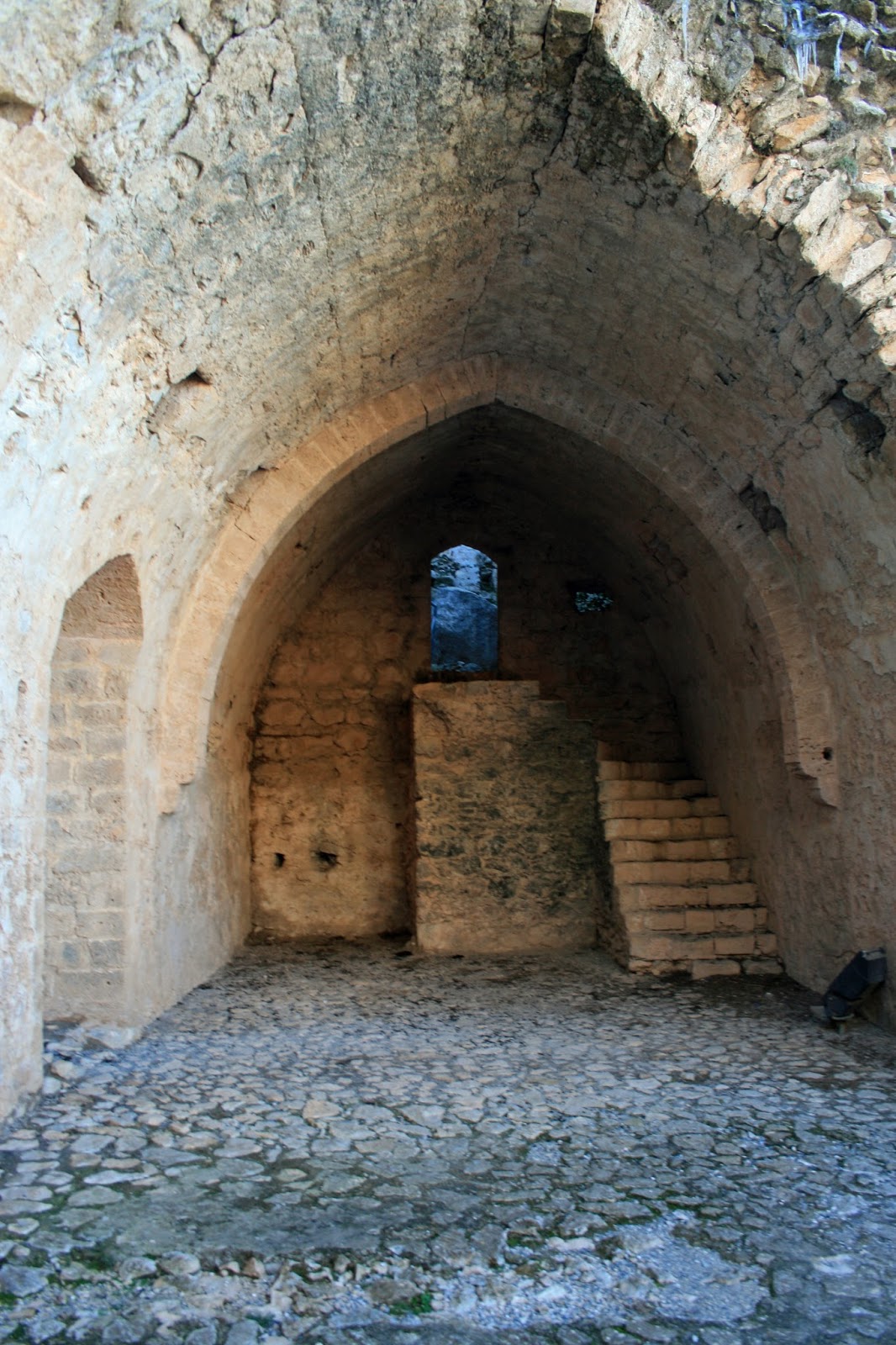
The surrounding enclosed spaces would have been either vaulted, with a wide, slightly pointed arch being the dominant, indeed iconic shape of crusader architecture, or topped by a flat roof supported by beams. A combination of these forms, with vaulted chambers on the ground floor and rooms with flat roofs above was common, but in more expensive structures double vaulted chambers at right angles to the chambers below could be stacked upon one another. A good example of this is the Hospitaller Castle of Kolossi. Below are three images of a vaulted chambers, one an upstairs chamber from the Hospitaller castle at Kolossi, one a cellar from the Byzantine/Crusader castle of St. Hilarion, and the third showing a wine or oil press in the chamber, something very common in the crusader kingdoms.



Doors and windows could be either arched or square, with the Romanesque forms of “double-” or “triple-light” windows presumably as common in the Holy Land as in the countries of the crusaders’ origin. Below is a lovely example of a medieval portal in Jerusalem, and two examples of windows form St. Hilarion and Krak de Chevaliers respectively.


Because there were major glass producing centers in the crusader states (notably Tyre and Beirut), window glazing was more common in the crusader states than in the West, a fact supported by both archaeological finds and descriptions. Below is an example of crusader glass manufacture, while the context is different, again this glass demonstrates the very high quality of the industry generally.


Archaeological evidence suggests windows in the crusader kingdoms used both plate glass and round glass set in plaster (the latter being presumably much cheaper and more common). To the left is an example of the round glass technique used here in the Templar Church in Famagusta, Cyprus.


As the description at the start of this essay indicated, interior décor could include polychrome marble, but mosaics and glazed tiles were also common. A wide variety of crusader glazed pottery has been found, using cream colors, yellows, greens and blues. The pottery gives us some indication of what colors and motifs may have been used on floor and wall tiles. Here is one example of crusader pottery:


However, we also know that the Turks and Saracens were very fond of brilliant blues and turquoise tiles in later centuries, and these may also have been available to the crusaders. At least I like to imagine it so! To the left is an example of modern tile work just to hint at the possibilities.


As for mosaics, the description at the start of the article is perhaps the best indication of quality and the fact that life-like motifs were possible in the crusader era.  However, we should not forget that mosaics floors were very common in the Roman and Byzantine periods, and the many crusader residences in fact dated from earlier periods and retained these older tiles. Below is a picture of tiles that date back the 4th century AD and were allegedly commission by St. Helena. Particularly under the influence of the Byzantine brides of Baldwin III and Amalric I, Byzantine styles and artists were welcomed and employed in the crusader kingdoms. They would easily have produced tiles similar to this example from the Church of the Nativity in Bethlehem.


Last but not least, no description of urban architecture in the crusader states (at least for the “upper crust”) would be complete without reference to gardens. As the opening description stressed, crusader elites oriented their houses so that their (glazed) windows looked out at either views (such as the ocean) or gardens. The Holy Land offered a variety of beautiful vegetation from trees such a palms and olives, lemons and pomegranates, to flowers such as hibiscus and oleander. Crusader gardens would have been beautiful indeed.  So to conclude, here is a picture of the garden in the crusader church of St. Anne in Jerusalem today.


Note: All photos except the glass and pottery were taken by the author.

Life in the crusader kingdoms is described in my three part biography of Balian d’Ibelin:


Buy Knight of Jerusalem                                                     Buy  Defender of Jerusalem

Saturday, October 17, 2015

Richard I by John Gillingham: A Review


John Gillingham describes his book on King Richard I, one in a series of biographies of English Monarchs by Yale University Press, as a political biography. In his preface to the book he stresses that he is not attempting to analyze Richard Plantagenet the man, but rather the political legacy of King Richard I, and he explicitly excludes from his discussion Richard’s “inner life.” He does not look at him as a son, husband or brother, but only in the context of his effectiveness as a ruler — first as a deputy for his mother and/or father and later in his own right as Duke of Aquitaine and King of England. Essentially, Gillingham sets out to determine whether Richard was a “good” or a “bad” king.

The focus is justified by the fact that King Richard has been both lionized and vilified by historians over the centuries. As Gillingham catalogues, medieval historians saw in him a hero on the scale of King Arthur, Roland and Charlemagne. Later Plantagenet kings were judged in comparison with him — the highest praise being to come near to equaling him. Yet during the Reformation and the later Tudor era Richard started to fall into disrepute as a result of Protestant condemnation of the crusades. By the 19th century it was commonplace to dismiss his achievements as paltry because they did not promote Victorian values such as empire building, trade and sound fiscal policy. In the 20th century RIchard was condemned for spending too little time in England and “oppressing the masses” with his taxes for “worthless” ventures such as the Third Crusade — and his ransom, of course.

Gillingham points out that, long before the historical debate, Richard inspired extreme opinions in his lifetime. Adulated and adored by some of his subjects and supporters, he was demonized by his political enemies, particularly Philip II of France. He is credited with abusing noblewomen and maidens, with hounding his father to his grave, murdering his political opponents, and with betraying the cause of Christ while in the Holy Land. The ironic result, Gillingham suggests, is that the most objective contemporary commentary on Richard probably come from Muslim sources. Unfortunately for us, these only describe his actions during the less than two years in which he was active in the Holy Land.

Given the treacherous nature of his sources, Gillingham does an admirable job of depicting Richard Plantagenet based on what he actually did rather than on what people said about him. In doing so, he convincingly builds the case that Richard was a remarkably effective monarch — judged by the standards and values of his day. In doing so, he highlights the absurdity of expecting a mercantilist monarch in a feudal kingdom, much less a mild and tolerant ruler in a brutal and violent age.

What emerges is a complex but on the whole admirable and competent leader, a statesman as well as a general. As Gillingham documents, Richard was not just a dashing knight and outstanding commander, nor merely a brilliant tactician, strategist and logistician. He was a sound financial manager, who alone among the leaders of the Third Crusade was consistently in a financial position to recruit and provision troops. He managed to raise a truly enormous ransom without, in fact, beggaring his subjects. He was, to be sure, creative in his methods of raising funds — from selling offices to selling conquests (Cyprus). Rather than wrinkling our noses at these allegedly distasteful practices, however, we should consider that the alternative would indeed have been to tax the innocent poor rather than milk the grasping rich. He was also an astonishingly effective diplomat, not only in his complicated negotiations with Saladin, but in turning his erstwhile German enemies into allies, and in his tedious but eventually effective efforts to pry the Counts of Flanders and Toulouse out of the French camp and into his own.


Last but not least, despite his reluctance to discuss the private side of Richard, Gillingham does offer insight into Richard’s personality. We get glimpses of a man who was very well educated, loved music and was more than superficially pious. We learn that he had a fine and subtle sense of humor and often spoke half in jest, and was man adept at using a light-hearted tone to deliver serious messages. While he clearly inherited the infamous Plantagenet temper, it did not dominate him, and he was rarely irrational even when angry. Most important, Gillingham’s Richard is a man of many parts far removed from the buffoon-like Richard found in so many films and novels that reduce him to a brutal idiot or a jovial but empty-headed figurehead.


This biography is well-worth reading and is a must for anyone interested in the period. 

Richard plays a key role in the third book of my Balian d'Ibelin biography as Balian -- after some initial disagreements and conflicts -- was eventually chosen by the Lionheart to negotiate the truce with Saladin that ended the Third Crusade.

Read the first two books in the series:


Knight of Jerusalem: A Biographical Novel of Balian d'Ibelin

Book I

A landless knight,

                A leper King

                                And the struggle for Jerusalem.


Defender of Jerusalem: A Biographical Novel of Balian d'Ibelin

Book II

A divided kingdom,
                         A united enemy,
                                                  And the struggle for Jerusalem.


Friday, October 9, 2015

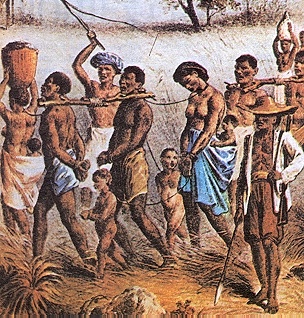
Slavery in the Crusader Kingdoms

The surrender of Jerusalem in 1187 resulted in between twelve and fifteen thousand Christians being taken into slavery. The entire Christian population of Jaffa and many lesser places had already been enslaved. Some historians claim that as many as 100,000 Christians were subjected to slavery as a result of Saladin's conquest of the Kingdom of Jerusalem, although I think a figure of forty to fifty thousand is a more reasonable estimate. Even the lower figure would have represented between 6 and 9 % of the total population. It is important to put this devastating development into perspective. 


Slavery has tragically been part of the human condition for as long as we have recorded history. The Ancient Egyptians, Assyrians, Persians — and Ancient Greeks and Romans — were all slave-owning societies. Slavery persists even today in places like Morocco and other parts of the Sahel but is — to my knowledge — no longer legal anywhere on earth.


However, the infamous black slave trade of the 18th and 19th centuries and the appalling emergence of slave societies in the New World have largely obscured the fact that for nearly a thousand years Christianity had a strong inhibiting effect on slavery in the Western World. From about 600 onwards, Western Europe became increasingly slave-free as the Vikings converted to Christianity and the Reconquista gradually pushed back the Moors in Spain. By about 1,000 AD, across Western Europe from Norway to the frontiers of Christianity in Spain and Prussia it was no longer acceptable to hold Christians as slaves. In Western Europe, slavery was replaced by the far more progressive institution of serfdom that accorded even the lowest strata of society rights and dignity unthinkable for chattel slaves.

The attitude of the Orthodox Church was less rigorous than the Roman Catholic Church, however.  In the Byzantine Empire slaves were common. Although the majority of these slaves were non-Christians, being Slavs and Muslims captured in warfare or purchased from traders who imported them from non-Christian territories, there are records of poor Christians selling their children. This suggests that in a society that tolerated slaves, the possession of Christian slaves was either not wholly prohibited or the prohibition was not enforced. Meanwhile, throughout the Muslim world slavery was widespread and perfectly acceptable without any scruples about the enslavement of fellow Muslims.


The establishment of Western/Latin kingdoms in the Levant, therefore, brought an immediate collision between Western and Eastern practices with respect to slavery -- as well as with respect to the treatment of women. As with women, the crusader kingdoms remained largely true to Western (Latin) traditions, and the enslavement of Christians is not documented among the Latin elite. However, the majority of the inhabitants of the crusader kingdoms had previously been subject to Roman, Arab and Turkish rule — all of which condoned slavery, and thus the Latin settlers found themselves surrounded by slave-owning societies. More important, they soon learned that if they fell into enemy hands and could not raise a ransom, they too would become slaves.

Imad ad-Din’s description of what became of Christian prisoners is eloquent:

…men … had to accustom themselves to an unaccustomed humiliation, and …well-guarded women were profaned, … nubile girls married, and noble women given away, and miserly women forced to yield themselves, and women who had been kept hidden stripped of their modesty, and serious women made ridiculous, and women kept in private now set in public, and free women occupied, and precious ones used for hard work and pretty things put to the test, and virgins dishonored and proud women deflowered, … and untamed ones tamed, and happy ones made to weep!

A 19th Century Western Depiction of Women being Sold in an Arab Slave Market - Victorian Pornography that "cleanses" the reality and disguises the brutality, horror, and misery.
The Arab custom of enslaving captive Christians explains why captured Muslim prisoners were in return often subjected to slavery by their Christian captors.  Thus, as was typical for the crusader kingdoms, a kind of hybrid society in which Western and Eastern customs lived side-by-side emerged.

The custom of keeping captured enemies as slaves, however, had another purpose as well. It provided the Christian kingdoms with a bargaining chip for the release of their own captives. Balian d’Ibelin threatened to kill the five thousand Muslim captives held in Jerusalem if Saladin would not give him terms. Even more famously, the terms of the surrender agreed to between the Muslim defenders of Acre and Richard the Lionheart in 1191 included (depending on source) either the release of all enslaved Christians or the same number of Christians as Muslims who surrendered at Acre (ca. 1,500). It was, according to the old French continuation of William of Tyre, Saladin’s failure to comply with this condition that caused Richard to slaughter the garrison of Acre. Far too many modern historians ignore this factor — the rage and desperation on the part of the relatives of Christian captives that Richard (as commander) was responding to when he ordered the execution of the garrison -- when they judge Richard’s action at Acre.


However, unlike the antebellum South in the U.S., agriculture in the crusader states was carried out predominantly by native peasants and Latin settlers. The former enjoyed a status similar to serfs, which meant they were tied to the land but by no means chattel slaves, while the latter enjoyed even higher status as freemen. Slaves may have provided the labor on sugar plantations, and may also have been used for large building projects, but they did not provide the skilled labor needed in the urban economies that dominated the Latin East. Thus, despite the undeniable existence of Muslim slaves within the crusader kingdoms, the crusader states cannot be considered “slave states” — in sharp contrast to their opponents in Egypt, Syria and the Turkish states.
 
A 13th Century Arab Manuscript that clearly depicts a slave market.
Shamefully, however, the slave trade was a significant component of the trade carried out by the Italian maritime powers operating in the Levant. It was the Italian city-states that dominated the lucrative slave trade, supplying the insatiable demand of Muslim markets for slaves from captives taken in (not yet Christianized) Eastern Europe. Indeed, slaves were one of the three most important imports to the Muslim Middle East along with iron and timber. This trade deserves double condemnation. On the one hand for its inherent inhumanity and, on the other, for contributing directly and significantly to the ability of the Muslim states to wage warfare against the crusader states; Muslim armies of this time relied heavily on Mamluks or slave soldiers.


Dr. Helena P. Schrader holds a PhD in History.
She is the Chief Editor of the Real Crusades History Blog.
She is an award-winning novelist and author of numerous books both fiction and non-fiction. Her three-part biography of Balian d'Ibelin won a total of 14 literary accolades. Her most recent release is a novel about the founding of the crusader Kingdom of Cyprus. You can find out more at: http://crusaderkingdoms.com

Crusader society is described in award-winning:


 Buy now!                                       Buy now!                                   Buy now (paperback)
                                                                                                                or Kindle!

Friday, October 2, 2015

Jerusalem is Lost! The Surrender of Jerusalem 1187

The Damascus Gate of Jerusalem by which some of Saladin's troops would have entered the city.
On Oct. 2, 1187, the gates of Jerusalem opened to admit Salah ad-Din and his army. The most holy city in Christendom, site of Christ’s passion, had been surrendered to the Muslims after 88 years of Christian rule. The surrender of Jerusalem was the inevitable consequence of the devastating defeat of the feudal forces of the Kingdom of Jerusalem at the Battle of Hattin three months earlier. That battle had left Jerusalem defenseless; all fighting men including the knights of the Temple and the Hospital had been called up to halt the invasion that ended in disaster at Hattin, leaving the city itself denuded of troops. Left behind in Jerusalem were non-combatants: women, children, the old and infirm and the clergy. Furthermore, by the time Jerusalem surrendered, these civilian residents of Jerusalem had been joined by as many as 60,000 to 80,000 refugees from other parts of the Kingdom overrun by Saladin’s troops. An estimated 100,000 Christians were in Jerusalem when it surrendered, predominantly women, children and clergy.

What is remarkable about the surrender of Jerusalem in 1187 was not that it surrendered under the circumstances, but that it did not surrender without a fight. Saladin had offered the inhabitants very generous terms. He said he did not want to risk damage to the holy sites in Jerusalem (as was nearly inevitable in a siege and assault) and therefore offered to let the inhabitants leave peacefully with all their portable goods if they would surrender peacefully. But the anonymous “burgesses” who represented the city of Jerusalem in the absence of any noblemen refused. According to the Old French continuation of the Chronicle of William Tyre (widely believed to be based on first-hand accounts) the “burgesses” replied “if it pleased God they would never surrender the city.” Saladin the offered to leave the city alone for roughly six months if they promised to surrender the city at the end of that time, if no reinforcements had arrived. They still refused, saying again “if it pleased God they would never surrender that city where God had shed His blood for them.”[1] This was a clear commitment to martyrdom rather than surrender — perhaps not such a surprising sentiment from a city that at this time must have been dominated by clergy as they would have been the only men of “authority” (read noble birth and education) left in the city.

The "Dome of the Rock" errected over the rock on which Mohammend allegedly ascended into Heaven; it was this monument sacred to Islam that Saladin did not want to risk damaging in a siege and assault.
But Saladin did not enter Jerusalem over the corpses of “martyrs” and their families. He entered it peacefully after a negotiated settlement that ended a week of ferocious fighting.  Ibn al-Athir writes: “Then began the fiercest struggle imaginable; each side looked on the fight as absolute religious obligation. There was no need for a superior authority to drive them on: they restrained the enemy without restraint, and drove them off without being driven off. Every morning the Frankish cavalry made sorties to fight and provoke the enemy to battle; several of both sides fell in these encounters.”[2] Imad ad-Din’s report is (as always) even more melodramatic in his description. According to him, “They challenged [us] to combat and barred the pass, they came down into the lists like enemies, they slaughtered and drew blood, they blazed with fury and defended the city, they fumed and burned with wrath, they drove us back…. They fought grimly and struggled with all their energy, descending to the fray with absolute resolution… they blazed and set fire to things…they made themselves a target for arrows and called on death to stand by them.”[3] Turning to Christian sources, the source considered by scholars the most authentic claims that: “The Christians sallied forth and fought with the Saracens…. On two or three occasions the Christians pushed the Saracens back to their tents.”[4] Women, children and clergy did that? For eight days?


Clearly this was not merely a fanatical but a well-organized defense, and the key to that is one man: Balian d’Ibelin. Balian, Baron of Ibelin, had been one of only four barons to escape the catastrophe at Hattin. At Hattin he had commanded the third largest contingent of troops after the King and the Count of Tripoli, and he, along with the Templars, had been charged with the thankless and gruesome task of commanding the rear-guard in a situation where it was under near continuous attack while on the march. The Templars suffered enormous losses during this march and we must assume that Ibelin did too. Certainly, when he broke out of the trap at Hattin it was with at most 3,000 infantry and a couple hundred knights. These troops, however, he had led to Tyre. His presence in Jerusalem was solitary — the result of a safe-conduct granted him by Saladin so that he could remove his wife and children to safety. The terms of the safe-conduct were that he go to Jerusalem unarmed and remain only one night. On arrival, however, the citizens of Jerusalem and particularly the Patriarch begged him to remain and take command of the defense. This he did.

The inhabitants of Jerusalem and the Patriarch clearly recognized Ibelin’s value. He wasn’t just any baron, he was a man who had played a prominent role in the defeat of Saladin at Montgisard, and had fought at every major battle against Saladin since. Still, he was just one man. He brought not a single additional fighting man to the defense of Jerusalem, and -- on taking stock of what men he had in Jerusalem -- he discovered there was only one other knight in the entire city. This induced him to knight over eighty youths of “good birth,” which was undoubtedly a morale-booster to the individuals honored, but hardly a significant increase in the fighting strength of the defenders!

The Seal of Balian d'Ibelin's son John
So how did Ibelin put up such a ferocious and effective defense with women, children and clergy for 8 days?  We don’t know exactly, however, it is clear Ibelin must have had an exceptional organizational talent and also been a charismatic and inspirational leader. He would have had to organize civilians into improvised units, and then assign these units discrete tasks — whether it was defending a sector of the wall, putting out fires, or ensuring that the men and women doing the fighting were supplied with water, food and ammunition. Most astonishing, his improvised units not only repulsed assaults, they also sortied out several times, destroying some of Saladin’s siege engines, and “two or three times” chasing the Saracens all the way back to the palisades of their camp.

Ibelin must have relied heavily upon women in his defense of Jerusalem. The Old French Continuation of William of Tyre quotes the Patriarch of Jerusalem saying: “For every man that is in this city, there are fifty women and children.” [5] Furthermore, we know from sieges only a few decades later in the Languedoc (notably the siege of Toulouse in which Simon de Montfort was killed) that women could be very active in manning the walls. Unlike Victorian women, medieval women were not known for being delicate and prone to swooning. They were partners in crafts and trades, often had their own businesses, and when it came to this siege they understood perfectly what was at stake: their freedom.

Although hard to see in this medieval depiction, the siege engine that fired the fatal shot against Simon de Montfort was allegedly manned by women.
Notably, the Arab sources never acknowledge this simple fact. First of all, their own women were not in a position to contribute to the defense, so women manning siege engines, pouring boiling oil over the ramparts, or even exposing themselves to danger to bring men (strange men not their husbands, brothers or sons) water, food and ammunition was utterly inconceivable to them.  Secondly, it was considered dishonorable to be killed by a woman under any circumstances, so no one wanted to even contemplate this possibility; it would have disgraced the fallen. Instead, the Arab sources explained the surprisingly spirited and tenacious defense of Jerusalem to phantom survivors of Hattin. Imad ad-Din conjures up no less than “70,000 Frankish troops, both swordsmen and archers”[6] — a fantastic figure more than double the total Frankish army deployed (and destroyed) at Hattin!

After five days of futile assaults on the northwest corner of the city from the Gate of St. Stephen to David's Gates, Saladin had nothing but casualties to show for his efforts. He therefore redeployed opposite the northeast corner of the city. More important, he deployed sappers to undermine the walls.  The sappers were protected by heavy wooden roofs and platforms as well as covering fire. Within three days they managed to dig tunnels under the city walls, and on September 29 a segment of the northern wall roughly 30 meters long collapsed. Although the Christians managed to beat-back the initial assaults sent through the breach, by nightfall it was clear that the city was now no longer defensible.


That night, Ibelin led a last desperate sortie out of the Jehosaphat Gate, probably directed at Saladin’s own tent, which had been set up on the Mount of Olives. The sortie was easily repulsed. As dawn broke on September 30, the remaining inhabitants of Jerusalem, residents and refugees alike, were facing almost certain slaughter. Because they had rejected his generous terms earlier, Saladin had sworn before multiple witnesses that he would take the city by force and spare no one.

Nevertheless, under a flag of truce Ibelin sought a parlay with Saladin. The Sultan met with Ibelin outside the walls of the city, but flatly refused to negotiate. He reiterated his intention to take the city by force. Indeed, while Ibelin and Saladin were speaking, the Sultan’s banners were planted on the northeast corner of the city, and Saladin pointed out that no one negotiated for a city he already possessed. Fortunately for the Christians in the city, the Sultan’s banners were tossed down again; Ibelin could retort that Saladin did not yet possess the city. Ibelin then played his only trump. He told Saladin that if the defenders knew they would be granted no mercy, then they would fight all the harder. Not just that, he said, they would slaughter their own families, the Muslim prisoners/slaves inside Jerusalem, and the livestock, and then they would destroy the holy places — including the Rock sacred to Islam — before sallying forth to certain death intent on taking as many of the enemy to their graves with them as possible.

Jerusalem from the Mount of Olives Today; the Dome of the Rock is visible between the trees.

Saladin, who had already made his desire to preserve the holy places known, capitulated in face of this blackmail. After consulting with this emirs, he agreed to spare the lives of the Christians in Jerusalem, but only on the condition that they bought freedom. After much haggling, it was agreed that each man would have to pay 10 dinar, each woman 5 and each child 2. Those that could not pay this ransom would become the property of the Sultan, slaves.

Ibelin protested that the city was full of refugees, who had already lost everything. According to the Old French Continuation of William of Tyre he argued “In a city such as this there are only a few people apart from the burgesses who could manage [the ransom], and for every man who can pay the ransom there are a hundred who could not redeem themselves even for two bezants. For the city is full of ordinary people who have come from the surrounding area for protection.”[7] After considerable haggling, the Sultan agreed to a lump-sum payment of 30,000 bezants for (varying by source) between 7, 000 and 18,000 Christian paupers.

The Medieval Working-Class would have had difficulty paying the ransom set by Saladin. 
These 30,000 bezants were paid by the Hospital with the money deposited by King Henry II of England, but even so when the 40 days granted the Christians to raise their ransoms were up, some 15,000 Christians were unable to pay and condemned to slavery. Ibelin, appalled, offered to stand surety for them while the ransom was raised, but Saladin refused, although he did “give” 1,000 slaves to his brother and 500 each to Balian and the Patriarch of Jerusalem, so that 2,000 souls were freed at the last minute.

Allegedly, some non-Latin Christians also opted to pay the extra taxes imposed on Christians in Muslim states in order to remain in Jerusalem, but there is no indication that the non-Latin Christians undermined the defense of Jerusalem itself. On the contrary, they appear to have contributed substantially to the defense of Jerusalem as long as the fighting was going on. Only after the city became indefensible as a result of the breach in the wall, did they begin to seek a compromise with their assailants — a perfectly comprehensible reaction that does not imply fundamental hostility to the Latin rulers of Jerusalem.

On November 18, 1187, forty days after the surrender of Jerusalem, the Christians departed Jerusalem, leaving the city in Muslim hands. The news of the fall of Jerusalem allegedly killed Pope Urban III and so shocked the Christian kingdoms in the West that it set in motion the Third Crusade.

The siege and surrender of Jerusalem in 1187 is described in:


                                                                     Buy now!

[1] The Old French Continuation of William of Tyre, translated and quoted The Conquest of Jerusalem and the Third Crusade, by Peter Edbury, p. 55.

[2] Ibn al-Athir, translated and quoted in Arab Historians of the Crusades by Francesco Gabrieli, p. 140-141.

[3] Imad ad Din, translated quoted and translated in Arab Historians of the Crusades by Francesco Gabrieli, p. 154.

[4] Old French Continuation of William of Tyre, translated and quoted The Conquest of Jerusalem and the Third Crusade, by Peter Edbury, p. 56.

[5] Old French Continuation of William of Tyre, translated and quoted The Conquest of Jerusalem and the Third Crusade, by Peter Edbury, p. 58.

[6] Imad ad Din, translated quoted and translated in Arab Historians of the Crusades by Francesco Gabrieli, p. 154.

[7] Old French Continuation of William of Tyre, translated and quoted The Conquest of Jerusalem and the Third Crusade, by Peter Edbury, p. 60.