COPYRIGHT

All content on this blog is protected by copyright.
Content used elsewhere without attribution constitutes theft of intellectual property and will be prosecuted.
Showing posts with label Henry of Champagne. Show all posts

Saturday, October 11, 2025

Re-Establishment of the Kingdom of Jerusalem

  The Third Crusade was over. The Kingdom of Jerusalem now had to survive on its own. Yet tragedy struck almost at once. 


In April 1192, Richard received news that his brother John had allied with Philip II of France and he was at risk of losing his crown and his empire. He announced his decision to return to the West to confront his domestic enemies and asked each man in the army to decide according to his own conscience whether to remain to fight for Jerusalem or not.  The Itinerarium describes what happened next:

When they had discussed this for some time, the wiser of them returned this reply to the royal enquiry: because the country had been devastated by disputes and disagreements, … the most essential thing was to create a new king whom everyone would obey, to whom the country could be entrusted, who would wage the people’s wars and whom the whole army would follow. If this did not happen before King Richard’s departure, they declared they would all leave since they were unable to guard the country by themselves.[i]

Although Richard had long upheld the rights of Guy de Lusignan to the crown of Jerusalem, the course of the Third Crusade had convinced him that Guy was not fit to be king. Therefore, rather than impose him on the barons and commons of Jerusalem, Richard asked the Franks who had fought with him who they wished to be their king. ‘At once all the people, small and great, went down on their knees and begged and implored him to raise the marquis [Conrad Marquis de Montferrat, Queen Isabella’s husband] to be their prince and defender….’[ii] 
 
Richard accepted this decision and sent his nephew Henri Count of Champagne to Montferrat in Tyre with the news of his election. The message delivered, Champagne left Tyre but had only gone as far as Acre when the news overtook him that Conrad had been assassinated. Although attempts were later made to pin the blame on Richard, Saladin and even Humphrey of Toron, the most probably explanation is that Montferrat had offended the Assassins. 
 
Champagne immediately returned to Tyre, probably to verify the truth of this apparently incredible rumor. One version of what happened has captured the popular imagination and been repeated uncritically ever since. Allegedly ‘the people’ of Tyre welcomed Henri with jubilation and proclaimed him king. This has no basis in historical fact. Kings were not elected by ‘popular acclaim’ in the Kingdom of Jerusalem, least of by the citizens of a single city. The High Court, composed of the most important barons and bishops of the realm, elected the kings. The Lyon Continuation of Tyre, which is based in large part on material from Outremer, explicitly states that ‘on the advice of the barons of the Kingdom of Jerusalem,’ Richard nominated his nephew Henri de Champagne as the next king. 
 
While this is undoubtedly closer to the truth, it still ignores an important point. Queen Isabella had already been recognized by the barons and bishops of Jerusalem as Queen. She was very much alive and, indeed, pregnant. All this ‘proclaiming,’ ‘electing’ and ‘nominating’ actually consisted of finding a suitable husband for the widowed queen. Champagne was a 26-year-old bachelor who had been campaigning in the Holy Land more than eighteen months, having come out before the main forces of the Third Crusade. He was a nephew to both the King of England and the King of France, his mother being Eleanor of Aquitaine’s daughter by Louis VII. This made him a diplomatic choice, assuring support from both the French and English. 
 
Medieval chronicles agree, however, that Henri de Champagne was initially reluctant to accept the crown. Acceptance meant he would not be able to return home. The kingdom itself existed more in people’s hearts than in reality. It was threatened on all sides by the armies of Saladin. The crusading force that had established control of the coastline was already disintegrating, and the King of England had announced his intention to return home. Furthermore, if Queen Isabella gave birth to a son, this posthumous child of Montferrat would take precedence over Champagne’s own offspring. It did not look like a very promising proposition to the young Count of Champagne. Yet Henri changed his mind abruptly — according to the Itinerarium because Queen Isabella persuaded him by her grace and beauty. 
 
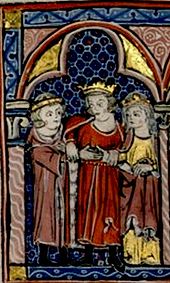
Whatever the exact sequence of events, on 5 May 1192— just eight days after she had been so unexpectedly widowed — Isabella married the Count of Champagne. Henri’s first act as King of Jerusalem was to persuade his uncle the King of England to remain through the campaign season rather than immediately depart for England. This enabled the crusaders to consolidate gains, and with Richard’s dramatic victory at Jaffa, to bring Saladin to the negotiating table. When Richard departed in October, he allegedly promised his nephew that he would return with a new crusading army to continue where he left off when the truce expired. Meanwhile, Henri and Isabella set about re-establishing regular government from a ‘provisional’ capital in Acre. The institutions of government from the High Court down were reconstituted and started to function again. For the moment, at least, the kingdom had been saved.


[i] Anonymous, Itinerarium Peregrinorum et Gesta Regis Ricardi translated by Helen Nicholson as ‘The Chronicle of the Third Crusade’ (Crusades Texts in Translation) [Aldershot: Ashgate, 1997] book 5, chapter 24, 302-3.

[ii] Itinerarium, book 5, chapter 24, 303.


The bulk of this entry is an excerpt from Dr. Schrader's comprehensive study of the crusader states.

Dr. Helena P. Schrader is also the author of six books set in the Holy Land in the Era of the Crusades. The situation in Outremer following the end of the Third Crusade and the creation of the Kingdom of Cyprus is depicted in detail in The Last Crusader Kingdom.


           Buy Now!                                                  Buy Now!                                                    Buy Now!
 

          Buy Now!                                               Buy Now!                                                      Buy Now!

"The Tale of the English Templar" is a fictional work that depicts the destruction of the Knight's Templar. 


An escaped Templar, an intrepid, old crusader, and a discarded bride
embark on a quest for justice in the face of tyranny. 
 
"St. Louis Knight" is a novel set against the backdrop of the Seventh Crusade and St. Louis' sojourn in the Holy  Land. A Templar novice and King Louis are the central characters. 
It is now available in audiobook as well as paperback and ebook.

 
 A crusader in search of faith --
A lame lady in search of revenge --
And a King who would be saint.

St. Louis' Knight takes you to the Holy Land in the 13th century, and a world filled with knights, nobles, prophets -- and assassins. 
(Available in Audiobook)

Thursday, December 29, 2016

The Short Reign and Tragic End of Henry of Champagne


As the consort of Queen Isabella of Jerusalem from May 1192 until September 1197, Henry of Champagne was recognized by the High Court of Jerusalem and by all his contemporaries, domestic and foreign, as the rightful King of Jerusalem ― yet he preferred to call himself the Count of Champagne to the day he died. We can only speculate on whether that preference sprang from humility or a failure to identify with his adopted kingdom. Certainly, Henry of Champagne came to the throne unexpectedly and with little preparation, and had he lived longer, he might well have come to feel more comfortable in his role as King of Jerusalem. But his life was cut tragically short in an accident at the age of 31.
 
His reign started auspiciously. His first act as King of Jerusalem appears to have been to persuade his uncle the King of England to remain through the campaign season rather than depart for England at once. As a result, the crusading army was kept together long enough for a second (albeit equally unsuccessful) attempt on Jerusalem. 

Richard of England then set his mind to regaining the coast between Tyre and Tripoli, a clear means of strengthening Henri’s new kingdom, but Saladin’s sudden assault on Jaffa forestalled him. Richard immediately took a handful of knights in a few ships and set off for Jaffa to stiffen the defense long enough for relief to come by land.  

Henri meanwhile mustered the Army of Jerusalem and started down the coast to relieve Jaffa. When the army found its advance blocked just south of Caesarea by Saladin’s forces, however, Henri followed his uncle’s example and took ship with just a few men for Jaffa ― abandoning his army. It was not a particularly regal or strategic thing to do, but Henri appears to have gotten away with it. The relief of Jaffa was eventually successful, and his ignominious behavior at Caesarea was forgotten.

A month later, a truce had been signed with Saladin lasting three years and eight months or until April 1196. Richard Plantagenet was free to return to his besieged inheritance in the West, taking with him not only the bulk of the crusaders but the enormous shadow he had cast over Henri. Henri was at last in a position to show his merit as a king.

Unfortunately, Henry stumbled at once. Almost immediately after Richard’s departure, the Pisans started attacking shipping going to Acre. Whether this was state-piracy or instigated by the still-embittered deposed-King Guy de Lusignan is not clear. In any case, Henri blamed the Pisan Commune in Acre of abetting their countrymen, and when Aimery de Lusignan, the  older brother of Guy, defended the Pisans, Henri saw a Lusignan plot against him. He ordered Aimery de Lusignan arrested for treason. 

This only had the effect of angering Henri’s vassals and the Masters of both the Knights Templar and the Knights of St. John. Aimery de Lusignan, unlike his younger brother Guy, had been in the Holy land for nearly two decades by this point and he enjoyed the respect of his peers. He had been appointed Constable of the Kingdom by Baldwin IV, long before the catastrophe of Hattin.  Furthermore, and most important, the King of Jerusalem did not have the right to arrest the Constable ― only the High Court did.  Henri was forced to back down, but Aimery (not surprisingly) did not want to remain in a Kingdom ruled by a man who had arrested him unjustly. He surrendered the office of Constable and went to join his brother on Cyprus.

Henry’s next known act is considerably more to his credit. Sometime during the truce with Saladin ca. 1195, King Leo of Armenia seized Prince Bohemond of Antioch during a state visit in revenge for a similar incident years earlier. He demanded the surrender of Antioch to Armenia. Prince Bohemond ordered the surrender (to secure his own release), but the citizens of the city led by his own sons and the patriarch refused to follow his orders. Instead they sent to Henry of Champagne to negotiate the release of the Prince of Antioch on more reasonable terms. Henri appears to have carried out this diplomatic mission successfully, arranging that an Armenian princess marry Bohemond’s heir. 


On his return trip, Henri traveled via Cyprus, where Aimery de Lusignan had not only succeeded his brother as lord of the island but persuaded the Holy Roman Emperor to make him a King. Meeting now as equals, the two men were reconciled, and to symbolize their new friendship (and secure the future of their houses) they agreed that Aimery’s three sons should be betrothed to Henri’s three daughters by Isabella of Jerusalem. 

Henri then returned to his own Kingdom as the truce with the Saracens drew to a close.  Saladin had meanwhile died and his brother al-Adil had successfully eliminated Saladin’s eldest and second sons to seize power for himself in Damascus and Cairo. As the truce ended, he took a large force to attack Acre, evidently seeking to bolster his popularity and support by delivering a victory against the Franks. 

Champagne went out to meet al-Adil with a force composed primarily of German crusaders, who had since arrived in the Holy Land in anticipation of the end of the truce, and the knights and barons of Jerusalem. These proved insufficient to defeat the threat, and Champagne had to call up the commons as well, who then managed to thwart the invasion and send al-Adil back across the border. Little is really known about this engagement, but the Lyon Continuation of William of Tyre gives the entire credit for this victory to a local baron, Hugh of Tiberius, with Champagne simply taking advice. While implausible as written, the account may be indicative of a general feeling among the local barons that Champagne was not a terribly effective battle commander, certainly not comparable to his famous uncle Richard the Lionheart.

 
His death, however, may have contributed to this retroactive assessment of him. On September 10, 1197 Henry of Champagne accidentally fell from a window into a courtyard of the royal palace at Acre and broke his neck. There was no question of foul play. One version says he stepped backwards into the window and lost his balance. Another says he leaned out of the window and the railing gave way. Apparently his jester, a dwarf, either tried to stop him and also lost his balance, or flung himself after him in grief. Either way he allegedly landed on top of Champagne, ensuring his injury was fatal. 

Henry of Champagne left behind three young daughters, the eldest of which died young, and the second of which, Alice, became Queen of Cyprus in accordance with the agreement he had made with Aimery de Lusignan. 

He also left behind an ugly law-suit. Since he had never returned from the Holy Land, his brother Theobold laid claim to the County of Champagne and his sons after him, but Henri’s surviving daughters, Alice and Philippa, challenged their cousins' claim. They argued that as the daughters of the elder son (Henry) they were the rightful heirs to Champagne. 

In an effort to negate Alice and Philippa’s (very valid) claim, Theobold’s sons attempted to argue that Henry’s marriage to Isabella had been bigamous, thereby making his cousins Alice and Philippa illegitimate. The reasoning was that Isabella’s divorce from her first husband Humphrey de Toron had been bogus and so she was still married to him (since he was still alive) at the time of her marriage to Henry. This claim was spurious and never accepted by the courts, but it colored the chronicles (all written in France).  As a result, this court case has left lasting legacy of distorted historiography, which casts Isabella’s divorce from Toron is a lurid light and makes villains of all who supported it -- from Henry himself to Isabella's  mother, Maria Comnena, and her step-father Balian d'Ibelin.


Henry de Champagne is a significant character in “Envoy of Jerusalem,” where his relationship to Isabella is developed and examined.