
In the era of the crusades, there were no border posts with customs agents. There were no mapping agencies or official maps based on
engineering surveys.
There certainly was no GPS.
Where kingdoms met the sea they ended.
Sometimes rivers or other geographical characteristics provided clear and
easily recognizable borders. Yet in the vast landmass of Anatolia and Syria
such features were rare.
So how were borders defined and understood in the
crusader states?
And what impact does this have on our understanding of them?
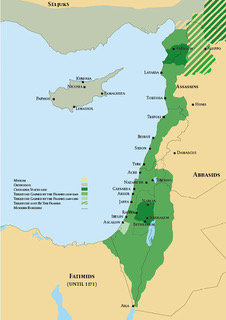
The fundamental fact about medieval borders is that they were less a matter of location than of control. As in Ancient Sparta, political borders were not defined by geography but rather by -- as the Spartans put it -- "the reach of their spears." That is, by the ability of a political power to exert control over a particular territory.
Yet that is only half the equation. Since no state or ruler in the Middle Ages had the capacity to control every cubic yard of territory claimed, the best they could hope for was the submission of the population. Where there were no inhabitants, the land effectively belonged to no man -- no matter who laid claim to it. This was particularly true of the forests of northeast Europe in this period -- and the deserts of the Middle East.
In inhabited areas, in contrast, the political affiliation of any region was defined not so much by geography as by psychology, that is: by whether the inhabitants of a particular region identified themselves as the subjects of one ruler or another. At a simplistic level, a man was the subject of the government to whom he paid his taxes.

Yet in an era where taxes were largely local, i.e. to a feudal landlord, a guild, a city administration, even that was not necessarily a clear indication of identity with a more centralized state/power. Rural populations, in particular, tended to be focused on the immediate vicinity. Peasant mobility was limited by profession, even in the absence of serfdom, and intermarriage within villages or between neighboring villages was the norm. These patterns created over-lapping networks of loyalties to the family, the locality, and the local lord rather than to distant authorities. After all, under feudalism, a man legally owed fealty to his direct overlord not to the crown. In times of conflict, men usually held to their communities, their families and to their lords, even if that meant coming in conflict with a higher feudal authority or the crown itself.
In the Holy land, both the Franks and the Seljuks were outsiders and the loyalty of some local communities to these alien elites was weak at best. Yet, unlike in most of Western Europe, the population too was ethnically and religiously diverse. Rather than sharing ethnic, linguistic and religious identities with their neighbors, villages in Palestine and Syria were fragmented and diverse. In short, the close bonds that usually tied local communities together did not exist to the same degree; neighbors might identify more with different authorities or might feel closer to someone more distant than the family next-door.
Problematic was the fact that the intermingling of Christian and Muslim populations in some regions was so complete that it was not always possible to draw lines based on religious affiliation. Furthermore, if each side had partisans in each village, both sides felt 'entitled' to claiming them -- and initially did. Soon, however, both parties recognized that in some regions the raids and counter-raids destroyed the wealth -- and food supplies -- of both sides.

As a result, in the early twelfth century, Franks and Saracens evolved the practice of revenue sharing in certain border regions. This meant, rather than even attempting to draw a border, the parties agreed to first collect the revenues from everyone -- and then divide them based on an agreed formula. The rationale for the ratio determining how much revenue went to each party varied from treaty to treaty and presumably reflected the relative proportion of Christian versus Muslim inhabitants in the specific locales covered by the treaties.
And yet, assuming that the loyalties of the native population inherently followed religious lines, while convenient and comprehensible, is an over-simplification. In the entire history of the crusader states, there is not a single instance of revolt or uprisings on the part of the local population against the Franks -- despite the fact that a large minority was Muslim, and a majority was not Latin. So loyalty and identification with the Franks evolved even among non-Christians.
Traditionally, this is explained by indifference on the part of a native population used to exploitation by a carrousel of invaders from Alexander the Great onwards. Another explanation is the lower levels of taxation and higher standards of justice under the Franks remarked upon by Ibn Jubayr. However, a third explanation might be that the fluid borders followed the psychological divide between the locals inclined to identify with the Franks and those more inclined to identify with the Seljuks. That is, that the Franks were only able to exert lasting control over regions in which the population -- for whatever reason -- was willing to recognize Frankish authority as legitimate. Again, while there may have been a high correlation between accepting Frankish rule and religion, but it would be wrong to assume this was absolute. Jews, Samaritans and some Muslims, particularly Shia Muslims, may also have preferred Frankish to Seljuk rule for their own reasons.
Nor should the impact of individual personalities be overlooked. In one recorded incident from 1156, the lord of Nablus came in conflict with an imam because the latter's sermons attracted too many peasants, who thereby did not work their fields. The imam responded by emigrating and persuading a number families to follow him. Although there are serious reasons to doubt the veracity of this account (the author claims the lord with whom he clashed as "Baldwin d'Ibelin" -- a man who never held Nablus), it seems plausible that the actions of individuals could cause both immigration and emigration as well as inspire varying levels of loyalty.
The bottom line is that borders were fluid and more psychological than physical.
All my novels set in the crusader state attempt to reflect this reality.


Yet in an era where taxes were largely local, i.e. to a feudal landlord, a guild, a city administration, even that was not necessarily a clear indication of identity with a more centralized state/power. Rural populations, in particular, tended to be focused on the immediate vicinity. Peasant mobility was limited by profession, even in the absence of serfdom, and intermarriage within villages or between neighboring villages was the norm. These patterns created over-lapping networks of loyalties to the family, the locality, and the local lord rather than to distant authorities. After all, under feudalism, a man legally owed fealty to his direct overlord not to the crown. In times of conflict, men usually held to their communities, their families and to their lords, even if that meant coming in conflict with a higher feudal authority or the crown itself.
In the Holy land, both the Franks and the Seljuks were outsiders and the loyalty of some local communities to these alien elites was weak at best. Yet, unlike in most of Western Europe, the population too was ethnically and religiously diverse. Rather than sharing ethnic, linguistic and religious identities with their neighbors, villages in Palestine and Syria were fragmented and diverse. In short, the close bonds that usually tied local communities together did not exist to the same degree; neighbors might identify more with different authorities or might feel closer to someone more distant than the family next-door.
Problematic was the fact that the intermingling of Christian and Muslim populations in some regions was so complete that it was not always possible to draw lines based on religious affiliation. Furthermore, if each side had partisans in each village, both sides felt 'entitled' to claiming them -- and initially did. Soon, however, both parties recognized that in some regions the raids and counter-raids destroyed the wealth -- and food supplies -- of both sides.

As a result, in the early twelfth century, Franks and Saracens evolved the practice of revenue sharing in certain border regions. This meant, rather than even attempting to draw a border, the parties agreed to first collect the revenues from everyone -- and then divide them based on an agreed formula. The rationale for the ratio determining how much revenue went to each party varied from treaty to treaty and presumably reflected the relative proportion of Christian versus Muslim inhabitants in the specific locales covered by the treaties.
And yet, assuming that the loyalties of the native population inherently followed religious lines, while convenient and comprehensible, is an over-simplification. In the entire history of the crusader states, there is not a single instance of revolt or uprisings on the part of the local population against the Franks -- despite the fact that a large minority was Muslim, and a majority was not Latin. So loyalty and identification with the Franks evolved even among non-Christians.
Traditionally, this is explained by indifference on the part of a native population used to exploitation by a carrousel of invaders from Alexander the Great onwards. Another explanation is the lower levels of taxation and higher standards of justice under the Franks remarked upon by Ibn Jubayr. However, a third explanation might be that the fluid borders followed the psychological divide between the locals inclined to identify with the Franks and those more inclined to identify with the Seljuks. That is, that the Franks were only able to exert lasting control over regions in which the population -- for whatever reason -- was willing to recognize Frankish authority as legitimate. Again, while there may have been a high correlation between accepting Frankish rule and religion, but it would be wrong to assume this was absolute. Jews, Samaritans and some Muslims, particularly Shia Muslims, may also have preferred Frankish to Seljuk rule for their own reasons.
Nor should the impact of individual personalities be overlooked. In one recorded incident from 1156, the lord of Nablus came in conflict with an imam because the latter's sermons attracted too many peasants, who thereby did not work their fields. The imam responded by emigrating and persuading a number families to follow him. Although there are serious reasons to doubt the veracity of this account (the author claims the lord with whom he clashed as "Baldwin d'Ibelin" -- a man who never held Nablus), it seems plausible that the actions of individuals could cause both immigration and emigration as well as inspire varying levels of loyalty.
The bottom line is that borders were fluid and more psychological than physical.
All my novels set in the crusader state attempt to reflect this reality.


