COPYRIGHT

All content on this blog is protected by copyright.
Content used elsewhere without attribution constitutes theft of intellectual property and will be prosecuted.
Showing posts with label Sixth Crusade. Show all posts

Saturday, November 15, 2025

The Templars and the Excommunicated Emperor

The so-called "Sixth" Crusade was undertaken by a man under a ban of excommunication and against the explicit orders of the pope.  Yet most modern commentators consider the crusade "successful" and ridicule the medieval opponents of Frederick Hohenstaufen -- including the Knights Templar -- as bigots and fanatics. The situation was in fact highly complex and the Templar opposition to the Hohenstauffen was far from groundless.


Frederick II Hohenstaufen first “took the cross” and vowed to lead a new crusade to regain Christian control of Jerusalem at his coronation as “King of the Romans” in Aachen on July 25, 1215.  Five years later at his coronation in Rome as “Holy Roman Emperor” he renewed his crusading vows. However, a Muslim insurrection on Sicily turned out to be more difficult to suppress than anticipated, and Frederick got bogged down in the fighting until 1223 ― by which time the Fifth Crusade, which he had promised to support was irretrievably lost. The Pope showed understanding, however, and agreed he could postpone his crusade until 1225.

When 1225 came, Frederick still did not set off on crusade, but he did marry the heiress to the Kingdom of Jerusalem, Yolanda (also sometimes referred to as Isabella II). This marriage meant that in addition to the spiritual motive of restoring Christian rule over Christendom’s most sacred site, Frederick now had a personal and dynastic interest in Jerusalem: he wanted to make his new kingdom as large, strong and prosperous as possible ― or that was what people presumed.  


In the summer of 1227, Frederick at last assembled a large army ― only to see this decimated by an epidemic disease that started killing the crusaders before they even embarked. Under threat of excommunication if he did not depart, Frederick doggedly set sail despite being ill. While at sea, the most important of Frederick’s subordinate commanders, the Landgraf of Thuringia, died of the disease. Frederick decided that he too was too ill to command a crusade. While ordering the Grand Master of the Teutonic Knights and other galleys under the Duke of Limburg to proceed, he returned to Brindisi. The Pope, the vigorous and uncompromising Gregory IX, promptly excommunicated the Holy Roman Emperor.

Under the circumstances, the excommunication was hardly justified. Rather, the excommunication was Pope Gregory’s opening volley in an all-out attack on what he viewed as the unacceptable infringement of papal authority by the Holy Roman Emperor. It was the opening act of a power-struggle that would last for decades and pitted conflicting philosophies about the respective role of sacred and secular leadership.

That struggle is not the subject of this essay, but the impact of the communication on Frederick’s authority is.  Effectively, with the excommunication, Frederick’s campaign to the Holy Land lost papal blessing (whether fairly or not), and his campaign could not officially be viewed as a “crusade.”  Furthermore, the excommunication gave his many internal opponents and rivals an excuse for insubordination and rebellion, and meant that Fredrick’s Italian domains were soon being stolen from him by troops with papal support. Most important from the Templar point of view: as Christians and vassals of the pope, they were now prohibited, at the risk of the souls, from having contact with the Holy Roman Emperor. It was, to say the least, a very awkward situation!

The situation was further complicated by the fact that in May 1228, Queen Yolanda of Jerusalem died of the complications of childbirth. She left an infant son Conrad as heir to the throne of Jerusalem. As a result, Frederick could no longer call himself “King of Jerusalem;” at best he could claim the regency for his infant son.

Under the circumstances, Frederick would have been justified in abandoning the campaign to the Holy Land altogether and focusing on defending his birthright. Then again, when fighting an intransigent pope, what better way to undermine papal authority than to liberate the Holy City? The liberation of Jerusalem was bound to appear in the eyes of many (or so Frederick appears to have reasoned) as divine favor and vindication. Furthermore, Frederick had good reason to believe he would liberate Jerusalem because he had already been approached by the Sultan of Egypt, al-Kamil, who offered to deliver Jerusalem to him in exchange for the Emperor’s support in his war against his brother the Sultan of Damascus al-Mu’azzam.

So Frederick II went ahead with his plans for a crusade and in June 1228 set sail with his army, arriving in Tyre on September 3 and Acre later the same month.  Here he was welcomed ― at least according to some accounts ― as a savior by both the Knights Templar and Hospitaller. (Roger of Wendover, Vol II, p. 351) If so, his relations with the military orders, particularly the Templars, soon soured.

The tensions either started or surfaced when the Holy Roman Emperor laid claim to the Templar castle on Athlit, just south of Haifa, called “Castle Pilgrim.”  This castle had been built at great expense by the Templars just ten years earlier. It was the Templar equivalent of Krak de Chevalier ― a massive castle that proved completely invincible and never fell to siege or assault. (It was abandoned when the Christian cause became hopeless.)  It could accommodate 4,000 defenders and its walls enclosed not just fighting platforms, accommodation, chapels and storerooms, but pastures and fishponds, orchards and gardens, salt-mines, a shipyard, and freshwater springs. 


Castle Pilgrim Today - Photo Courtesy of Shalom Holy Tours

By what right the Holy Roman Emperor believed he could lay claim to this castle remains mysterious. He was not King of Jerusalem (his infant son was) and even had he been recognized as regent, the Kings of Jerusalem did not have any legal authority over the Knights Templar. Barber notes that Frederick had a policy of “monopolizing castles in the Kingdom of Sicily.” (Barber, p. 133) Which is all very well and good, but still does not justify confiscation of a castle held by an independent order in a Kingdom with completely different laws (as Frederick was soon learn).

The Templar response to the Emperor’s arrogant attempt to lay claim to something that was not his was predictable: they closed the gates and manned the walls. Frederick II was forced to recognize he could not possibly take the castle by force and resumed his “crusade” instead. Meaning, he unimaginatively followed the same plan as Richard the Lionheart by taking his army down the coast to Jaffa. The difference was that while Richard the Lionheart had to fight his way forward every mile of the way against the aggressive and well-led armies of Saladin, Frederick II faced no Muslim opposition at all. The Sultan of Egypt al-Kamil was too busy besieging his nephew (his brother had since died) in Damascus.
Furthermore, while the Templars and Hospitallers had willingly submitted to the leadership of Richard the Lionheart, acting as his vanguard and rearguard respectively, the militant orders could not submit to Frederick II, who was excommunicate. Yet they could not allow Frederick (and the Teutonic Knights) to march without them either. Robinson puts it like this: “Could the Templars live with themselves if they allowed Christians to be butchered while they simply stood by? And what if Frederick, either through battle or bargaining, could actually regain the Holy City?” (Robinson, p. 262) The Templars and Hospitallers (commanded, incidentally, by two brothers Pedro and Guerin de Montaigu) elected to “follow” the Emperors army a day’s march behind. By the time the armies reached Arsuf a compromise was devised: the Holy Roman Emperor issued orders in the name God or Jesus Christ rather than his own.

The fragile rapprochement was shattered, however, when on February 18, 1229 Frederick announced a truce negotiated in secret with the Sultan al-Kamil. This truce, hailed by many modern commentators as a work of genius, a master-stroke, and more, was condemned soundly by Frederick’s contemporaries ― and for good reasons. First, it did not (as most accounts today claim) restore Christian control of Jerusalem ― rather it loaned them control of the city for a set period of just ten years and ten months. Second, it prohibited the fortification of Jerusalem ― to ensure that control would return to the Muslims at the end of the ten year truce (loan). Third, it forbade the military orders from reinforcing or improving their great castles in the county of Tripoli, e.g. Krak de Chevaliers, al-Marquab, Chastel-Blanc and Tortosa. Fourth, it prohibited the Christians from attacking al-Kamil in his home base of Egypt. Finally, most infuriating for the Knights Templar, it denied them access to their traditional headquarters in the “Temple of Solomon” because the entire Temple Mount was reserved for the Muslims.


The Christian world was shocked by the Emperor’s duplicity in negotiating away their interests without so much as consulting them. When the Holy Roman Emperor announced his intention to wear his crown in the Church of the Holy Sepulcher the Patriarch of Jerusalem put his own city, the Holy City of Jerusalem, under interdict.

That did not interest Frederick Hohenstaufen in the least. After all, he’d already be excommunicated. He went ahead and placed his crown on his own head while the loyal Master of the Teutonic Knights eulogized him in a speech. The other militant orders, however, respected the interdict and were not present any more than the local barons and citizens were.

The Holy Roman Emperor’s mentality is further revealed by the following incident recorded by the Muslim contemporary historian ibn Wasil and related in Abulafia’s biography of Fredrick as follows:  

…after Frederick’s first night in Jerusalem the emperor is said to have complained to [his host] Shams ad-Din saying “O qadi, why did the muezzins not give the call to prayer in the normal way last night?” To which Shams ad-Din replied: “This humble slave prevented them, out of regard and respect for your Majesty.” But Frederick is supposed to have said: “My chief aim in passing the night in Jerusalem was to hear the call to prayer given by the Muezzin, and their cries of praise to God in the night.” (Abulafia, p. 185)
If that weren’t enough, Friedrich next reproofed a priest for carrying a Bible while visiting the Temple Mount and threatened with death anyone who followed this priest’s example. This behavior gave credence to the Pope’s hostility, making more and more people believe that Frederick’s “crusade” had been a sham from the start and that Frederick was indeed a godless atheist.

The Temple Mount Today - Photo by the Author
 
His behavior did not even win him friends in Muslim circles. As Abulafia puts it:
 
…the Muslim sources, greatly confused by Frederick’s behavior, saw him as an emperor whose interest in the recovery of Jerusalem was rather meager, and whose sympathy for his own religion was surprisingly ― indeed scandalously ― slight… For the Muslims, ‘it was clear that he was a materialist and that his Christianity was simply a game to him.’ This they found offensive, on the Islamic principle that adherents of each Religion of the Book must observe its prescribed principles correctly. (Abulafia, p. 185-186)
 
After just two nights in Jerusalem, the Holy Roman Emperor returned to Acre ― only to find the Templars and the Patriarch of Jerusalem trying to gather troops for a new crusade on the grounds that Frederick’s truce was a personal one between himself and al-Kamil (as indeed it was!) and that they were not bound by it ― any more than the supporters of the Sultan of Damascus were.  (Who, incidentally, saw the truce in the same light: as an insult that he did not have to respect.)

Fredrick at once went on the offensive against the Templars. In addition to railing against them publicly, he started a slander campaign that echoed down the ages to this day. He may also have ordered the kidnapping of the Master of the Temple with the intent of taking him back to Sicily in chains. This, at any rate, is the allegation of the contemporary historian Philip of Novare, who was an eye-witness of this curious crusade, albeit a staunch partisan of the Ibelins. (The latter had fallen fowl of the Holy Roman Emperor and were to lead a successful revolt against his rule in Outremer.)  Novare writes the following:

The emperor was by now unpopular with all the people of Acre, especially was he disliked by the Templars; and at this time there were many valiant brothers of the Temple, and the master was Brother Peter de Montaigu… The emperor did much that seemed evil, and he always kept galleys under arms, with their oars in the locks, even in winter. Many men said that he wished to capture the lord of Beirut, his children…[and]the master of the Temple … and that he wished to send them to Apulia. On one occasion they said that he wished to kill them at a council to which he had called and summoned them, but they became aware of it and came in such strength that he did not dare do it. (Novare, pp. 89-90)

Through his own propaganda machine, Frederick made counter claims that the Templars and Hospitallers wanted to assassinate him.  It is impossible at this distance of space and time to know the truth. Undisputable, however, is the fact that Frederick laid siege to the Templar castle in Acre at the end of April 1229. He also allegedly posted cross-bowmen at strategic places to cut off the Templar’s communication with the outside world. The emperor’s action against the Temple at Acre was as unsuccessful as his attempt to seize Castle Pilgrim.

On May 1, Frederick Hohenstaufen left Acre to sail back to his homeland, which was under attack by papal forces led by father-in-law, the former King of Jerusalem John de Brienne. To reach his galley in the harbor, he chose to pass down the Street of the Butchers. It was a mistake. As the Holy Roman Emperor passed, the common people of Acre pelted him with refuse and offal.

Back in his Kingdom of Sicily he took his revenge by confiscating all the properties of the Templars and Hospitallers within his domains. Although the Pope negotiated the return of these properties to the respective orders in the Treaty of San Germano, July 1230, the properties had still not been returned by 1239, and this was one of the reasons given for a second ex-communication of Frederick in that year. Meanwhile, in the Holy Land, the Templars supported the baronial opposition to Frederick’s authoritarian government throughout the next fifteen years.

Sources:

Abulafia, David. Frederick II: A Medieval Emperor. Oxford University Press, 1988.
Barber, Malcolm. The New Knighthood: A History of the Order of the Temple. Cambridge University Press. 1994.
Howarth, Stephen. The Knights Templar. Barnes & Noble Books, 1993.
Novare, Philip. The Wars of Frederick II against the Ibelins in Syria and Cyprus. Translated by John Le Monte. Cambridge University Press, 1936.
Pernoud, Regine. The Templars: Knights of Christ. Translated by Henry Taylor. Ignatius Press, 2009.
Robinson, John J. Dungeon, Fire and Sword: The Knights Templar in the Crusades. Michael O’Mara Books, 1991.
Roger of Wendover. Liber qui dicitur Flores Historiarum, Vol. II Edited by H.F. Hewlett. London, 1887.
 
"The Tale of the English Templar" is a fictional work that depicts the destruction of the Knight's Templar. 


An escaped Templar, an old knight, and a discarded bride embark on a quest for justice in the face of tyranny. 


"St. Louis Knight" is a novel set against the backdrop of the Seventh Crusade and St. Louis' sojourn in the Holy  Land. A Templar novice and King Louis are the central characters. 
It is now available in audiobook as well as paperback and ebook.
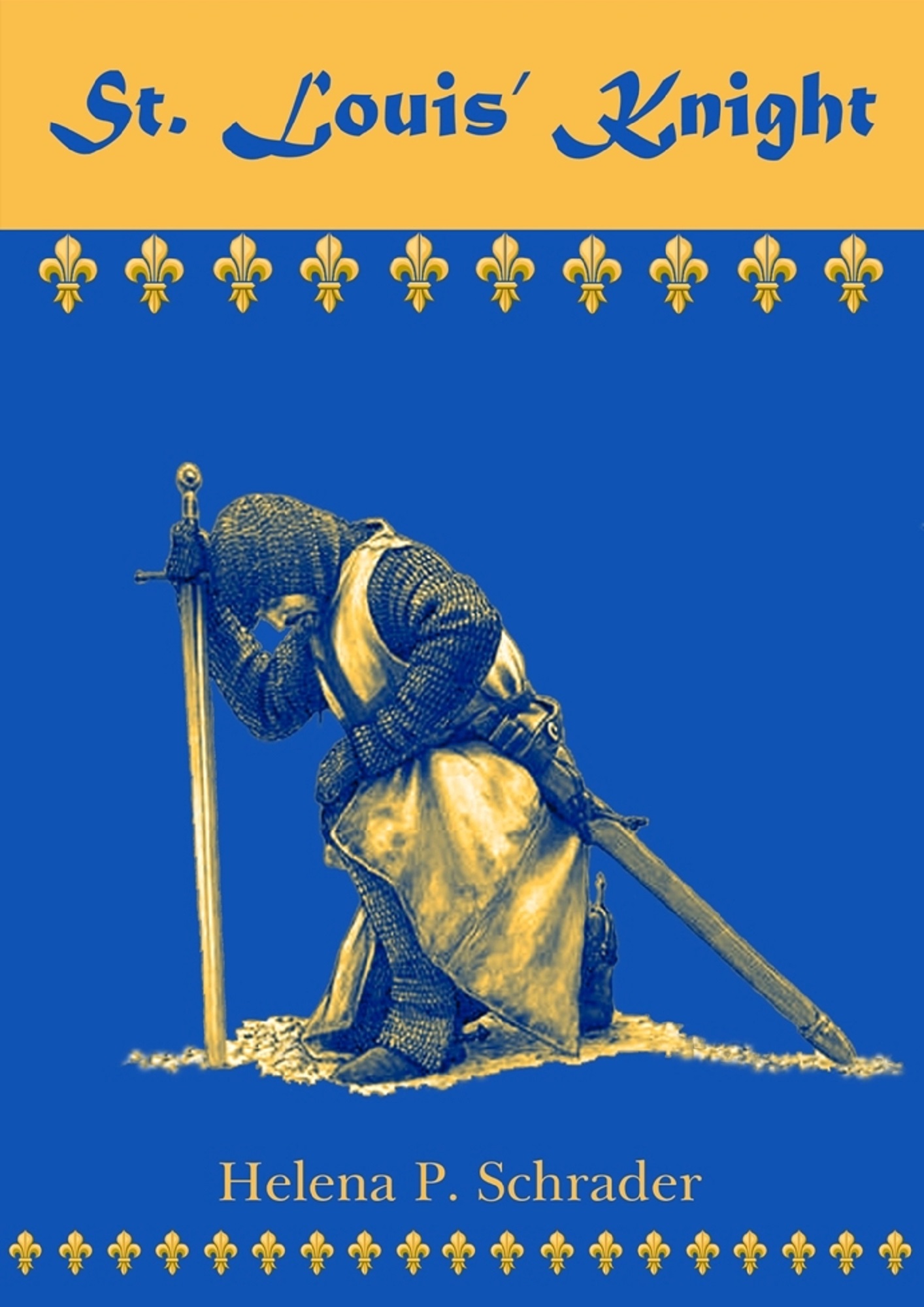
 
 A crusader in search of faith --
A lame lady in search of revenge --
And a King who would be saint.

St. Louis' Knight takes you to the Holy Land in the 13th century, and a world filled with knights, nobles, prophets -- and assassins. 
(Available in Audiobook)
 
The Knights Templar were at the height of their popularity in the late 12th century and appear in my novels set in this period. 


 Buy now!                                                           Buy now!                                                            Buy Now!

Saturday, May 9, 2020

Balian of Beirut: Part I

 Balian of Beirut died as regent of the Kingdom of Jerusalem, and he had been the man to capture the last Imperial bastion, Tyre. Throughout his adult life, he had been an ardent supporter of his father’s struggle for the Rule of Law in Outremer and took over the leadership of the baronial opposition to Hohenstaufen rule at his father’s death in 1236. Yet, he had a decidedly different temperament and personality from his father and grandfather. What follows is a biography in two parts.


Balian first enters the historical record on the (unnamed) day of his knighting. Interestingly, Novare notes that he and his younger brother Baldwin were knighted jointly, suggesting that either Balian’s knighting was delayed or his brother’s was moved forward — or both. The knighting of a lord’s eldest son was always celebrated more or less lavishly, and a lord was often allowed to levy special taxes to help finance the occasion. Knighting two sons at once was a means of getting the most out of that expenditure. More significantly, the entire event was held in Cyprus rather than in Balian’s future lordship of Beirut.  At the time of the knighting (ca. 1224), Beirut’s younger brother Philip was acting regent of Cyprus for the child king Henry I.  The fact that Balian was knighted on Cyprus suggests that he had served his apprenticeship as a squire with his uncle in Cyprus. The event was marked by great celebrations lasting several days and including jousting, plays, and other games. Unfortunately, it was in one such game that Sir Amaury Barlais believed he had been cheated by a certain Sir Toringuel, a charge that eventually led to attempted murder and exile, and contributed to the tensions that eventually erupted in civil war. (See: Seeds of Civil War).


While Balian had no role in this drama aside from being the cause of the celebration, his father tasked him with escorting Barlais out of the Kingdom of Cyprus. It was a delicate mission for one so young, and subsequent events suggest that he may not have handled it all too well. Then again maybe nothing he could have done would have convinced Barlais that the Ibelins were not his enemies.


Balian’s next historical appearance was more fateful. In 1228, when the Holy Roman Emperor arrived on Cyprus on his way to Syria, he sent avowals of his great love and respect for his “dear uncle” of Beirut (i.e. uncle of his deceased Empress Yolanda) and invited him and all his sons to a banquet. Balian and one of his brothers (sources differ on whether it was Baldwin or Hugh) were singled out for the greater “honor” of serving the Emperor at the table, “one with the cup and the other with the bowl.”[i] As related in The Emperor’s Banquet, Frederick II used the occasion (when his guests were unarmed and he had hundreds of armed men surrounding them) to attempt to extort money from Beirut.  When the latter refused to cave-in without a judgment of the court, Frederick took twenty hostages, including both of Beirut’s sons. They were to serve as assurances that Beirut would appear before a court. Again, Balian is here an object rather than an actor.


He was a victim next. Novare records that Balian and his brother were “put in pillories, large and exceedingly cruel; there was a cross of iron to which they were bound so that they were able to move neither their arms nor their legs….”[ii] Note: they were hostages for their father’s good behavior; the Emperor had not so much as accused them of committing a crime — much less proven that they were guilty of wrong-doing. Furthermore, Balian and his brother were not released until weeks later. Novare notes that the Ibelin sons “had endured so long an imprisonment on land and in the galleys at sea and were so miserable that it was pitiful to behold them.”[iii]


Despite this, Novare claims that after his release, Balian joined the Emperor’s household “willingly and amiably.” This is a little too much “goodness and light” in the opinion of historians. Peter Edbury’s far more logical interpretation is that Balian remained a hostage — albeit under better conditions.[iv] That the Emperor considered holding Balian the best means of coercing his father is clear from Novare’s report which puts the following words into the Emperor’s mouth: “I well know that Balian is your very heart and so long as I have him I shall have you.”[v]


Yet again, he was not the only hostage. The Emperor released Baldwin (or Hugh) but insisted that Beirut’s fourth son John, a youth of no more than 13 or 14, join his household as a squire. Clearly he was a second hostage, and one can only speculate why Frederick preferred the younger son over the older hostage Baldwin/Hugh.  Surprisingly, John ingratiated himself so well with the Emperor that he was offered a fief in Italy (Foggia). Balian, on the other hand, remained an inveterate opponent of the Hohenstaufen — something wholly understandable after having been tortured for nothing.


Henceforth, Balian is found at the forefront of the struggle against the Emperor. He sailed with his father in June 1229 to Cyprus and at the Battle of Nicosia, after his father had been unhorsed and isolated and his uncle slain, it was Balian who rallied the knights of Ibelin and led a decisive charge that put their enemies to flight. (See: Battle of Nicosia).


He was also active in the siege of St. Hilarion, at one point when a sally from the castle had over-run the Ibelin camp, “Sir Balian came… recovered the camp, and, spurring up to the gate of the wall, broke his lance on the iron of the wall gate.”[vi] At another point, when Novare himself was badly wounded before the castle, Balian “succored him and rescued him most vigorously.”[vii] Even taking into account Novare’s bias and affection for his “compeer” Balian, it would appear that by Beirut’s heir, now about 22 years old, was developing into an exceptionally bold knight.


It was probably at this juncture, after the defeat of the five imperial baillies but before the expedition of Riccardo Filangieri in 1231, that Balian married Eschiva de Montbèliard. Eschiva was the daughter and heiress of Walter de Montbèliard, the former Regent of Cyprus (1205-1210), and his wife Burgundia de Lusignan; her maternal grandparents were Aimery de Lusignan and Eschiva d’Ibelin. She had married sometime before 1229 Gerard de Montaigu, a nephew of both the Templar and Hospitaller Masters, Pedro and Guerin de Montaigu respectively, and also the nephew of the Archbishop of Nicosia, Eustorge de Montaigu.  Gerard had been killed in the Battle of Nicosia (July 14, 1229), fighting on the Ibelin side. The traditional year of mourning would have ended in July 1230, making the second half of 1230 the most probably date of the wedding.


Because Balian and Eschiva were cousins (Balian’s uncle Philip had married Eschiva’s aunt Alys, the sister of her father) they needed a dispensation from the pope for their marriage. However, this appears to have been lacking. Because it was lacking, Edbury states that the Archbishop of Nicosia excommunicated them and was then “hounded…out of his province” to take refuge in Acre.[viii] According to other sources, a papal excommunication was issued on March 4, 1231, however, in Cyprus at this time the year started on March 25, so a date of March 4, 1231 in Cypriot chronicles corresponds to March 4, 1232 in today's reckoning.*


Most probably, Nicosia (an uncle of Eschiva’s deceased husband and possibly offended by her desire to remarry so soon) threatened an excommunication. Something (probably intimidation from Balian and his friends) induced him to flee to Acre before he could implement it. At that point, Nicosia may have appealed to the Papal Legate and Patriarch of Jerusalem, but the latter — owing much to the Lord of Beirut and being a bitter opponent of Frederick II — did nothing. So Nicosia appealed over the Patriarch’s head, directly to the pope. The latter then issued the excommunication in March of 1232, the news reaching Outremere only shortly before the Battle of Argidi.


In any case, we know that in the fall of 1231, the Lord of Beirut entrusted his heir with holding the key port of Limassol against the Emperor’s fleet with some 600 knights and roughly 3,800 other fighting men on board. These men under the Imperial Marshal Riccardo Filangiere had been sent to re-establish imperial rule on Cyprus. Balian was so successful (despite having few troops at his disposal) that Filangieri opted not to force a landing at all. Instead, the imperial ships sailed across to Syria, where Filangieri promptly took the city of Beirut — but not the citadel.


The citadel of Beirut was well-provisioned with supplies and water, but Beirut had reduced the garrison to a minimum to concentrate his fighting men on Cyprus. Now it faced a siege with woefully inadequate manpower. Beirut, who was still on Cyprus, recognized the peril his castle was in and appealed to the King of Cyprus to aid him in recovering his city and relieving his castle. The King of Cyprus not only agreed but called up the entire army of Cyprus.


Delayed by storms and bad weather, however, it was the spring of 1232 before the Ibelin army reached Beirut. It was rapidly apparent that the Ibelin forces were too weak to dislodge the Imperialists, so the next best option was to send men through the Imperial blockade to reinforce the garrison. Roughly 100 men (knights, sergeants and squires) volunteered for this dangerous mission, and Balian expected to be entrusted with it. Instead, Beirut chose his younger brother Johnny — much to Balian’s outrage. Why? There is no mention of displeasure or excommunication. Rather, Beirut blandly announced that he had “greater need” for Balian “without than within.”[ix] In other words, young John was expendable; Balian was not.


Short term, Beirut wanted his heir to undertake a diplomatic mission to win the Prince of Antioch to the Ibelin cause. Antioch, however, appears to have doubted the Ibelin’s chances of success in their rebellion against the most powerful monarch on earth and preferred not to anger the Hohenstaufen. Balian found himself isolated and cut off, as Antioch refused him permission to return to the Kingdom of Jerusalem. Balian’s frustration and determination to rejoin his father can be measured by the fact that he contracted with the Genoese to bring two ships from Cyprus to take him off, and when they were disabled by Antioch, he sought a safe-conduct from the Sultan of Damascus so he might pass through Saracen territory and from there to Acre to join his father.


As fate would have it, he did not need to make use of this safe-conduct. The Lord of Beirut had persuaded the Genoese of Acre to aid him and obtained so much support from his peers that the Imperial forces feared a confrontation. They abandoned Beirut and withdrew to Tyre, which was Imperialist in sentiment. Balian coming south from Antioch was the first Ibelin to reach Beirut after the siege was lifted. He found the citadel badly damaged but was greeted with great joy by his younger brother John and the rest of the garrison. Because he remained in Beirut, he was not present at the debacle of Casal Imbert, where his brothers Baldwin, Hugh and Guy, were humiliated and defeated in a surprise night attack.


However, encouraged by their success at Casal Imbert, the Ibelin’s inveterate, old opponent Amaury Barlais led Imperial mercenaries back to Cyprus and seized control of the entire island in the Emperor’s name. According to Novare, the Imperialist return had been so sudden that:


“most of the ladies and damsels and children of Cyprus were … not able to go to [the fortress of St. Hilarion] and so they took refuge in the churches and houses of religion, and many there were who took refuge and hid in the mountains and caves. These ladies dressed themselves as shepherdesses and their children as shepherds’ children, and these women went to glean the grain which was there and on this they lived, both themselves and their children, in such great misery that it is pitiful to relate.”[x]


Notably, Balian’s wife was not one of those who took refuge in a church or disguised herself as a shepherdess. Eschiva de Montbèliard, Novare tells us, “… dressed in the robes of a minor brother and…mounted a castle called Buffavento…[and] she provisioned it [Buffavento] with food, of which it had none.”[xi]


Meanwhile, Novare tells us dramatically,


“The Langobards…committed all the abominations and outrages and villainies of which they knew and were capable. They broke into the churches and the Temple and the house of the Hospital and all the religious houses, and they dragged the ladies and the children who clung to the altars and to the priests who chanted Masses….They put the ladies and children into carts and on donkeys most shamefully and sent them to [Kyrenia] to prison.”[xii]


The King of Cyprus could not allow these conditions to reign in his kingdom and he hurried back with the Cypriot host. He had come of age on May 3, during the Battle of Casal Imbert, and he led his army, but he wisely left the command to the experienced Lord of Beirut.


And Balian? He joined his father directly from Beirut, as the Cypriot army sailed up the coast of the Levant from Acre. The Cypriots made landfall at Famagusta that was strongly garrisoned by Imperial forces. They therefore landed on an island off the coast connected by a ford at low tide. They were able to off-load men and horses out of range of the Imperial forces. During the night small boats were sent into the city by cover of darkness, causing great confusion among the enemy. Frightened into thinking they were outnumbered, the Imperial forces set fire to their ships and pulled out. Throughout this operation there is no mention of Balian, suggesting that he was indeed in “disgrace” at this time. This would have been consistent with a March 1232 excommunication.


The King of Cyprus advanced unopposed to his capital. The Imperial forces chose to make a stand across the road from Nicosia to Kyrenia. They chose a strong position on the flank of the steep mountain range that cuts Nicosia off from the coast. The Imperial forces were drawn up on the slope and had the tactical advantage. All they really had to do was wait, but over-estimating their own strength they threw this advantage away. They charged the Cypriots. And Balian? This is what Novare, who was present at the battle, has to say:


Sir Balian, his son, had always in this war led the first troop. At this time [Beirut] made [Balian] come before him and demanded that he swear to obey the command of the Holy Church, for he was under sentence of excommunication because of his marriage. [Balian] replied that he could not accede to this request. The noble man [Beirut] … said: “Balian, I have more faith in God than in your knighthood, and since you do not wish to grant my request, leave the array for, and it please God, an excommunicated man shall never be a leader of our troop.”[xiii]


Balian disobeyed. 

 More than that, as Novare tells us:


“…he escaped and went to the first rank where were his brother Sir Hugh and Sir Anceau; he gave them advice and showed them that which he knew to be of advantage, and then he left them and placed himself before them to the side. He had but few men who were with him, for at that time there were only five knights who would speak to him, all the others having sworn to respect the command of Holy Church…


“When the advance guard of the first company of Langobards approached the division of my lord of Beirut and the king, Sir Balian spurred through a most evil place, over rocks and stones, and went to attack the others above the middle of the pass. So much he delayed them and did such feats of arms that no one was able to enter or leave this pass…Many times was he pressed by so many lanes that no one believed that he would ever be able to escape. Those who were below with the king saw him and knew him well by his arms and each of them cried to my lord of Beirut: “Ah, Sir, let us aid Sir Balian, for we see that he will be killed there above.” [The Lord of Beirut] said to them: “Leave him alone. Our Lord will aid him, and it please Him, and we shall ride straight forward with all speed, for if we should turn aside we might lose all.”[xiv]


The Cypriot forces were eventually victorious and chased the Imperial troops up and over the mountain to Kyrenia. Here the survivors, including the leaders of the Imperial faction, took refuge in the powerful fortress on the shore.  Because the Cypriots lacked a fleet, however, the leaders of the Imperial party were able to sail from Kyrenia to safety. Barlais, Bethsan, and Gibelet sailed to Italy where they were received by the Emperor and rewarded with Italian fiefs. Filangieri sailed for Tyre, where he continued to assert his claim to be Baillie of Jerusalem. Nevertheless, a strong garrison held the castle of Kyrenia for the Emperor, and the Ibelins were forced to besiege it.

The siege was bitter with treason on both sides. Sir Anceau de Brei, one of the Ibelin’s staunchest and most colorful supporters, was wounded in the thigh by a crossbow and died some six months later of the infection. The Queen of Cyprus, Alice of Montferrat, who had sided with the Langobards and put herself in the castle of Kyrenia of her own free will, died of illness during the siege. At one point, Balian is reported leading an assault on the city that was fought off after grievous injuries to the attackers. So, apparently, Balian was back in his father’s favor, yet it is unclear if the excommunication had been lifted in the meantime or not.


Kyrenia fell after roughly a year-long siege, and the Lord of Beirut returned to Syria, where the Emperor tried to convince him that all would be forgiven and forgotten if he would just — as a point of honor — first come into the Emperor’s territory and place himself at the Emperor’s mercy. Beirut answered by relating a fable of a stag who an aging lion sweet-talks into coming into his lair. Twice he escapes with serious wounds, but the third time he is killed. Beirut stoutly declared he would heartless (more like brainless!) to trust the Emperor after all the times the Emperor had broken his word and attacked him or his without cause or due process.


Balian, however, appears to have remained in Cyprus with King Henry.  At all events, In March 1236 he was named Constable of Cyprus. In October of the same year, however, his father died. At the age of 29 or at most 30 Balian had become Lord of Beirut. 

The first half of Balian's life was characterized by deeds of courage, military competence and leadership, but also by undeniable impetuosity and passion. He charged in regardless of risks, and once he gave his heart nothing would induce him to abandon his lady. He does not appear to have inherited his grandfather's gift for negotiation and there is not a trace of his father's caution, calm and reason in the stories told about him. Yet he would need both to step into his father's shoes effectively.

Balian's story continues in two weeks. Meanwhile, you can learn more about Balian in my current series describing the war between Frederick II and the barons of Outremer starting with:


Best Christian Historical                                                                  Best Historical Fiction
Fiction 2019!                                                                                               2020


BUY NOW!                                        BUY NOW!


[i] Novare, Philip. The Wars of Frederick II against the Ibelins in Syria and Cyprus (New York: Columbia University Press, 1936) 77.
[ii] Novare, 81
[iii] Novare, 87.
[iv] Edbury, Peter. The Kingdom of Cyprus and the Crusades, 1191 – 1374 (Cambridghe: Cambridge University Press, 1991) 59.
[v] Novare, 81.
[vi] Novare, 106.
[vii] Novare, 106.
[viii] Edbury, Peter. John of Ibelin and the Kingdom of Jerusalem (Woodbridge: Boydell Press, 1997) 56
[ix] Novare, p.132.
[x] Novare, 142.
[xi] Novare, 142
[xii] Novare, 143.
[xiii] Novare, 151.
[xiv] Novare,153
* Peter Edbury demonstrated this peculiarity in the dating of Cypriot events of the 12th and 13th centuries in his essay: "Redating the death of Henry I of Cyprus?" Law and History in the Latin East (Farnham Surry: Ashgate, 2014) 339-348.