COPYRIGHT

All content on this blog is protected by copyright.
Content used elsewhere without attribution constitutes theft of intellectual property and will be prosecuted.

Thursday, August 8, 2019

Medical Care in the Crusader States

It has long been thought that "Saracen" medicine was far superior to Western medicine, and film and fiction often contrast "barbaric" (not to say sadistic) Western/Christian ignorance to sophisticated and enlightened Saracen/Muslim practice. Yet recent scholarship has demonstrated that the differences between "Eastern" and "Western" medicine were far less significant than was assumed. A closer examination of the sources has also revealed that most "Eastern" physicians and practices praised by contemporaries were native Christians rather than Muslims. Perhaps most surprising of all: the standard of treatment was remarkably sophisticated and included highly complex procedures from hernia and cataract operations to (limited) brain surgery.  Below is a short comparison of Eastern and Western medicine followed by a summary of contemporary practices based Piers D. Mitchell’s seminal work Medicine in the Crusades: Warfare, Wounds and the Medieval Surgeon. Piers D. Mitchell is an osteoarchaeologist.
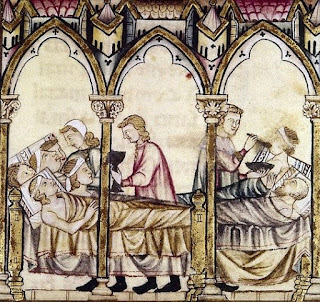

  
East meets West: Medicine in the Crusader States

Before turning to the state of medical knowledge in the crusader era, it is important to understand where it came from. On the one hand, "Saracens and Christians shared the same conceptual framework for medical science, which they inherited from the classical world." (1) On the other hand, both East and West had a body of practical knowledge for treating wounds particularly based not on theory but on experience, i.e. empirical knowledge. Whereas both Christian and Muslim physicians based their theories of medicine on classical Greek texts about the four "humors" of the body, their treatment of concrete cases of injury and illness varied based more on climate, availability of pharmaceuticals, and tradition.

It has frequently been noted by crusades historians, that the residents of Outremer were quick to turn to "Eastern" doctors, leading most commentators to assume a superiority on the part of "Muslim" doctors. There are several weaknesses to this approach. First, some of the presumed superiority was due simply to greater familiarity with both the diseases common in the Middle East and the ingredients (most derived from locally available products) available for treatment. 

More important, however, is the fact that many of these "Eastern" doctors were not Muslims at all, but rather native Christians. The fact that many native Christians of the Levant spoke Arabic by the time the Crusaders arrived and had adopted Arab-sounding names has misled students of the crusades to assume the physicians named and praised were also Muslims and their knowledge of medicine derived from Arab rather than Greco-Roman traditions. Yet, in fact, "when [contemporary] Western sources referred to 'oriental' or even 'Saracen' doctors, it usually meant only that they were natives of Outremer, and their language was Arabic. Most were probably Eastern Christians."(2)  For example, the famous and influential medical scholar Ibn Butlan was a Christian who spent most of his life in Byzantine Antioch. 


Negative views of crusader medicine have also been derived from Muslim sources. Yet, it is important to remember that the Islamic world in this period looked down on Christians as "backward" and "barbaric" based not on specific examples but rather on a fundamental world view of Islam  -- and so all aspects of Muslim society -- as inherently superior to all other religions. As the newer religion, it was understood "as being...a corrective to the misunderstandings that had crept into the religious practices of the earlier recipients of the religion of Abraham."(3)

Famously, Usama ibn Munqidh's memories highlight two examples in which European medical treatment resulted in the death of the patient. Yet these anecdotes do not prove that the procedures were standard, nor can we know if the patient died because of the treatment was inherently incorrect or incorrectly executed by the practitioner. Furthermore and often overlooked is the fact that Usama also notes two "effective cures the orientals learned from the occidentals: the use of wine to disinfect wounds, and an ointment for scrofula."(4) 

With that let me turn to a brief description of common medical procedures in the crusader states. 
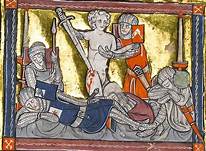


Treating Trauma

Based on available records, it has been calculated that between 15 and 20 of knights on crusade died in battle or as a result of wounds obtained there; the proportion of foot soldiers lost due to military engagement was probably higher.  Nevertheless and surprisingly for modern readers, very many more survived their wounds due to competent medical treatment.

In the 12th and 13th centuries, the weapons employed produced first and foremost puncture wounds (from arrows, lances and swords), followed by cuts/amputations caused by swords and axes, fractures/crushed bones caused by maces and stones thrown from siege engines, and, last but not least burns from Greek fire, boiling pitch and water. The fundamental treatment for each of these kinds of wounds does not differ significantly from what is recommended today.

Medieval medical practitioners and soldiers, for example, understood the essential fact that a man can bleed to death. When treating puncture wounds, stopping hemorrhaging was, then as now, the primary concern. The difference between arteries and veins was likewise understood, and the need to stop arterial bleeding as rapidly as possible recognized. The use of the tourniquet and precise cauterizing were both known, and surgeons were expected to be able to close off arterial bleeding with their fingers long enough to apply a cautery.  Not only is the procedure for this carefully described in medical texts of the period, but there are also numerous recorded instances of men surviving this treatment and recovering so completely that they could fight again without impediment.

While amputations were likewise cauterized and cuts were bound, or if necessary, sewn back together, arrows presented additional problems. Although it would have been rare for an arrow to hit an artery, the arrow itself often remained in the wound and the need to remove it was paramount. But many arrows were designed to do more damage if pulled backwards (out the way they went in) by the addition of barbs or the shape of the arrowhead itself.  Medieval surgeons, therefore, had the option of pushing it through the injured man and out the other side or waiting for the wound to putrefy and the surrounding tissue to become soft enough to make it easier to remove.  Horrible as this sounds, the fact that many knights are described fighting with multiple arrows stuck into their armor suggests that it may have been comparatively rare for an arrow to become so deeply embedded that it was life-threatening ― without killing outright as in the case of arrows to the throat, eyes, armpits, etc.

In the case of broken bones, the need to set bones to ensure they mended straight and functional was likewise recognized. Bones were held in place by splints, bandaging or plaster ― or a combination thereof. In the case of burns, the primary concern was to prevent blisters from forming and the wound from completely drying. Moist cooling the wound was thus the recommended treatment, whether by means of placing the affected limb in a bowl of liquid, applying wet compresses soaked in herbs or the application of ointments.
 
Anesthetics

Surprisingly (at least for me), the use of anesthetics during operations or the treatment of wounds was common.  An anesthetic was given to the patient either in a drink (usually wine) or placed on a sponge that was then held to his/her nose. Mitchell notes that the various plants recommended for preparing anesthetics (e.g. henbane, hemlock, poppy, deadly nightshade, mandragora root and lettuce seed to name a few) have been demonstrated to have pain-killing and or sedative effects. He hypothesizes that “cocktails” combining several of the recommended ingredients could have been very potent ― and dangerous if the dose was miscalculated or the extracts improperly prepared. Patients in the crusader states were lucky to have ready access to one of the most effective narcotics known to man: opium. Mitchell writes that there is evidence of its use for medicinal (rather than recreational) purposes by the Franks in the crusader states.
Infection

While the fatal danger of infection was widely recognized and feared, the cause was not understood. As a result, some medieval medical practices contributed to infection. Once infection occurred, however, medieval doctors attempted to cure it. The successful use of vinegar, which has strong antiseptic properties, is recorded in treating festering wounds and severe burns, for example. Medieval doctors also understood the need to drain festering wounds.  Mitchell notes no significant differences between crusader treatment for infection that standard practice elsewhere.
 
Next week I will address the evolution of hospitals, something Edgington describes as the most impressive development in crusader medical care. (5)


1. Susan B. Edgington, "Oriental and Occidental Medicine in the Crusader States," in The Crusades and the Near East: Cultural Histories (London: Routledge, 2011), 189. 
2. Edgington, 197.
3. Niall Christie, Muslims and Crusaders: Christianity's Wars in the Middle East, 1095-1382, from the Islamic Sources (London: Routledge, 2014), 77.
4. Edgington, 201.
For the description of contemporary medical treatments, the principal source is Medicine in the Crusades: Warfare, Wounds and the Medieval Surgeon, by Piers D. Mitchell, Cambridge University Press, 2004.
5. Edgington, 208.

Throughout my award-winning, "Jerusalem" trilogy and my newer books lifestyle in Outremer is depicted as realistically as possible.

                                                                                                                               Best Biography 2017

 Buy now!                                       Buy now!                                               Buy now!


         Buy Now!                                                   Buy Now!                                             Buy Now!


Dr. Helena P. Schrader holds a PhD in History.

She is the Chief Editor of the Real Crusades History Blog.
She is an award-winning novelist and author of numerous books both fiction and non-fiction. Her three-part biography of Balian d'Ibelin won a total of 14 literary accolades. Her current series describes the civil war in Outremer between Emperor Frederick and the barons led by John d'Ibelin the Lord of Beirut. Dr. Schrader is also working on a non-fiction book describing the crusader kingdoms. You can find out more at: http://crusaderkingdoms.com

Thursday, August 1, 2019

Byzantinum and the Crusades Part IV: Humiliation and Reconcilation


It is easy to conceive of the crusades as a conflict between Latin Christian West and the Muslim Middle East, forgetting that between these two geographic/

religious groupings stood an Orthodox Christian Empire -- Byzantium. Yet the latter both triggered the crusades and became a victim of them. Today I conclude my four-part series on the complex role played by Byzantium in the era of the crusades by looking at the Fourth Crusade and its aftermath.


Ironically, while the first three crusades had never been aimed at the capture of Constantinople, persistent Byzantine suspicious that Constantinople was the “real” target of Western armies became a self-fulfilling prophecy at the start of the 13th century. From the perspective of the West, the first hundred years of crusading history had been littered with examples of Byzantine betrayal -- from the failure of the Byzantine Empire to come to the aid of the crusaders at Antioch to Isaac II’s treaty with Saladin at the moment of Jerusalem’s fall. With the notable exception of Manuel I — who contemporary Western chroniclers universally praised — the “Greeks” were seen as treacherous and cowardly. This had led to repeated calls for the seizure of Constantinople starting with Bohemond of Taranto in 1107.  Throughout the 12th century, however, the voices calling for an attack on the "treacherous" and "cowardly "Greeks" had been firmly silenced by crusader leadership.


The start of the 13th century, however, saw a new constellation of factors. On the one hand, Jerusalem had been lost to the Sultan and a massive crusade to recapture it had ended in only partial success. This discouraged Western interest in a new crusade on the part of the land-owning, military class that needed to provide both the resources and the manpower for such an undertaking — although the tragic “Childrens’ Crusade” soon showed that popular sentiment still favored efforts to regain control of the Holy City. Meanwhile, in the Holy Land itself, the resources of Cyprus were beginning to bolster the local nobility and feed an economic recovery that laid the foundation for a partial recovery that would last a half-century. In short, at the start of the century, retrenchment was the order of the day. 

Yet, Venice had neither forgotten the injuries done it by the Byzantines nor recovered from the commercial losses that resulted from their expulsion from Constantinople. When some overly optimistic noblemen failed to raise either the troops or the funds they anticipated for a new crusade, Venice took advantage of the assembly of fighting men on its doorstep to launch that has gone down in history as the "Fourth Crusade."


I have described the course of the so-called Fourth Crusade elsewhere. (See: https://defendingcrusaderkingdoms.blogspot.com/2019/02/the-hijacked-crusade.html) What I wish to highlight here is that the Fourth Crusade did not, in fact, either destroy the Byzantine Empire nor end all ties with the West. To be sure, for the first several decades, the old Empire was fractured and Frankish states established in the core in Constantinople and Greece.  But several competing successors jostling for the title of heir continued to exist in Asia and the Balkans. Furthermore, these successors reconquered Constantinople in 1261, and the restored Byzantine empire survived nearly two-hundred years after that.

Chris Wright in his fascinating article “On the Margins of Christendom” highlights the extent to which the fall of Constantinople to the crusaders in 1204 forced the Byzantines to face facts and recalibrate their policies in a more realistic manner. No longer were the great monarchs of Western Europe dismissed as “barbarians.” No longer were  Western culture and politics dismissed as irrelevant. The arrogance that placed Constantinople at the center of the world was shattered. While rightly feeling outraged and unjustly attacked, Byzantine elites for the first time recognized that the earlier crusades had indeed been genuine efforts to liberate the Holy Land, rather than cynical plots to destroy the Byzantine Empire.

Mystra - A Byzantine Outpost in the Frankish Peloponnese
Now, defeated by the mercenaries of Venice, the spokesmen for the fragmented Byzantine empire skillfully evoked crusader rhetoric to condemn both what had happened and the Pope’s continued self-serving calls for new crusades to defend Latin control of Constantinople. With the papacy increasingly declaring “crusades” for its own political aims — against heretics in the Languedoc, against the Hohenstaufens in Italy and Sicily, against the successors of the Byzantine Empire — the concept of crusading for Jerusalem became a Byzantine rather than a Latin theme, a rod with which to beat the Latins with their own hypocrisy. 

It was in no small measure the disgust of the lay population with the papal misuse of crusading rhetoric and privileges that led to a decline in crusading enthusiasm until St. Louis revived it through his own passionate commitment. Certainly, the repeated papal calls for “crusades” to defend Latin conquests in the former Byzantine Empire fell largely on deaf ears. By 1261 the embarrassment was over. Constantinople was back in Orthodox hands.


It was during the period of “exile” from Constantinople, however, that Byzantine intellectuals started to differentiate themselves from contemporary Rome (i.e. the Pope’s Rome) by focusing more on their Greek roots. For the first time, some of the Byzantine elites began to call themselves Greeks (Hellenes), rather than Romans -- although the majority of the population continued to identify themselves as Romans. 


Furthermore, far from destroying all trust and cooperation between the Byzantine Empire and the Western “barbarians,” the interlude of Western control of the Eastern Roman Empire forced the restored Byzantine Emperors to recognize their fellow monarchs in the West as equals rather than inferiors. Furthermore, as the Turkish threat grew, the Byzantines were forced again to seek Western aid and support, with only partial success. Yet it is one of the ironies of history that one of the most harmonious periods in West European-Byzantine relations was when cooperation between the two power centers was already too late.


Sources and recommended reading:

Angold, Michael, “The Fall of Jerusalem (1187) as Viewed from Constantinople,” in The Crusader World, ed. Adrian Boas (London: Routledge, 2016), 289-309.

Chrissis, Nicolaos, “Byzantine Crusaders: Holy War and Crusade Rhetoric in Byzantine Contacts with the West (1095-1341),” in The Crusader World, ed. Adrian Boas (London: Routledge, 2016), 259-277.

Papayianni, Aphrodite, "Memory and Ideology: The Image of the Crusades in Byzantine Historiography, Eleventh - Thirteenth Centuries," in The Crusader World, ed. Adrian Boas (London: Routledge, 2016), 278-288.

Wright, Chris, "On the Margins of Christendom: The Impact of the Crusades on Byzantium," in ed. Conor Kostick (London: Routledge, 2011), 55-82.


Balian d'Ibelin married a Byzantine princess and their sons retained an exceptional appreciation of Byzantium's role in the Eastern Mediterranean.


       Buy now!                                       Buy now!                                         Buy now!

Dr. Helena P. Schrader holds a PhD in History.
She is the Chief Editor of the Real Crusades History Blog.
She is an award-winning novelist and author of numerous books both fiction and non-fiction. Her three-part biography of Balian d'Ibelin won a total of 14 literary accolades. Her current series describes the civil war in Outremer between Emperor Frederick andthe barons led by John d'Ibelin the Lord of Beirut. Dr. Schrader is also working on a non-fiction book describing the crusader kingdoms. You can find out more at: http://crusaderkingdoms.com


Thursday, July 25, 2019

Byzantium and the Crusades Part III: Detente and Defeat


It is easy to conceive of the crusades as a conflict between Latin Christian West and the Muslim Middle East, forgetting that between these two geographic/
religious groupings was an Orthodox Christian Empire -- what we have come to call the Byzantine Empire. Yet it was the latter which  both triggered the crusades and became a victim of them. Today I continue my four-part series on the complex role played by Byzantium in the era of the crusades by looking at the reign of Manuel I Comnenus and the Third Crusade. 

Manuel I and his second wife, Maria of Antioch

Manuel I Comnenus reigned from Constantinople for nearly 40 years from 1143 to 1180 and has gone down in Byzantine history as a great monarch. During his reign, the Byzantine Empire continued to flourish economically and artistically, while also maintaining its political position despite some setbacks and defeats.

At his ascension, Manuel inherited the traditional suspicion of the crusaders and their motives from his predecessors. His attitude was reinforced by the indiscipline and reprehensible behavior of some German elements during the Second Crusade. The Byzantines responded with open hostility that escalated into armed clashes -- right up to the gates of Constantinople itself. Yet eventually Conrad III and, after his arrival, Louis VII of France were able to reason with Manual. Their differences were settled, and Manuel concluded an alliance with Conrad III aimed at the Normans of Sicily.


Conrad III and Louis VII arrive at Constantinople during the Second Crusade

Relations between Constantinople and the Latin West suffered a renewed setback, however, when Reynald de Châtillon invaded Cyprus and engaged in an orgy of savagery including the mutilation of prisoners, extortion, rape, pillage, and destruction. Although Châtillon was condemned by the Latin Church and the King of Jerusalem, his behavior only reinforced existing Byzantine prejudices against the Latin Christians as “barbarians.” Manuel responded by collecting a large army and marching on Antioch. Châtillon had no allies. The King of Jerusalem explicitly encouraged Manuel to teach Châtillon a lesson. Châtillon chose submission and met Manuel barefoot and bareheaded with a noose around his neck to symbolize his submission to the Byzantine Emperor.


This event appears to have been a turning point in Manuel’s policies toward the crusader states. At the latest from this time forward, Manuel adopted “crusader rhetoric” in his communications with the West and in official statements. That is, rather than retaining a disdainful distance from the notion of crusading, Manuel embraced the cause as worthy. While this may reflect acknowledgment that the crusades had done some good by restoring most of the Holy Land to Christian control, it was probably also an attempt to regain the initiative for Constantinople.  


King Amalric of Jerusalem and his Byzantine Queen, Maria Comnena
Manuel's new policies included a series of marriage alliances with key crusader dynasties. Two of his nieces married successive Kings of Jerusalem, Theodora married Baldwin III and Maria married Amalric I. His son was married to the daughter of King Louis VII of France. His daughter married a son of the powerful North Italian family of Montferrat. Most important, following the death of his empress, Manuel himself married Maria, the daughter of the Prince of Antioch. Manual’s marriage offensive was most likely a conscious attempt to civilize and subtly influence policy in Western courts, particularly the Kingdom of Jerusalem.


Manuel's emphasis on cultural influence is further evidenced by the substantial resources he devoted to the restoration of the Church of the Nativity in Bethlehem and contributions to the decoration of the Church of the Holy Sepulcher in Jerusalem. Particularly in the reign of Amalric I, art historians detect increased Byzantine influence on architecture, illumination and other art forms.


Mosaic Tiles at the Church of the Nativity
More obvious and more direct was a willingness on the part of Manual to ransom prominent crusader lords languishing in Muslim captivity. Ransoming prominent prisoners naturally created ties of gratitude, while also serving as magnificent public relations gestures that earned respect and admiration from the public at large. Thus Manuel ransomed even his arch-enemy Reynald de Châtillon, as well as Bohemond III of Antioch and, in one of the more dramatic and significant actions, paid a king’s ransom (literally) for Baldwin d’Ibelin, the Baron of Ramla and Mirabel. (For more on the significance of this event see: https://schradershistoricalfiction.blogspot.com/2018/07/the-house-of-ibelin-baldwin-proud.html)


The most important feature of Manuel’s co-operative policies with the crusader states, however, were the series of joint military operations initiated during the later years of his reign. These included action against Nur ad-Din in 1158-59 and an invasion of Egypt in 1167-68.


The reward for his change in tone and substance was the acknowledgment of Byzantine suzerainty over all the crusader states during a state visit by King Amalric (and his Byzantine Queen Maria Comnena) to Constantinople in 1171. Yet in this moment of triumph over the “barbarians” Manuel also made a fatal miscalculation. In 1171, apparently in response to growing popular discontent over Venetian privileges and increasing wealth, Manuel ordered the simultaneous arrest of all the Venetians resident in his Empire and the confiscation of their property. 


The move reflected Byzantine hubris: the confidence that the Venetians would never be able to take revenge for this arbitrary act. Certainly, the initial attempt by the Venetians to send a fleet to free their captives met with defeat. It would take 33 years before the Venetians would have their revenge, but when it came it would surpass the worst nightmares of the Byzantines.

Meanwhile, Manuel died in 1180 and was initially succeed by his eleven-year-old son Alexios. The government fell to his widow, Maria of Antioch. However, she was not popular, and her policies, which favored the other Italians, who had flooded to fill the vacuum left by the expulsion of the Venetians, earned her even more hostility. The anti-Western faction in Constantinople found an ally in the ambitious uncle of the late Manuel I. In April 1182, Andronikos entered Constantinople and the mob was set loose on the Latin population. According to Charles M. Brand in his history Byzantium Confronts the West, 1180-1204, (Boston: Harvard University Press, 1968): 
The populace turned on the merchants, their families, and the Catholic monks and clerics who lived in the crowded quarters along the Golden Horn…When the mobs attacked, no attempt at defense was made. The crowds raced through the streets seeking Latins. The choicest victims were the helpless: women and children, the aged and the sick, priests and monks. They were killed in streets and houses, dragged from hiding places and slaughtered. Dwellings and churches full of refugees were burned, and at the Hospital of the Knights of St. John, the sick were murdered in their beds.  The clergy were the particular objects of the crowd’s hatred. The head of the pope’s emissary, Cardinal John, was cut off and dragged through the streets on the tail of a dog….The Orthodox clergy took the lead in searching out concealed Latins to deliver to the killers.


Maria of Antioch was deposed and, for a brief period, Andronikos ruled with Manuel’s son Alexios II. During this period, Alexios was forced by Andronikos to sign his mother’s execution order. In Oct. 1183, Alexios was strangled on the orders of Andronikos, who assumed sole power. Just two years later, in Sept. 1185, Andronikos was himself deposed and tortured to death by a mob in Constantinople.


His successor, Isaac II Angelos, was in a precarious situation that precluded the pursuit of a clear policy. Already in 1187, he faced a rebellion from one of his most successful generals, Alexios Branas, and only months later was taken by surprise by the devastating Christian defeat at Hattin and the subsequent fall of Jerusalem. Significantly, however, his brother was at Saladin’s court at this time and Isaac promptly started negotiations with the Sultan. Historian Michael Angold notes:
This represented a clear break with Comnenian policies. There were many in the Byzantine administration…who were critical…. [However,] once it became clear that reviving Manuel Comnenus’s policy of entente with the crusader states was impractical — largely because of the loss of Cyprus — an understanding with Saladin was the most effective way of protecting Byzantine interests in Anatolia, where Saladin could bring his influence to bear on the Seljuqs of Rum. [Angold, 297.]

From cooperation with Saladin to opposition to the Third Crusade was a small step. Isaac initially wanted to prevent the German crusaders under the leadership of Frederick Barbarossa from passing through his territories altogether. He appears to have reverted to the earlier pattern of assuming the “real” reason for the crusade was to overthrow him and seize Constantinople rather than restore Christian control of the Holy Land.


Frederick Barbarossa
Isaac’s anti-crusader policy met with serious opposition within his own government, and when Isaac proved incapable of countering Barbarossa’s superior military capabilities, Isaac was forced to modify his policies. Yet the combination of his treaty with Saladin and his initial attempts to prevent the passage of the German crusaders fueled Latin suspicions of the Byzantines. Increasingly the “Greeks” were seen as duplicitous, treacherous, and cowardly. Fatally, Western sentiment turned decisively against Byzantium at a time with the Empire lacked competent, popular and entrenched leadership.


Next week I will conclude this four-part series with a look at the Fourth Crusade and its aftermath.


Sources and recommended reading:

Angold, Michael, “The Fall of Jerusalem (1187) as Viewed from Constantinople,” in The Crusader World, ed. Adrian Boas (London: Routledge, 2016), 289-309.

Chrissis, Nicolaos, “Byzantine Crusaders: Holy War and Crusade Rhetoric in Byzantine Contacts with the West (1095-1341),” in The Crusader World, ed. Adrian Boas (London: Routledge, 2016), 259-277.

Papayianni, Aphrodite, "Memory and Ideology: The Image of the Crusades in Byzantine Historiography, Eleventh - Thirteenth Centuries," in The Crusader World, ed. Adrian Boas (London: Routledge, 2016), 278-288.

Wright, Chris, "On the Margins of Christendom: The Impact of the Crusades on Byzantium," in ed. Conor Kostick (London: Routledge, 2011), 55-82.


Balian d'Ibelin married a Byzantine princess and their sons retained an exceptional appreciation of Byzantium's role in the Eastern Mediterranean.


       Buy now!                                       Buy now!                                         Buy now!

Buy Now!

Dr. Helena P. Schrader holds a PhD in History.
She is the Chief Editor of the Real Crusades History Blog.
She is an award-winning novelist and author of numerous books both fiction and non-fiction. Her three-part biography of Balian d'Ibelin won a total of 14 literary accolades. Her current series describes the civil war in Outremer between Emperor Frederick and the barons led by John d'Ibelin the Lord of Beirut. Dr. Schrader is also working on a non-fiction book describing the crusader kingdoms. You can find out more at: http://crusaderkingdoms.com