COPYRIGHT

All content on this blog is protected by copyright.
Content used elsewhere without attribution constitutes theft of intellectual property and will be prosecuted.
Showing posts with label Medical care. Show all posts

Saturday, December 20, 2025

Knights Hospitaller - The Oldest Military Order

Of the many "militant orders," the Knights Hospitaller, were the oldest and the most enduring.  Today I pay a tribute to them with a short summary of their history. 


The roots of the Knights of St. John of Jerusalem go back before the First Crusade. In about 1070, a hospice for pilgrims was established near the Church of the Holy Sepulcher with funds from Italian merchants and staffed by Benedictine monks and nuns. Although the Benedictines were expelled from Jerusalem before the arrival of the first crusaders, they returned after Jerusalem was in Christian hands, and with help from the Christian secular authorities, re-established a hospital. Soon, further grants of money and land from the Christian lords enabled the monks to establish a chain of hospitals throughout the Holy Land and to set up hospices at the embarkation ports for pilgrims setting out from Europe or returning from Outremer. The monks and nuns running these hospitals and hospices soon became known as the “Hospitallers.”

In 1113, the monks of the Hospital (also referred to as the Brothers of St. John and the Brothers of the Holy Sepulcher) requested and received from the Pope the right to become an order in their own right. This new order, as with the Templars a decade later, was made directly subordinate to the Pope, and in or about 1130 it adopted the Augustine Rule. Meanwhile, this new order was rapidly acquiring significant donations in land and treasure in both the West and in the Holy Land, a reflection of the undiminished support for a Christian-controlled Holy Land.

The "Hospital" in Acre is still massive and impressive; the Hospital in Jerusalem was much larger.
Photo by H. Schrader 
Nevertheless, the Hospital of St. John remained a traditional monastic order. Although it had been granted the explicit right to defend its properties and pilgrims, members of the Order were prohibited from bearing arms. As a result, throughout the 12th century the Hospital was dependent for its protection on knights who owed feudal duty to the Hospital via their landholdings, voluntarily offered their services, or were hired mercenaries. These defensive forces, whatever their source, must have been substantial, however, because the Hospital was given very powerful fortresses, notably the most impressive crusader castle of them all: Krak des Chevaliers.
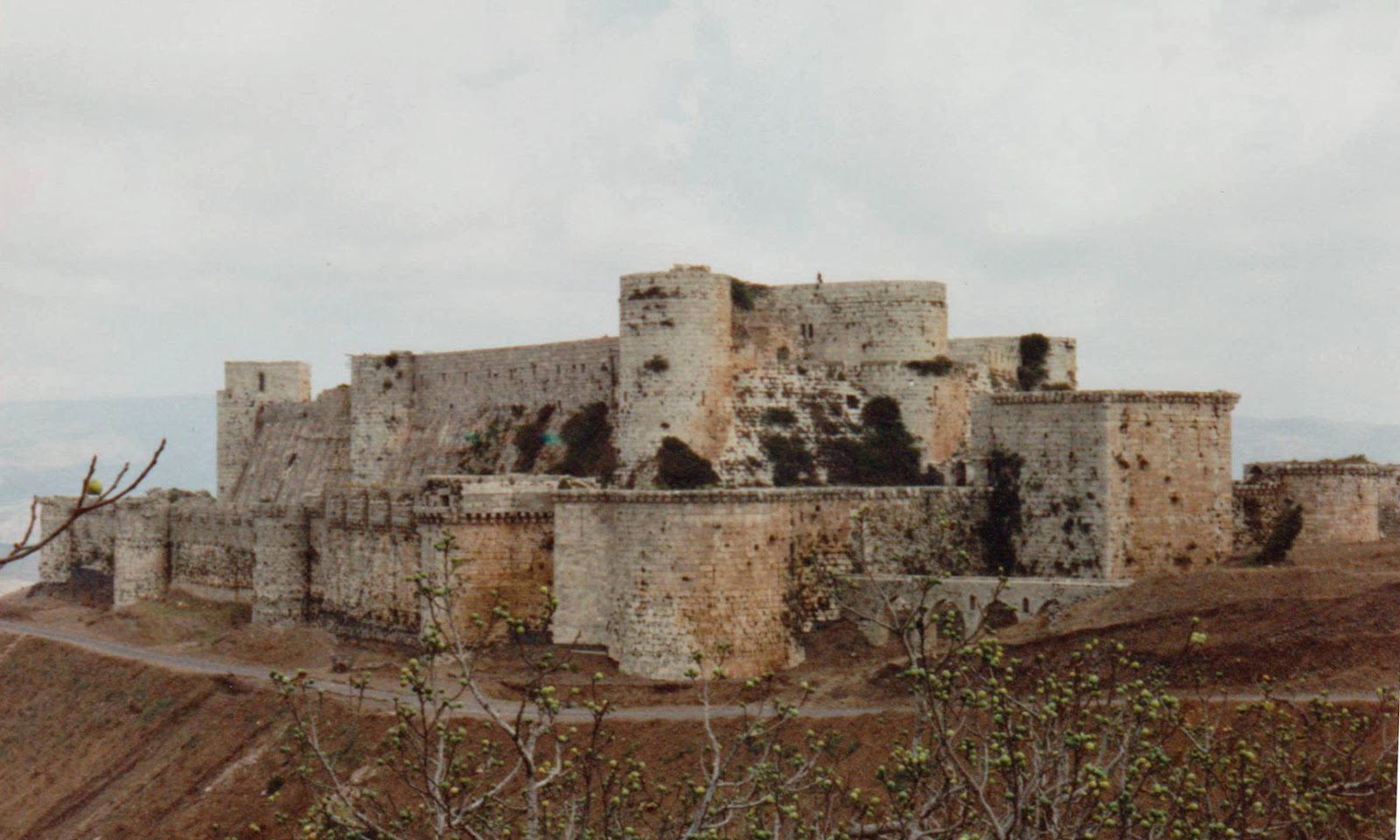
Krak de Chevaliers in Modern Day Syria. Photo by H Schrader
It would have been pointless to turn over such vitally important military resources to an order incapable of maintaining and defending them, but the exact status of the Hospital’s fighting men remains obscure until 1206 when the Hospitaller Rule was changed to allow for fighting monks. Thereafter, the Hospitallers began to recruit fighting men, probably starting with those who were already associated with it in some way, and like the Templars, they had both knights (men of noble birth) and sergeants. Within a very short time, the knights dominated the Order. The Hospitallers, however, continued to have priests, monks, and nuns devoted solely to the care of the sick, and the network of hospitals was not abandoned. At about this time, the entire Order adopted black robes (reminiscent of their Benedictine origins) adorned with a white cross. One notable difference with the Templars, however, was that there was no distinction in dress between the knights and the sergeants of the Hospital.

The Hospitallers, like the Templars, warned new recruits that “… when you desire to eat, it will be necessary for you to fast, and when you would wish to fast, you will have to eat. And when you would desire to sleep, it will be necessary for you to keep watch, and when you would like to stand on watch, you will have to sleep. And you will be sent this side of the sea and beyond, to places which will not please you, and you will have to go there. It will be necessary for you, therefore, to abandon all your desires to fulfill those of another and to endure other hardships in the Order, more than I can describe to you.” (Barber, Richard, The Knight and Chivalry, p. 275) Like the Templars, the Hospitallers vowed poverty and chastity as well as obedience.

Austere Monastic Accommodation; in this case the Cistercian Monastery of Fontfroid
The similarity between the two powerful militant orders led to open rivalry between them for recruits, resources, and power in the first half of the 13th century. This led on occasion to open fighting between members of the orders on the streets of Acre and Tripoli, but more often to subtle maneuvering behind the scenes. For decades, the Hospitallers and Templars consistently backed rival claimants to the throne of Jerusalem and rival Italian trading communities. As the end of Christian Palestine neared, however, the Hospitallers and Templars put aside their differences and jealousies to rally to the now lost cause. In the last decades of Christian Palestine, Hospitallers and Templars fought side by side, ferociously and futilely, at Antioch, Tripoli, and finally Acre.

After the fall of Acre, the Hospital also relocated its headquarters to Cyprus, but conflict with the King of Cyprus convinced the leadership of the Hospital (evidently more flexible, imaginative, and analytical than the tragic Jacques de Molay) of the necessity for independence from secular authority. The Hospitallers undertook the capture of the island of Rhodes from Turkish forces in 1306, finally seizing the capital city in 1309. With this move, the Hospitallers removed themselves, and the bulk of their movable treasure, from the grasp of Philip IV – or any king inclined to follow his example. Even more important, however, from this island base the Hospitallers built up a powerful fleet capable of challenging the naval power of the Turks and of launching hit-and-run raids into Saracen territory. The Hospitallers had “reinvented” themselves and had found a new justification for their existence.

Hospitaller Castle at Kolossi, Cyprus. Photo by H. Schrader
The Hospitaller fleet remained a significant force protecting Christian shipping and commerce throughout the next two and a half centuries. The base of this fleet on Rhodes, so close to the Turkish coast, was a constant provocation to Turkish, rulers. Numerous attempts were made to capture Rhodes, notably in 1440, 1444, 1480, and 1522. During the first 3 sieges, the Hospitallers withstood vastly superior numbers, in one case (1444) driving off the enemy with a daring sortie from within the city. On the other two occasions, they were rescued by the timely arrival of a relieving fleet from the West. In 1522, an army allegedly 100,000 strong attacked a force of just 600 knights and 4,500 local auxiliaries. After 2 months of bombardment a breach in the landward wall was made, yet 3 assaults through the breach, carried out with complete disregard for casualties, failed. Sultan Suleiman called off the costly assaults and settled down for a long siege, cutting Rhodes off from all relief. Recognizing the hopelessness of their situation, the surviving Hospitallers, now more commonly called Knights of St. John, surrendered on honorable terms.


When the Hospitallers withdrew on their ships from Rhodes, they were effectively homeless, but Emperor Charles V offered them the island of Malta as their new headquarters. From here they continued to operate their fleet so effectively that Sultan Suleiman decided he had to dislodge them from their new home. In 1565 he again assembled a large siege force. The Knights of St. John had 500 knights of the Order and 10,000 other troops. The Turks launched their first attack in May and after a month of fighting captured an outlying fort, slaughtered the garrison, and floated their mutilated bodies across the harbor to the main fortress as a warning of what was to come. The Hospitallers replied by executing Turkish prisoners and catapulting their heads into the Turkish camp. A Turkish assault on the main fortifications was undertaken on July 15, and a breach in the walls effected by August 7. Yet two assaults through the breach, on August 19 and 23, both failed. On September 7 a Spanish fleet arrived from the West and scattered the demoralized Turkish forces. The defense of Malta had cost the Hospitallers half their knights and 6,000 of the other defenders.

A dramatic 19th century of the Hospitaller defense of Malta.

Thereafter, the Knights of St. John focused again on making the seaways of the Mediterranean safe for Christian shipping, a task that became increasingly easy as Turkish naval power declined. But this victory, like the defeat in Acre 300 years earlier, robbed them of their raison d’ĂȘtre. The Knights of St. John, now commonly known as the Knights of Malta, slid into a slow decline. They became more involved in commerce than warfare, and their fortresses turned into palaces. When Napoleon laid siege to Malta in 1798, the last frail remnants of the once mighty Hospitaller Order surrendered in just two days.


The Hospitallers played an important role in the Holy Land in the 12th century and so also figure in my biographical novel about Balian d'Ibelin and the fall of the Kingdom of Jerusalem. 


  Buy now!                                                                  Buy now!                                                             Buy now!
 

"The Tale of the English Templar" is a fictional work that depicts the destruction of the Knight's Templar. 


An escaped Templar, an intrepid, old crusader, and a discarded bride
embark on a quest for justice in the face of tyranny. 
 
 
"St. Louis Knight" is a novel set against the backdrop of the Seventh Crusade and St. Louis' sojourn in the Holy  Land. It is now available in audiobook as well as paperback and ebook:
 
 A crusader in search of faith --
A lame lady in search of revenge --
And a King who would be saint.

St. Louis' Knight takes you to the Holy Land in the 13th century, and a world filled with knights, nobles, prophets -- and assassins. 
(Available in Audiobook)


Saturday, July 19, 2025

Leprosy in Crusader Times

King Baldwin IV of Jerusalem was a leper. This was so exceptional in the history of Western monarchies that he has gone down in history simply as “the Leper King.” Most people know nothing else about him, not even his Christian name.  Yet not only was he a king, he was an effective, respected and beloved king -- as I described last week. Today I want to look more closely at how it was possible for him to become king at all.

  
The Mask of Baldwin IV in the Hollywood Film "The Kingdom of Heaven"
 
Without doubt, leprosy is one of the most appalling diseases known to man. Victims of the disease suffer from symptoms including a loss of feeling in their affected limbs, a discoloring and hardening of the skin, disfiguring growths or nodules that deform the face, hands and legs, open ulcers, particularly on the soles of the feet, and, in its most virulent form, the disease can deform even the skeleton and skull, while progressively triggering a deterioration of control over one’s limbs, leading finally to the loss of toes, fingers, ears, noses, and eyesight. Because of this gradual decay of the body lepers were sometimes referred to the “living dead” or “walking corpses.”

Medieval carving showing a leper
 
Leprosy is a global phenomenon, present today on every continent.  While some scientists suggest it originated in East Africa (along with mankind and horses), the oldest anthropological evidence of the disease is a nearly 3,000 year old skeleton found in India. Certainly it was known in ancient Egypt, ancient Greece, ancient China, and is recorded in the Old Testiment as well.
 
In Western medical texts, Hippocrates described symptoms that match leprosy as early as 460 BC, but no cure was found for leprosy until the 20th century. Furthermore, modern medical research shows that as much as 30% of a population may become infected during an epidemic, yet once endemic, only 5% of any given population is likely to contract the disease. Yet that research was not available until the last century.
 
Throughout most of human history, the leprosy was believed to be not only incurable but also highly contagious.  At the extreme, some medical tracts (including Arab ones) suggested that just breathing the same air as lepers could result in infection. It was this terror of catching such a horrible and incurable disease that led many societies to ostracize lepers, notably the Jews and the Germanic tribes of northeastern Europe, both of which expelled lepers from their societies.
 
 
So how could a leper become a king? 
 
Because he lived in a Near Eastern, Christian monarch in the twelfth century. By this time Eastern Christianity had come to view leprosy not as a curse nor as an outward expression of sin nor a form of divine punishment nor even something unclean. Rather it viewed leprosy as a symbol of divine grace. 
 
According to the gospels, Christ cured a leper following the Sermon on the Mount, and in the gospel of Luke (16:19-31) a poor beggar “covered with soars” called Lazarus is scorned by a rich man but finds favor with God. In the Medieval tradition, this man was a leper and Lazarus became the patron saint of lepers. The significance of lepers in the New Testament is twofold. First, leprosy was at the time incurable, so that healing a leper could only be a miracle, a divine act, and Christ demonstrates his divinity by curing the leper. Second, and often overlooked today, lepers were outcasts in Jewish society, prohibited from entering the Temple, so in curing the leper Christ was extending his grace even to outcasts.


By the 4th century AD, Church leaders in both the East and the West had seized upon these biblical references to argue that the greatest Christian virtue was to demonstrate love and charity toward the outcasts of society — something best demonstrated by love for those most commonly rejected in heathen societies: lepers. Within a short space of time, the sufferings of Job were associated with leprosy, and leading theologians reminded the Christian community that each leper (no less than any other man) had been made in God’s image and been redeemed by Christ. 

The argument went farther: Disease humbled even the proudest and wealthiest, bringing them closer to God, and no disease did that more thoroughly than leprosy. Far from being a punishment for sin, therefore, leprosy was the ultimate test of righteousness. While the victims were, it was argued, already marked by God for salvation, those willing to show them Christian love and charity would also win the favor of God. Legends started to evolve in which Christ appeared on earth as a leper, and the disease started to be referred to as “the Holy Disease.”

A monk treats a child with leprosy; a sign of charity.
 
Furthermore, the lives of saints often highlight acts of charity or kindness toward lepers, including kissing them. Likewise, from this period onward, we can trace the development and spread of hospitals especially established for the care of lepers, particularly in the Byzantine Empire. They are recorded in Constantinople itself and all the way to Alexandria. Notably, there was an important leper hospital in Jerusalem as well.


The Leper Hospital at Jerusalem no longer exists; this is the Hospitaller HQ at Acre
 
The establishment of leper hospitals enabled the removal of lepers from homes, markets, and work-places and so to a degree isolated lepers from mainstream society. No matter what the Church preached about the Christ-like nature of loving lepers, most ordinary humans preferred not to undergo the ultimate test of holiness by suffering such a debilitating and humiliating disease! A degree of segregation was therefore both rational and understandable. However, these new establishments were not isolated and cut off from society, nor were they places of detention or  characterized by horrible living conditions. On the contrary, they were large complexes with their own churches, dormitories, kitchens, water reservoirs, orchards and land. People, whether the wealthy relatives of victims of the disease, or men and women anxious to gain credit in heaven were willing to endow leper hospitals or make charitable gifts to them in coin or kind.

Furthermore, leper hospitals were not prisons, in which lepers were incarcerated against their will. The lepers could come and go as they pleased, and if they remained it was because they benefited from the charity and care they received rather than from compulsion. Furthermore, the lepers in these hospitals largely governed their own affairs, electing their own officials, who they then obeyed as in the monastic tradition. Likewise, they had chapter meetings, like monks, and female lepers appear to have had the same rights as their male counterparts. In at least one case a woman is recorded as a “commander” of a leper hospital. 

A "Chapter House" where collective decisions would have been made.
 
Significantly, however, it was in Jerusalem that a leper hospital grew into a religious order in its own right, the Order of St. Lazarus. The leper hospital had been established during Byzantine rule of the Holy City but after the establishment of the Latin Kingdom of Jerusalem, it was taken over by the Knights Hospitaller. By in 1147, the leper hospital had broken away from the Hospitallers and was recognized as a religious order in its own right. Initially referred to as the Leper Brothers of Jerusalem, the members of this new religious order soon came to be called the Knights of St. Lazarus, and adopted a green cross as their symbol. (Note: the Templars wore red crosses on white, the Hospitaller at this time white crosses on black, and the Teutonic Knights adopted a black cross on white.) 

Membership in the Order of St. Lazarus was mandatory for knights of the other militant orders who developed leprosy after taking holy vows, and for members of the nobility of Outremer, who came down with the disease, but was not confined to these individuals. Any leper, of course, could join the community, and healthy individuals, intent on showing Christian love and charity, could do so by joining the order and serving the lepers. Enough healthy knights belonged to the Order by the 13th century for knights to have fought at the Battle of Gaza in 1244, the Battle of Ramla in 1253, and during the defense of Acre in 1291. They may also have fought at Hattin in 1187.

All the above battles post-date the death of Baldwin IV and while that may be pure chance, it seems more likely that it was Baldwin IV’s steadfast service to his kingdom on the battlefield that inspired knights to join the Order of St. Lazarus and encouraged the Order itself to take on a more militant role. Baldwin initially led his armies on horseback, despite being unable to use his hands, and later led from a litter. A greater example of courage from a man suffering from such a debilitating disease can hardly be imagined. 

King Baldwin IV leads his army on horseback in the film "The Kingdom of Heaven"
  
But it is equally significant that his powerful barons, their knights, and all the free burghers of the Kingdom of Jerusalem were willing to do homage to and obey a leper. Baldwin IV could not have defeated Saladin repeatedly (as he did!), if he had not commanded the undivided and unquestioning loyalty of his subjects. This fact, more than his own actions, tells us that leprosy in the crusader Kingdom of Jerusalem was indeed recognized as a “holy disease.” Baldwin IV’s leprosy, far from evoking contempt or even revulsion, as Hollywood and many modern writers would have us believe, inspired awe among his contemporaries. 


Contemporary attitudes toward leprosy in the Kingdom of Jerusalem are reflected in Schrader's award-winning Jerusalem Trilogy, particularly the first and second books in which Baldwin IV is an important character:


 Buy now!                                                       Buy now!                                                    Buy now!

"The Tale of the English Templar" is a fictional work that depicts the destruction of the Knight's Templar. 


An escaped Templar, an intrepid, old crusader, and a discarded bride
embark on a quest for justice in the face of tyranny. 
 

"St. Louis Knight" is a novel set against the backdrop of the Seventh Crusade and St. Louis' sojourn in the Holy  Land. A Templar novice and King Louis are the central characters. 
It is now available in audiobook as well as paperback and ebook.

 
 A crusader in search of faith --
A lame lady in search of revenge --
And a King who would be saint.

St. Louis' Knight takes you to the Holy Land in the 13th century, and a world filled with knights, nobles, prophets -- and assassins. 
(Available in Audiobook)

Thursday, August 15, 2019

Hospitals for the Holy Land

It is widely believed that Arab/Muslim medicine was far superior to Western/Christian medicine, yet when Saladin captured Jerusalem in 1187, he was so impressed with the Hospital of the Knights of St. John that he allowed it to remain open for another year. Indeed a visitor from the West shortly before the fall of Jerusalem described it as a "palace" with beautiful buildings, "rich in the means of refreshing the poor."(1)

I want to first consider why hospitals are considered one of the greatest innovations of Outremer.


At the time of the First Crusade, Western Europe did not know hospitals in the sense of places where acutely ill patients received professional medical treatment. There were, of course, infirmaries in monasteries and convents to treat the sick members of the community, but they were not established for the benefit of the general public. Furthermore, the infirmarer and his assistants were first and foremost a monks/nuns, not trained doctors/nurses. There were also almshouses for the infirm and aging, hospices for the dying, and various forms of charitable institutions to look after the chronically and incurably ill such as lepers, the blind, and the seriously disabled. In general, however, if the rich got sick, they sent for a physician to treat them in their homes; if the poor got sick they treated themselves or sought the services of a barber or other informally trained medical practitioner.
 
Another feature of 11th century Western medicine was that all care was centered around religious institutions, and even in those cases where wealthy secular benefactors had taken the initiative to found or endow a house for the poor/sick/ aged/blind/leprous etc, care was almost invariably provided by members of the clergy (secular or monastic).  In addition, an important component of the “treatment” was hearing Mass and saying prayers regularly. While men and women patients were separated by a partition or by being housed on separate floors, there was little to no attempt to separate patients based on type of illness at this time.


The Byzantine tradition was quite different. Although initially care of the sick had been provided at monasteries, already by the 7th century AD most hospitals were both financially independent and employed paid, professional staff rather than relying on members of a monastic institution providing care and treatment of patients. Most Byzantine hospitals were small to modest in size, ranging from ten to a hundred beds, although there were larger hospitals which boasted a large and highly specialized staff. In the most prestigious hospitals in Constantinople, for example, physicians and surgeons (some of these further specialized by the type of operations they predominantly performed such as hernias, appendices, eyes, etc.), pharmacists, attendants (nurses), instrument sharpeners, priests, cooks, and latrine cleaners are all listed on the payroll. The administration of these institutions was in the hands of the senior medical staff, and the patients were divided up into wards based on both sex and medical condition. Notably, there is documentary evidence of a small number of female doctors as well as female nurses for the women’s wards.

Equally important, the medical staff worked in the hospitals for very small salaries, but only for six months of a year; presumably, they earned the bulk of their income from private practice in the alternating months in which they did not work in the hospital. This suggests that Byzantine hospitals, although no longer run by the Church, were nevertheless viewed as charitable places accessible it the middle and poorer classes. Furthermore, most junior doctors earned no salary at all since they were considered apprentices in their craft (the equivalent of modern interns). In the larger hospitals, however, there were libraries and teaching staff, making these the equivalent of modern “teaching hospitals.”


In the Muslim world, in contrast, there is no evidence of hospitals until the end of the eighth century. Furthermore, the idea of an institution dedicated to healing sick appears to have been inspired by contact with the Eastern Roman Empire following the conquest of Syria and the Levant. It soon became a matter of prestige, however, for Muslim rulers to establish and endow hospitals so that by twelfth-century most major cities in the Middle East boasted at least one and often more hospitals. The staff of these hospitals was all paid medical professionals and they could be drawn from any faith so that the doctors could be Muslim, Christian or Jewish. Although nursing staff for the women’s wards was female, doctors were invariably male. The famous Adudi hospital in Baghdad (and presumably other hospitals) was also a training institution with library and a staff that wrote medical texts as well. 

The administration of most hospitals in the Muslim world, however, was in the hands of a bureaucrat appointed by the ruler; in short, even in the age of the crusades, these hospitals were “public” in the sense of being state-run. The salaries were small, and again the doctors worked only half time (in the Muslim world, half-days rather than alternating months) in the hospital in order to be free to earn “real” money with private patients. (This practice is still common in Egypt today, by the way.) Hospitals in the Muslim world were large, often having several thousand beds. Perhaps because of this, it was also usual to divide patients up based on the diagnosis, so that there were separate wards for the mentally ill, people with fevers, stomach ailments, eye or skin conditions, etc. Patients were also segregated by sex, of course.


Possibly due to the nomadic past of both Arab and Turkish Muslims, the Muslim world appears to have been very progressive with respect to the establishment of mobile hospitals. These traveled with the Sultan’s armies as early as 942. They also provided care to outlying, rural areas not serviced by the large central hospitals in the urban centers of the Middle East. 

With the establishment of the crusader states in the Levant following the First Crusade, pilgrims from across the Latin West started flooding into the Holy Land on pilgrimage. The journey, whether by land or sea, was arduous and fraught with dangers from pirates and highway robbers to unfamiliar foods, snakes, scorpions, and accidents. Many pilgrims arrived in the Holy Land with injuries and/or in poor health. Being far from home, these pilgrims had no families, guilds or other networks of support; they needed assistance. Their plight sparked the foundation of one of the most important religious orders of the Middle Ages: the Hospitallers. (See separate entry.) But not just the Hospitallers. Pilgrims were coming from across Europe and they spoke different languages; they needed care-takers who could understand them. In consequence, a number of early hospitals were established by monks speaking the same language as the pilgrims, but most of these were later absorbed into the Hospitaller’s network as it became increasingly wealthy and powerful. A few, like the German hospital established during the siege of Acre in Third Crusade, evolved into independent orders. The German hospital became the Teutonic Knights, and the establishments for lepers were taken over by the Knights of St. Lazarus, to mention just two examples. Notably, all hospitals in the crusader states were run by religious/military orders; there were no secular hospitals in the Byzantine and Muslim tradition.


Furthermore, it is fair to say that the medical landscape of Outremer was dominated by the Hospitallers or Knights of St. John, and it is from this Order that we have the most complete information about care for the sick in the Crusader period. The hospitals of the Knights of St. John retained many features of Western medical institutions but adopted others from Byzantine and Muslim examples.


For example, being a religious order, the Hospitaller retained the Western emphasis on prayer as a means to recovery. The wards were usually situated to enable patients to hear Mass being read in an adjacent chapel or church.  Furthermore, patients were required to confess their sins on admittance to the hospital because it was believed that sin (and God’s displeasure) could cause illness. That said, however, eye witness accounts report that Muslims and Jews were also treated in the hospitals; we can only presume that they were exempt from confession at admittance.

Breaking with Western tradition, however, the hospitals run by the Knights of St. John employed professionally trained doctors and surgeons at least by the second half of the 12th century. There is at least one case of Jewish doctor being employed and taking the oath required of all doctors on the “Jewish book” rather than the bible. In contrast to both Byzantium and the Muslim world, the doctors of the Order of St. John were well-paid and worked full-time in the hospitals. The attendants or care-givers, on the other hand, were brothers and sisters of the Order of St. John, i.e. monks and nuns and as such neither salaried nor professionally trained, although they would certainly have rapidly gained extensive on-the-job training. The male care-givers are listed as “sergeants” in the records of the Order. The Rule of the Order of St. John required the nursing staff (male and female) to serve the sick “with enthusiasm and devotion as if they were their Lords.”


Following the Muslim more than the Byzantine tradition, the Hospitallers maintained very large establishments in major cities such as Jerusalem, Nablus, and Acre. The Hospital in Jerusalem had more than 2,000 beds, for example, and was divided into eleven wards for men and an unknown number of wards for women. (Our source for this information is male patients reporting on the hospital, who did not have access to the women’s wards.) Patients appear to have been segregated not only by sex but by type of illness, although this may not have been possible at smaller institutions in more provincial towns. The larger hospitals, such as that in Jerusalem, Nablus, and Acre, are described as very well-appointed by eyewitnesses that stressed there was adequate room for beds and for personnel to move between patients and adequate windows for fresh air and light. Archaeological evidence testifies to the Hospital in Jerusalem’s proximity to a major aqueduct and no less than five large cisterns providing ready water and a network of drains made it possible to flush out refuse and human waste.

Diet formed an important part of the treatment in Hospitaller establishments, possibly because so many of the patients were pilgrims suffering more from malnutrition than disease. Food poisoning and various forms of dietary problems were likewise also common. Furthermore, medieval medicine was based on the premise that illness resulted from an imbalance between the “humors” (e.g. blood, bile). Certain foods, notably lentils, beans, and cheese, were completely prohibited in the hospitals of St. John, but white bread, meat, and wine were daily fare. Patients also benefited from the wide variety of fruits available in the Holy Land: pomegranates, figs, grapes, plums, pears, and apples are all mentioned. 


The Hospitallers were able to provide such extensive and professional care to large numbers of patients because of the enormous endowments left to them ― often from former patients. Grants were also made in kind, for example, obligating a town or distant estate to provide set quantities of, say, sugar cane (used in medicines), almonds, or linen sheets on an annual or more frequent basis.

1) Susan Edgington, "Oriental and Occidental Medince in the Crusader States,"  The Crusades and the Near East: Cultural Histories, ed. Conor Kostick (London: Routledge, 2011)206.

Principal source: Medicine in the Crusades: Warfare, Wounds and the Medieval Surgeon, by Piers D. Mitchell, Cambridge University Press, 2004.


Throughout my Award-winning "Jerusalem" trilogy and my newer books lifestyle in Outremer is depicted as realistically as possible.

                                                                                                                               Best Biography 2017

 Buy now!                                       Buy now!                                               Buy now!


         Buy Now!                                                   Buy Now!                                             Buy Now!


Dr. Helena P. Schrader holds a PhD in History.

She is the Chief Editor of the Real Crusades History Blog.
She is an award-winning novelist and author of numerous books both fiction and non-fiction. Her three-part biography of Balian d'Ibelin won a total of 14 literary accolades. Her current series describes the civil war in Outremer between Emperor Frederick andthe barons led by John d'Ibelin the Lord of Beirut. Dr. Schrader is also working on a non-fiction book describing the crusader kingdoms. You can find out more at: http://crusaderkingdoms.com