COPYRIGHT

All content on this blog is protected by copyright.
Content used elsewhere without attribution constitutes theft of intellectual property and will be prosecuted.
Showing posts with label crusader lifestyle. Show all posts

Thursday, August 15, 2019

Hospitals for the Holy Land

It is widely believed that Arab/Muslim medicine was far superior to Western/Christian medicine, yet when Saladin captured Jerusalem in 1187, he was so impressed with the Hospital of the Knights of St. John that he allowed it to remain open for another year. Indeed a visitor from the West shortly before the fall of Jerusalem described it as a "palace" with beautiful buildings, "rich in the means of refreshing the poor."(1)

I want to first consider why hospitals are considered one of the greatest innovations of Outremer.


At the time of the First Crusade, Western Europe did not know hospitals in the sense of places where acutely ill patients received professional medical treatment. There were, of course, infirmaries in monasteries and convents to treat the sick members of the community, but they were not established for the benefit of the general public. Furthermore, the infirmarer and his assistants were first and foremost a monks/nuns, not trained doctors/nurses. There were also almshouses for the infirm and aging, hospices for the dying, and various forms of charitable institutions to look after the chronically and incurably ill such as lepers, the blind, and the seriously disabled. In general, however, if the rich got sick, they sent for a physician to treat them in their homes; if the poor got sick they treated themselves or sought the services of a barber or other informally trained medical practitioner.
 
Another feature of 11th century Western medicine was that all care was centered around religious institutions, and even in those cases where wealthy secular benefactors had taken the initiative to found or endow a house for the poor/sick/ aged/blind/leprous etc, care was almost invariably provided by members of the clergy (secular or monastic).  In addition, an important component of the “treatment” was hearing Mass and saying prayers regularly. While men and women patients were separated by a partition or by being housed on separate floors, there was little to no attempt to separate patients based on type of illness at this time.


The Byzantine tradition was quite different. Although initially care of the sick had been provided at monasteries, already by the 7th century AD most hospitals were both financially independent and employed paid, professional staff rather than relying on members of a monastic institution providing care and treatment of patients. Most Byzantine hospitals were small to modest in size, ranging from ten to a hundred beds, although there were larger hospitals which boasted a large and highly specialized staff. In the most prestigious hospitals in Constantinople, for example, physicians and surgeons (some of these further specialized by the type of operations they predominantly performed such as hernias, appendices, eyes, etc.), pharmacists, attendants (nurses), instrument sharpeners, priests, cooks, and latrine cleaners are all listed on the payroll. The administration of these institutions was in the hands of the senior medical staff, and the patients were divided up into wards based on both sex and medical condition. Notably, there is documentary evidence of a small number of female doctors as well as female nurses for the women’s wards.

Equally important, the medical staff worked in the hospitals for very small salaries, but only for six months of a year; presumably, they earned the bulk of their income from private practice in the alternating months in which they did not work in the hospital. This suggests that Byzantine hospitals, although no longer run by the Church, were nevertheless viewed as charitable places accessible it the middle and poorer classes. Furthermore, most junior doctors earned no salary at all since they were considered apprentices in their craft (the equivalent of modern interns). In the larger hospitals, however, there were libraries and teaching staff, making these the equivalent of modern “teaching hospitals.”


In the Muslim world, in contrast, there is no evidence of hospitals until the end of the eighth century. Furthermore, the idea of an institution dedicated to healing sick appears to have been inspired by contact with the Eastern Roman Empire following the conquest of Syria and the Levant. It soon became a matter of prestige, however, for Muslim rulers to establish and endow hospitals so that by twelfth-century most major cities in the Middle East boasted at least one and often more hospitals. The staff of these hospitals was all paid medical professionals and they could be drawn from any faith so that the doctors could be Muslim, Christian or Jewish. Although nursing staff for the women’s wards was female, doctors were invariably male. The famous Adudi hospital in Baghdad (and presumably other hospitals) was also a training institution with library and a staff that wrote medical texts as well. 

The administration of most hospitals in the Muslim world, however, was in the hands of a bureaucrat appointed by the ruler; in short, even in the age of the crusades, these hospitals were “public” in the sense of being state-run. The salaries were small, and again the doctors worked only half time (in the Muslim world, half-days rather than alternating months) in the hospital in order to be free to earn “real” money with private patients. (This practice is still common in Egypt today, by the way.) Hospitals in the Muslim world were large, often having several thousand beds. Perhaps because of this, it was also usual to divide patients up based on the diagnosis, so that there were separate wards for the mentally ill, people with fevers, stomach ailments, eye or skin conditions, etc. Patients were also segregated by sex, of course.


Possibly due to the nomadic past of both Arab and Turkish Muslims, the Muslim world appears to have been very progressive with respect to the establishment of mobile hospitals. These traveled with the Sultan’s armies as early as 942. They also provided care to outlying, rural areas not serviced by the large central hospitals in the urban centers of the Middle East. 

With the establishment of the crusader states in the Levant following the First Crusade, pilgrims from across the Latin West started flooding into the Holy Land on pilgrimage. The journey, whether by land or sea, was arduous and fraught with dangers from pirates and highway robbers to unfamiliar foods, snakes, scorpions, and accidents. Many pilgrims arrived in the Holy Land with injuries and/or in poor health. Being far from home, these pilgrims had no families, guilds or other networks of support; they needed assistance. Their plight sparked the foundation of one of the most important religious orders of the Middle Ages: the Hospitallers. (See separate entry.) But not just the Hospitallers. Pilgrims were coming from across Europe and they spoke different languages; they needed care-takers who could understand them. In consequence, a number of early hospitals were established by monks speaking the same language as the pilgrims, but most of these were later absorbed into the Hospitaller’s network as it became increasingly wealthy and powerful. A few, like the German hospital established during the siege of Acre in Third Crusade, evolved into independent orders. The German hospital became the Teutonic Knights, and the establishments for lepers were taken over by the Knights of St. Lazarus, to mention just two examples. Notably, all hospitals in the crusader states were run by religious/military orders; there were no secular hospitals in the Byzantine and Muslim tradition.


Furthermore, it is fair to say that the medical landscape of Outremer was dominated by the Hospitallers or Knights of St. John, and it is from this Order that we have the most complete information about care for the sick in the Crusader period. The hospitals of the Knights of St. John retained many features of Western medical institutions but adopted others from Byzantine and Muslim examples.


For example, being a religious order, the Hospitaller retained the Western emphasis on prayer as a means to recovery. The wards were usually situated to enable patients to hear Mass being read in an adjacent chapel or church.  Furthermore, patients were required to confess their sins on admittance to the hospital because it was believed that sin (and God’s displeasure) could cause illness. That said, however, eye witness accounts report that Muslims and Jews were also treated in the hospitals; we can only presume that they were exempt from confession at admittance.

Breaking with Western tradition, however, the hospitals run by the Knights of St. John employed professionally trained doctors and surgeons at least by the second half of the 12th century. There is at least one case of Jewish doctor being employed and taking the oath required of all doctors on the “Jewish book” rather than the bible. In contrast to both Byzantium and the Muslim world, the doctors of the Order of St. John were well-paid and worked full-time in the hospitals. The attendants or care-givers, on the other hand, were brothers and sisters of the Order of St. John, i.e. monks and nuns and as such neither salaried nor professionally trained, although they would certainly have rapidly gained extensive on-the-job training. The male care-givers are listed as “sergeants” in the records of the Order. The Rule of the Order of St. John required the nursing staff (male and female) to serve the sick “with enthusiasm and devotion as if they were their Lords.”


Following the Muslim more than the Byzantine tradition, the Hospitallers maintained very large establishments in major cities such as Jerusalem, Nablus, and Acre. The Hospital in Jerusalem had more than 2,000 beds, for example, and was divided into eleven wards for men and an unknown number of wards for women. (Our source for this information is male patients reporting on the hospital, who did not have access to the women’s wards.) Patients appear to have been segregated not only by sex but by type of illness, although this may not have been possible at smaller institutions in more provincial towns. The larger hospitals, such as that in Jerusalem, Nablus, and Acre, are described as very well-appointed by eyewitnesses that stressed there was adequate room for beds and for personnel to move between patients and adequate windows for fresh air and light. Archaeological evidence testifies to the Hospital in Jerusalem’s proximity to a major aqueduct and no less than five large cisterns providing ready water and a network of drains made it possible to flush out refuse and human waste.

Diet formed an important part of the treatment in Hospitaller establishments, possibly because so many of the patients were pilgrims suffering more from malnutrition than disease. Food poisoning and various forms of dietary problems were likewise also common. Furthermore, medieval medicine was based on the premise that illness resulted from an imbalance between the “humors” (e.g. blood, bile). Certain foods, notably lentils, beans, and cheese, were completely prohibited in the hospitals of St. John, but white bread, meat, and wine were daily fare. Patients also benefited from the wide variety of fruits available in the Holy Land: pomegranates, figs, grapes, plums, pears, and apples are all mentioned. 


The Hospitallers were able to provide such extensive and professional care to large numbers of patients because of the enormous endowments left to them ― often from former patients. Grants were also made in kind, for example, obligating a town or distant estate to provide set quantities of, say, sugar cane (used in medicines), almonds, or linen sheets on an annual or more frequent basis.

1) Susan Edgington, "Oriental and Occidental Medince in the Crusader States,"  The Crusades and the Near East: Cultural Histories, ed. Conor Kostick (London: Routledge, 2011)206.

Principal source: Medicine in the Crusades: Warfare, Wounds and the Medieval Surgeon, by Piers D. Mitchell, Cambridge University Press, 2004.


Throughout my Award-winning "Jerusalem" trilogy and my newer books lifestyle in Outremer is depicted as realistically as possible.

                                                                                                                               Best Biography 2017

 Buy now!                                       Buy now!                                               Buy now!


         Buy Now!                                                   Buy Now!                                             Buy Now!


Dr. Helena P. Schrader holds a PhD in History.

She is the Chief Editor of the Real Crusades History Blog.
She is an award-winning novelist and author of numerous books both fiction and non-fiction. Her three-part biography of Balian d'Ibelin won a total of 14 literary accolades. Her current series describes the civil war in Outremer between Emperor Frederick andthe barons led by John d'Ibelin the Lord of Beirut. Dr. Schrader is also working on a non-fiction book describing the crusader kingdoms. You can find out more at: http://crusaderkingdoms.com

Friday, February 22, 2019

The Culture of Bathing in Outremer


One of the most persistent myths about the Middle Ages is that people did not bathe regularly and went around dirty and stinking. This is demonstratively not true. The Medievalists.net have published a good and lengthy post on the topic (Bathing in the Middle Ages), which provides a great deal of documentation and detail. This entry is not intended to recount or compete with that or other sources, but rather focus on the unique traditions of "Outremer" or the Crusader States.


All the Crusader States established in the course and subsequent to the First and Third Crusades were in locations that had been under Greek influence at the latest since Alexander the Great. They had also been part of the Ancient Roman and Eastern Roman (Byzantine) Empires before coming under Arab and Turkish influence from the 7th to 11th centuries AD. This means that for the native population the predominant traditions with respect to personal hygiene came not from the Germanic tribes, Vikings or Celts, but from Greece, Rome, Egypt, and Arabia.

Whereas bathing in Western Europe is usually depicted in small, wooden tubs with curtains over them...


...the baths of any Roman town were gracious, spacious and elegant, often open to the skies in a series of atriums surrounded by colonnades.  They were public spaces in which men conducted business and politics. The baths of Turkey and Arabia, on the other hand, while darker and more inward-looking, nevertheless sumptuous with domed roofs and elegantly furnished with marble floors, benches, and fountains. They were less important for business and politics but all the more important culturally because of the emphasis Islam places on personal cleanliness. Both the Greco-Roman and Arab/Turkish traditions shared the principle of having both hot rooms for steaming/sweating (like a sauna) and cold rooms for washing off. Both also integrated massages with fragrantly scented oils into the bathing experience.

When the crusaders arrived in Outremer they found a large number of functioning bathhouses, particularly of the later (Turkish/Arab) type, already in place. Far from scorning, abandoning, dismantling or altering their function, the Frankish settlers adopted them readily -- rather like ducks to water, one might say.  Indeed, they started building their own, and archaeologists have identified a number of Frankish baths. These include baths in the Hospitaller and Templar headquarters in Jerusalem, at or near the monastery on Mt. Zion, at Atlit, a bathhouse on the Street of Jehoshaphat near the convent of St. Anne, and another in the Patriarch's quarter. (For more details I recommend Adrian J. Boas' excellent works Jerusalem in the time of the Crusades and Crusader Archaeology.) 

The Frankish settlers in Outremer adopted some of the bathing customs as well. Thus, while men and women bathed jointly in Western Europe, they probably bathed separately (either in separate spaces or at different times) in Outremer, although this is not 100% certain. The crusaders certainly adopted the custom of massages with scented oils stored in lovely glass vessels produced locally.


It wasn't only the bathhouses that the Frankish settlers of Outremer inherited from their predecessors. They also inherited Roman aqueducts and sewage systems. The Greeks (both Ancient and Byzantine) and Romans were famous for building very sophisticated and extensive networks for bringing fresh water to the public fountains of their cities, often from many miles away. The Franks followed this example and built a number of their own. Thus while cities extant in the Roman period had Roman aqueducts that the crusaders merely needed to repair and maintain, the construction of new castles, new towns or water-intensive industry such as sugar plantations, brought forth new aqueducts that date from the crusader period.


In crusader times, the city of Caesarea was served by no less than three Roman aqueducts. All photo copyrights: www.romanaqueducts.info
Likewise, the ancient cities were served by extensive (and again very solid and sophisticated) sewage systems. These consisted both of stone-faced drains and stone or pottery pipes. The Byzantines, for example, used pottery pipes to bring sewage down the outside of their residences from upper stories to underground sewage systems. Frankish castles had extensive latrines with sewers that emptied well below the level at which people lived. While rooftop cisterns and tanks provided the means to flush out these latrines with water (as we know castles in England did a hundred and fifty years later), the archaeological evidence is insufficient to verify the practice in the Holy Land. Archaeological evidence of highly sophisticated drainage systems to divert underground streams, however, have been uncovered, and the level of engineering skills available to the Frankish settlers of Outremer should not, therefore, be under-estimated.

To conclude, there may be a direct link between the hygienic conditions in Outremer and the hot-and-cold running water of Edward III and the Black Prince. The bulk of the crusaders, including Richard the Lionheart and Edward I of England, returned home, and by the time they went home they had probably become fond of the higher standards of hygiene enjoyed by the Frankish settlers -- the very standards that had induced the crusaders to ridicule the native "poulains" initially. (See Clash of Cultures)  The large number of crusaders returning particularly to France, Germany, and England may, in fact, explain the fact that Western Europe saw a flourishing of "bathhouse culture" in the 12th - 14th centuries. 

Throughout my Award-winning "Jerusalem" trilogy and my newer books I endeavor to depict the lifestyle of the characters as realistically as possible.

                                                                                                                               Best Biography 2017

 Buy now!                                       Buy now!                                               Buy now!


Buy Now!

                                                            Buy Now!


Dr. Helena P. Schrader holds a PhD in History.

She is the Chief Editor of the Real Crusades History Blog.

She is an award-winning novelist and author of numerous books both fiction and non-fiction. Her three-part biography of Balian d'Ibelin won a total of 14 literary accolades. Her most recent release is a novel about the founding of the crusader Kingdom of Cyprus. You can find out more at: http://crusaderkingdoms.com
 

Friday, October 23, 2015

A Home in the Holy Land


The Bishop of Oldenburg, travelling to the Kingdom of Jerusalem in 1212, was stunned by the luxury of the residences of the elite. According to Sir Steven Runciman in his "Families of Outremer," Oldenburg was particularly impressed by the Ibelin palace in Beirut: 

Its windows opened some on the sea, some on to delicious gardens. Its walls were panelled with plaques of polychrome marble; the vaulted ceiling [of the salon] was painted to resemble the sky with its stars; in the centre of the [salon] was a fountain, and round it mosaics depicting the waves of the sea edged with sands so lifelike that [the bishop] feared to tread on them lest he should leave a footmark.
Unfortunately, nothing of this palace remains today and, indeed, only scattered fragments of urban secular architecture from the crusader period have survived into the present. Even these remains have largely been obscured by the changing styles and functions that have altered the appearance of crusader structures almost beyond recognition in subsequent centuries. However, descriptions such as the one cited above as well as systematic analysis of the archeological evidence enables us to imagine a great deal. As a novelist writing about the crusader kingdoms, I am compelled to utilize all existing sources, both written and archaeological — and then add a hefty dose of imagination. What follows is a short survey of the key elements that would have defined an urban dwelling in the crusader kingdoms.

Due to a general scarcity of wood, the basic building material of the Middle East in the period was stone and/or brick. The latter, and often the former, was ususally plastered over and whitewashed. Most buildings were rectangular, two to three stories high, and crowned by flat roofs that might be decoratively crenellated and/or often provided additional living space in the form of a roof-top terrace that could be shaded from the sun bycanvas awnings. Whether used in this way or not, rooftops almost always collected rain water in a cistern. This house located on Kythera is much younger (17th century Venetian), but it has many of the features of crusader urban architecture.


Most dwellings would have been built around one or a series of courtyards. These in turn would have contained fountains, wells, kitchen and formal gardens, or working space, depending on the wealth of the occupant.  The courtyard below in Jerusalem has many medieval elements and does not look so very different from what it could have looked like in the 12th century.


The courtyard below from the Hospitaller headquarters in Acre is an example of a more spectacular, 13th century courtyard and only relevant for public buildings, but it is indicative of style, taste and crusader capabilities.


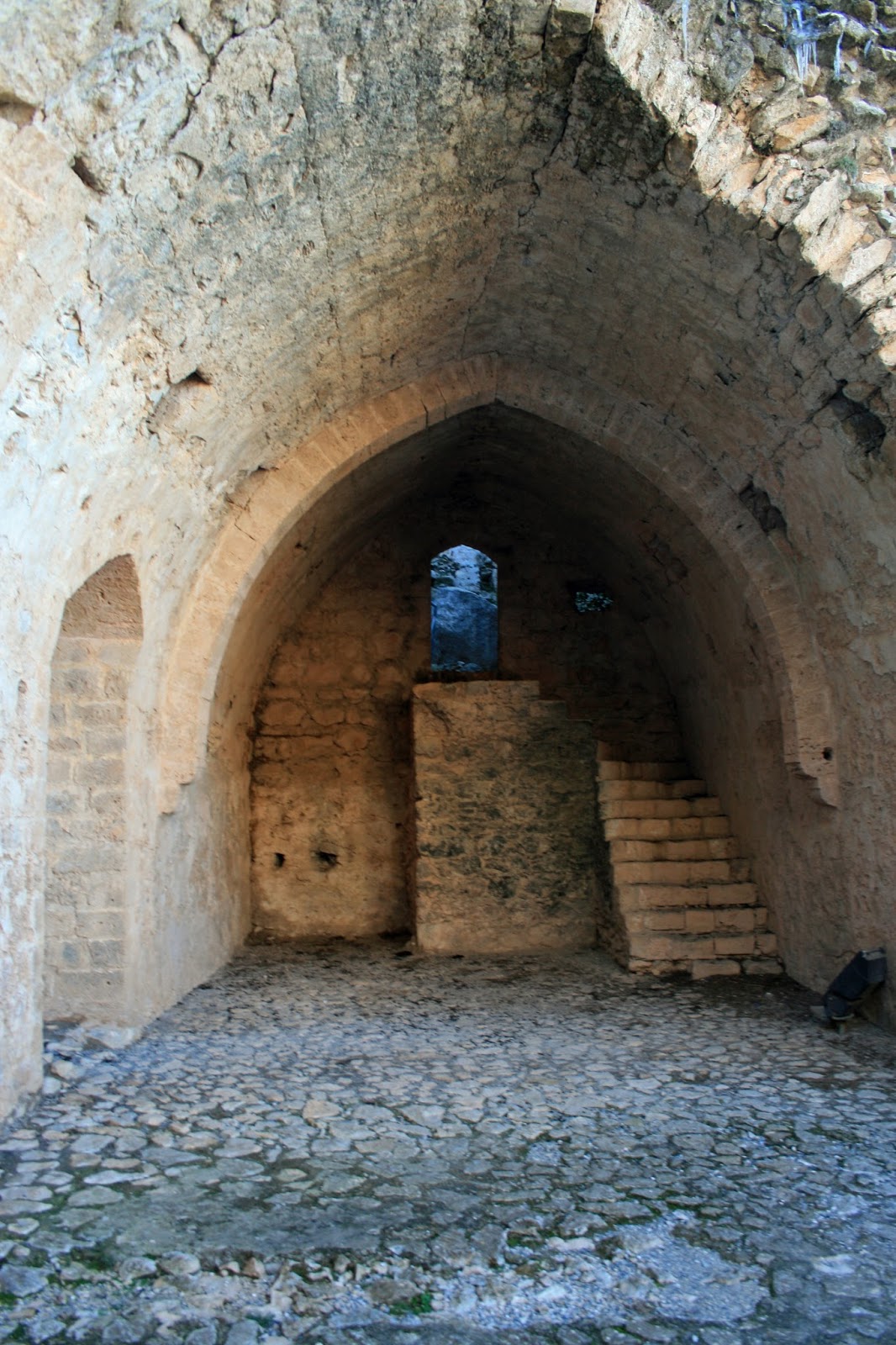
The surrounding enclosed spaces would have been either vaulted, with a wide, slightly pointed arch being the dominant, indeed iconic shape of crusader architecture, or topped by a flat roof supported by beams. A combination of these forms, with vaulted chambers on the ground floor and rooms with flat roofs above was common, but in more expensive structures double vaulted chambers at right angles to the chambers below could be stacked upon one another. A good example of this is the Hospitaller Castle of Kolossi. Below are three images of a vaulted chambers, one an upstairs chamber from the Hospitaller castle at Kolossi, one a cellar from the Byzantine/Crusader castle of St. Hilarion, and the third showing a wine or oil press in the chamber, something very common in the crusader kingdoms.


Doors and windows could be either arched or square, with the Romanesque forms of “double-” or “triple-light” windows presumably as common in the Holy Land as in the countries of the crusaders’ origin. Below is a lovely example of a medieval portal in Jerusalem, and two examples of windows form St. Hilarion and Krak de Chevaliers respectively.


Because there were major glass producing centers in the crusader states (notably Tyre and Beirut), window glazing was more common in the crusader states than in the West, a fact supported by both archaeological finds and descriptions. Below is an example of crusader glass manufacture, while the context is different, again this glass demonstrates the very high quality of the industry generally.


Archaeological evidence suggests windows in the crusader kingdoms used both plate glass and round glass set in plaster (the latter being presumably much cheaper and more common). To the left is an example of the round glass technique used here in the Templar Church in Famagusta, Cyprus.


As the description at the start of this essay indicated, interior décor could include polychrome marble, but mosaics and glazed tiles were also common. A wide variety of crusader glazed pottery has been found, using cream colors, yellows, greens and blues. The pottery gives us some indication of what colors and motifs may have been used on floor and wall tiles. Here is one example of crusader pottery:


However, we also know that the Turks and Saracens were very fond of brilliant blues and turquoise tiles in later centuries, and these may also have been available to the crusaders. At least I like to imagine it so! To the left is an example of modern tile work just to hint at the possibilities.


As for mosaics, the description at the start of the article is perhaps the best indication of quality and the fact that life-like motifs were possible in the crusader era.  However, we should not forget that mosaics floors were very common in the Roman and Byzantine periods, and the many crusader residences in fact dated from earlier periods and retained these older tiles. Below is a picture of tiles that date back the 4th century AD and were allegedly commission by St. Helena. Particularly under the influence of the Byzantine brides of Baldwin III and Amalric I, Byzantine styles and artists were welcomed and employed in the crusader kingdoms. They would easily have produced tiles similar to this example from the Church of the Nativity in Bethlehem.


Last but not least, no description of urban architecture in the crusader states (at least for the “upper crust”) would be complete without reference to gardens. As the opening description stressed, crusader elites oriented their houses so that their (glazed) windows looked out at either views (such as the ocean) or gardens. The Holy Land offered a variety of beautiful vegetation from trees such a palms and olives, lemons and pomegranates, to flowers such as hibiscus and oleander. Crusader gardens would have been beautiful indeed.  So to conclude, here is a picture of the garden in the crusader church of St. Anne in Jerusalem today.


Note: All photos except the glass and pottery were taken by the author.

Life in the crusader kingdoms is described in my three part biography of Balian d’Ibelin:


Buy Knight of Jerusalem                                                     Buy  Defender of Jerusalem