COPYRIGHT

All content on this blog is protected by copyright.
Content used elsewhere without attribution constitutes theft of intellectual property and will be prosecuted.
Showing posts with label crusader architecture. Show all posts

Saturday, September 5, 2026

LIfe in the Crusader States: Architectural Decoration

The most important remnants of Frankish art dating from the twelfth century are the decorations of the key crusader shrines: The Church of the Holy Sepulchre (Jerusalem), the Church of the Nativity (Bethlehem) and the Church of the Annunciation (Nazareth), as well as lesser crusader structures such as the Church of St. Anne, the Baptistry on the Temple Mount and the Templar and Hospitaller Headquarters.

Mosaics in the Church of the Nativity, Bethlehem

The Church of the Holy Sepulchre was dedicated on the fiftieth anniversary of the crusader capture of Jerusalem on 15 July 1149. The decorations which adorned the new structure reflected Roman, early Christian, Byzantine, Romanesque and even Arab decorative motifs along with Franco-Italian imagery. This was achieved by employing artists and craftsmen from the West and East, sculptors, masons, masters of mosaic work, and painters. Altogether, ‘it was a magnificent ecumenical statement of East and West unified in this unique Crusader sculptural ensemble’.[i]

The Church of the Nativity, the next spectacular renovation of the Frankish era, exhibits even more Eastern influence primarily because the Byzantine Emperor Manuel I was a joint sponsor of the project along with King Amalric. Here, mosaics dominated the decorative scheme, building on the remnants of the sixth-century church while adding new mosaic panels. The latter were designed and executed under the guidance of a Byzantine master by Frankish, Venetian and Byzantine craftsmen. Texts worked into the mosaics are in Greek, Latin and Syriac. In addition to the extensive mosaics, the columns were painted.

Work on a major church in Nazareth to mark the site of the Annunciation did not begin until after 1170. It was an ambitious project, with a 73-metre nave. The decoration differed dramatically from Bethlehem and Jerusalem, emphasizing sculpture rather than mosaics or frescoes. Work was not completed before Saladin’s invasion in 1187, and five of the column capitals intended for the church were buried for safekeeping. These have since been discovered and the outstanding quality of these figures initially led scholars to suspect a sculptor from southern France. Now, however, it is widely accepted that the artist was local — bearing witness to the high standard achieved by local artists in this period. The figures of the portals, tragically, have survived only as broken fragments because Baybars razed the church in 1263.

Much of the stonework done for Templar headquarters in Jerusalem, on the other hand, survived through reuse in Islamic structures because human figures were not depicted. It can be seen today, particularly in the Al-Aqsa mosque. In addition, based on sixteenth-century sketches, it appears the tombs of the first seven rulers of Jerusalem were excellent works of art. Unfortunately, the tombs themselves were severely damaged when Jerusalem fell to the Khwarazmians in 1244 and later utterly destroyed in an a fire in 1808.

Likewise, nothing remains of the furnishings and decorations of Frankish dwellings. Nevertheless, visitors from the West frequently commented on the interior adornment and paintings of the houses in the Latin East, albeit without providing descriptions precise enough to enable us to visualise them. The account of the hall in Beirut’s palace cited earlier informs us that artisans capable of producing everything from water-spewing dragons to polychrome marble that imitated flowers or hanging curtains and paving stones that mimicked ripples in the sand could be found in the crusader states. For those who could not afford polychrome marble, there was glazed and painted ceramics, wood, and plaster. The two latter media could be painted in monochrome colours or with patterns, foliage or entire scenes.



[i] See note 10, Folda, Crusader Art, 44.

The bulk of this entry is an excerpt from Dr. Schrader's comprehensive study of the crusader states.

Dr. Helena P. Schrader is also the author of six books set in the Holy Land in the Era of the Crusades.


           Buy Now!                                                  Buy Now!                                                    Buy Now!
 

          Buy Now!                                               Buy Now!                                                      Buy Now!


Friday, September 23, 2016

Hygiene in the Crusader States: Of Baths, Aqueducts and Sewers


One of the most persistent myths about the Middle Ages is that people did not bathe regularly and went around dirty and stinking. This is demonstratively not true. The Medievalists.net have published a good and lengthy post on the topic (Bathing in the Middle Ages), which provides a great deal of documentation and detail (such as Paris having 32 public baths in the 13th century and King Edward III installing taps for hot and cold running water in his palace at Westminster.) This entry is not intended to recount or compete with that or other sources, but rather focus on the unique traditions of "Outremer" or the Crusader States.

All the Crusader States established in the course and subsequent to the First and Third Crusades were in locations that had been under Greek influence since Alexander the Great at the latest. They had also been part of the Ancient and Eastern Roman (Byzantine) Empires before coming under Arab and Turkish influence from the 7th to 11th centuries AD. This means that for the native population the predominant traditions with respect to personal hygiene came not from the Germanic tribes, Vikings or Celts, but from Greece, Rome, Egypt, and Arabia.

Whereas bathing in Western Europe is usually depicted in small, wooden tubs with curtains over them...


..the baths of any Roman town were gracious, spacious and elegant, often open to the skies in a series of atriums surrounded by colonnades.  They were public spaces in which men conducted business and politics. The baths of Turkey and Arabia, on the other hand, while darker and more inward-looking, nevertheless were sumptuous with domed roofs and elegantly furnished with marble floors, benches, and fountains. They were less important for business and politics but all the more important culturally because of the emphasis Islam places on personal cleanliness. Both the Greco-Roman and Arab/Turkish traditions shared the principle of having both hot rooms for steaming/sweating (like a sauna) and cold rooms for washing off. Both also integrated massages with fragrantly scented oils into the bathing experience.

When the crusaders arrived in Outremer they found a large number of functioning bathhouses, particularly of the later (Turkish/Arab) type, already in place. Far from scorning, abandoning, dismantling or altering their function, the Frankish settlers adopted them readily -- rather like ducks to water, one might say.  Indeed, they started building their own, and archaeologists have identified a number of Frankish baths. These include baths in the Hospitaller and Templar headquarters in Jerusalem, at or near the monastery on Mt. Zion, at Atlit, a bathhouse on the Street of Jehoshaphat near the convent of St. Anne, and another in the Patriarch's quarter. (For more details I recommend Adrian J. Boas' excellent works Jerusalem in the time of the Crusades and Crusader Archaeology.) 

The Frankish settlers in Outremer adopted some of the bathing customs as well. Thus, while men and women bathed jointly in Western Europe, they probably bathed separately (either in separate spaces or at different times) in Outremer, although this is not 100% certain. The crusaders certainly adopted the custom of massages with scented oils stored in lovely glass vessels produced locally.


It wasn't only the bathhouses that the Frankish settlers of Outremer inherited from their predecessors. They also inherited Roman aqueducts and sewage systems. The Greeks (both Ancient and Byzantine) and Romans were famous for building very sophisticated and extensive networks for bringing fresh water to the public fountains of their cities, often from many miles away. The Franks followed this example and built a number of their own. Thus while cities dating from the Roman period or earlier had Roman aqueducts that the crusaders merely needed to maintain, the construction of new castles, new towns or water-intensive industry such as sugar plantations, brought forth new aqueducts that clearly date from the crusader period.


In crusader times, the city of Caesarea was served by no less than three Roman aqueducts. All photo copyrights: www.romanaqueducts.info
Likewise, the ancient cities were served by extensive (and again very solid and sophisticated) sewage systems. These consisted both of stone-faced drains and stone or pottery pipes. The Byzantines, for example, used pottery pipes to bring sewage down the outside of their residences from upper stories to underground sewage systems. Frankish castles had extensive latrines with sewers that emptied well below the level at which people lived. While rooftop cisterns and tanks provided the means to flush out these latrines with water (as we know castles in England did a hundred and fifty years later), the archaeological evidence is insufficient to verify the practice in the Holy Land. Archaeological evidence of highly sophisticated drainage systems to divert underground streams, however, have been uncovered, and the level of engineering skills available to the Frankish settlers of Outremer should not, therefore, be under-estimated.

To conclude, there may be a direct link between the hygienic conditions in Outremer and the hot-and-cold running water of Edward III and the Black Prince. The bulk of the crusaders, including Richard the Lionheart and Edward I of England, returned home, and by the time they went home they had probably become fond of the higher standards of hygiene enjoyed by the Frankish settlers -- the very standards that had induced the crusaders to ridicule the native "poulains" initially. (See Clash of Cultures)  The large number of crusaders returning particularly to France, Germany, and England may, in fact, explain the fact that Western Europe saw a flourishing of "bathhouse culture" in the 12th - 14th centuries. 

Throughout my Award-winning "Jerusalem" trilogy I endeavor to depict the lifestyle of the characters as realistically as possible.

                                                                                                                               Best Biography 2017

 Buy now!                                       Buy now!                                               Buy now!


Friday, October 23, 2015

A Home in the Holy Land


The Bishop of Oldenburg, travelling to the Kingdom of Jerusalem in 1212, was stunned by the luxury of the residences of the elite. According to Sir Steven Runciman in his "Families of Outremer," Oldenburg was particularly impressed by the Ibelin palace in Beirut: 

Its windows opened some on the sea, some on to delicious gardens. Its walls were panelled with plaques of polychrome marble; the vaulted ceiling [of the salon] was painted to resemble the sky with its stars; in the centre of the [salon] was a fountain, and round it mosaics depicting the waves of the sea edged with sands so lifelike that [the bishop] feared to tread on them lest he should leave a footmark.
Unfortunately, nothing of this palace remains today and, indeed, only scattered fragments of urban secular architecture from the crusader period have survived into the present. Even these remains have largely been obscured by the changing styles and functions that have altered the appearance of crusader structures almost beyond recognition in subsequent centuries. However, descriptions such as the one cited above as well as systematic analysis of the archeological evidence enables us to imagine a great deal. As a novelist writing about the crusader kingdoms, I am compelled to utilize all existing sources, both written and archaeological — and then add a hefty dose of imagination. What follows is a short survey of the key elements that would have defined an urban dwelling in the crusader kingdoms.

Due to a general scarcity of wood, the basic building material of the Middle East in the period was stone and/or brick. The latter, and often the former, was ususally plastered over and whitewashed. Most buildings were rectangular, two to three stories high, and crowned by flat roofs that might be decoratively crenellated and/or often provided additional living space in the form of a roof-top terrace that could be shaded from the sun bycanvas awnings. Whether used in this way or not, rooftops almost always collected rain water in a cistern. This house located on Kythera is much younger (17th century Venetian), but it has many of the features of crusader urban architecture.


Most dwellings would have been built around one or a series of courtyards. These in turn would have contained fountains, wells, kitchen and formal gardens, or working space, depending on the wealth of the occupant.  The courtyard below in Jerusalem has many medieval elements and does not look so very different from what it could have looked like in the 12th century.


The courtyard below from the Hospitaller headquarters in Acre is an example of a more spectacular, 13th century courtyard and only relevant for public buildings, but it is indicative of style, taste and crusader capabilities.


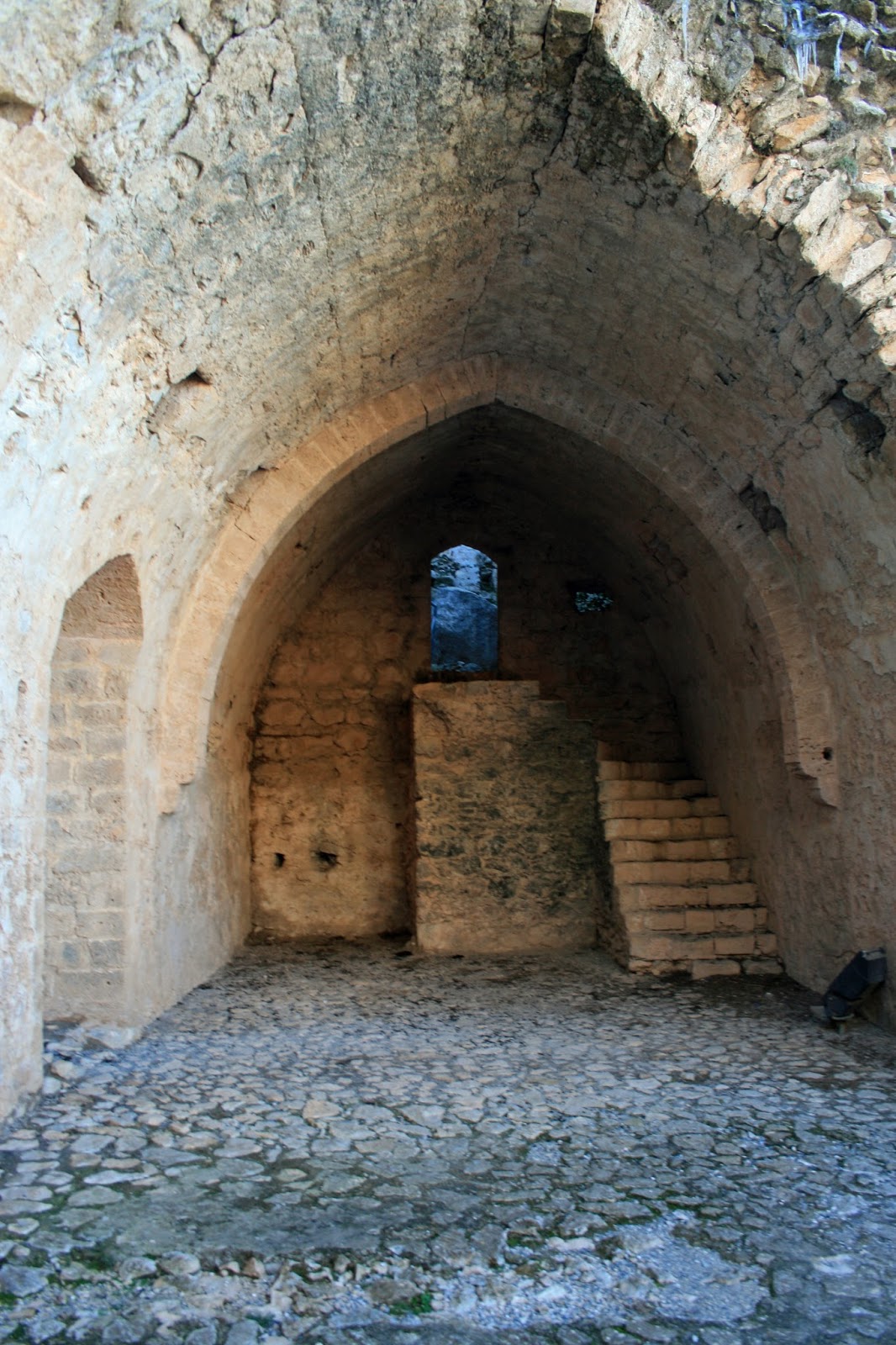
The surrounding enclosed spaces would have been either vaulted, with a wide, slightly pointed arch being the dominant, indeed iconic shape of crusader architecture, or topped by a flat roof supported by beams. A combination of these forms, with vaulted chambers on the ground floor and rooms with flat roofs above was common, but in more expensive structures double vaulted chambers at right angles to the chambers below could be stacked upon one another. A good example of this is the Hospitaller Castle of Kolossi. Below are three images of a vaulted chambers, one an upstairs chamber from the Hospitaller castle at Kolossi, one a cellar from the Byzantine/Crusader castle of St. Hilarion, and the third showing a wine or oil press in the chamber, something very common in the crusader kingdoms.


Doors and windows could be either arched or square, with the Romanesque forms of “double-” or “triple-light” windows presumably as common in the Holy Land as in the countries of the crusaders’ origin. Below is a lovely example of a medieval portal in Jerusalem, and two examples of windows form St. Hilarion and Krak de Chevaliers respectively.


Because there were major glass producing centers in the crusader states (notably Tyre and Beirut), window glazing was more common in the crusader states than in the West, a fact supported by both archaeological finds and descriptions. Below is an example of crusader glass manufacture, while the context is different, again this glass demonstrates the very high quality of the industry generally.


Archaeological evidence suggests windows in the crusader kingdoms used both plate glass and round glass set in plaster (the latter being presumably much cheaper and more common). To the left is an example of the round glass technique used here in the Templar Church in Famagusta, Cyprus.


As the description at the start of this essay indicated, interior décor could include polychrome marble, but mosaics and glazed tiles were also common. A wide variety of crusader glazed pottery has been found, using cream colors, yellows, greens and blues. The pottery gives us some indication of what colors and motifs may have been used on floor and wall tiles. Here is one example of crusader pottery:


However, we also know that the Turks and Saracens were very fond of brilliant blues and turquoise tiles in later centuries, and these may also have been available to the crusaders. At least I like to imagine it so! To the left is an example of modern tile work just to hint at the possibilities.


As for mosaics, the description at the start of the article is perhaps the best indication of quality and the fact that life-like motifs were possible in the crusader era.  However, we should not forget that mosaics floors were very common in the Roman and Byzantine periods, and the many crusader residences in fact dated from earlier periods and retained these older tiles. Below is a picture of tiles that date back the 4th century AD and were allegedly commission by St. Helena. Particularly under the influence of the Byzantine brides of Baldwin III and Amalric I, Byzantine styles and artists were welcomed and employed in the crusader kingdoms. They would easily have produced tiles similar to this example from the Church of the Nativity in Bethlehem.


Last but not least, no description of urban architecture in the crusader states (at least for the “upper crust”) would be complete without reference to gardens. As the opening description stressed, crusader elites oriented their houses so that their (glazed) windows looked out at either views (such as the ocean) or gardens. The Holy Land offered a variety of beautiful vegetation from trees such a palms and olives, lemons and pomegranates, to flowers such as hibiscus and oleander. Crusader gardens would have been beautiful indeed.  So to conclude, here is a picture of the garden in the crusader church of St. Anne in Jerusalem today.


Note: All photos except the glass and pottery were taken by the author.

Life in the crusader kingdoms is described in my three part biography of Balian d’Ibelin:


Buy Knight of Jerusalem                                                     Buy  Defender of Jerusalem