COPYRIGHT

All content on this blog is protected by copyright.
Content used elsewhere without attribution constitutes theft of intellectual property and will be prosecuted.
Showing posts with label Medical practitioners. Show all posts

Saturday, December 20, 2025

Knights Hospitaller - The Oldest Military Order

Of the many "militant orders," the Knights Hospitaller, were the oldest and the most enduring.  Today I pay a tribute to them with a short summary of their history. 


The roots of the Knights of St. John of Jerusalem go back before the First Crusade. In about 1070, a hospice for pilgrims was established near the Church of the Holy Sepulcher with funds from Italian merchants and staffed by Benedictine monks and nuns. Although the Benedictines were expelled from Jerusalem before the arrival of the first crusaders, they returned after Jerusalem was in Christian hands, and with help from the Christian secular authorities, re-established a hospital. Soon, further grants of money and land from the Christian lords enabled the monks to establish a chain of hospitals throughout the Holy Land and to set up hospices at the embarkation ports for pilgrims setting out from Europe or returning from Outremer. The monks and nuns running these hospitals and hospices soon became known as the “Hospitallers.”

In 1113, the monks of the Hospital (also referred to as the Brothers of St. John and the Brothers of the Holy Sepulcher) requested and received from the Pope the right to become an order in their own right. This new order, as with the Templars a decade later, was made directly subordinate to the Pope, and in or about 1130 it adopted the Augustine Rule. Meanwhile, this new order was rapidly acquiring significant donations in land and treasure in both the West and in the Holy Land, a reflection of the undiminished support for a Christian-controlled Holy Land.

The "Hospital" in Acre is still massive and impressive; the Hospital in Jerusalem was much larger.
Photo by H. Schrader 
Nevertheless, the Hospital of St. John remained a traditional monastic order. Although it had been granted the explicit right to defend its properties and pilgrims, members of the Order were prohibited from bearing arms. As a result, throughout the 12th century the Hospital was dependent for its protection on knights who owed feudal duty to the Hospital via their landholdings, voluntarily offered their services, or were hired mercenaries. These defensive forces, whatever their source, must have been substantial, however, because the Hospital was given very powerful fortresses, notably the most impressive crusader castle of them all: Krak des Chevaliers.
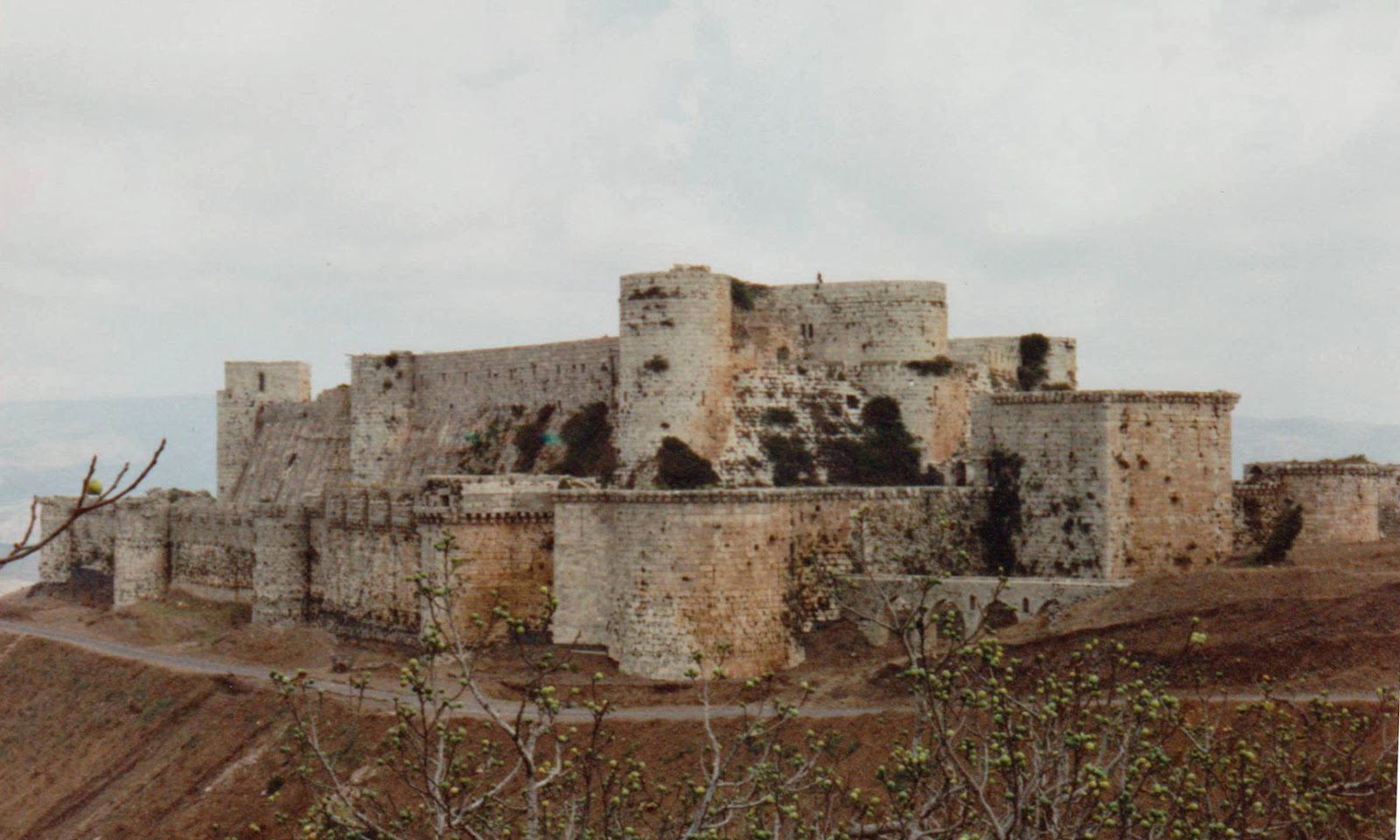
Krak de Chevaliers in Modern Day Syria. Photo by H Schrader
It would have been pointless to turn over such vitally important military resources to an order incapable of maintaining and defending them, but the exact status of the Hospital’s fighting men remains obscure until 1206 when the Hospitaller Rule was changed to allow for fighting monks. Thereafter, the Hospitallers began to recruit fighting men, probably starting with those who were already associated with it in some way, and like the Templars, they had both knights (men of noble birth) and sergeants. Within a very short time, the knights dominated the Order. The Hospitallers, however, continued to have priests, monks, and nuns devoted solely to the care of the sick, and the network of hospitals was not abandoned. At about this time, the entire Order adopted black robes (reminiscent of their Benedictine origins) adorned with a white cross. One notable difference with the Templars, however, was that there was no distinction in dress between the knights and the sergeants of the Hospital.

The Hospitallers, like the Templars, warned new recruits that “… when you desire to eat, it will be necessary for you to fast, and when you would wish to fast, you will have to eat. And when you would desire to sleep, it will be necessary for you to keep watch, and when you would like to stand on watch, you will have to sleep. And you will be sent this side of the sea and beyond, to places which will not please you, and you will have to go there. It will be necessary for you, therefore, to abandon all your desires to fulfill those of another and to endure other hardships in the Order, more than I can describe to you.” (Barber, Richard, The Knight and Chivalry, p. 275) Like the Templars, the Hospitallers vowed poverty and chastity as well as obedience.

Austere Monastic Accommodation; in this case the Cistercian Monastery of Fontfroid
The similarity between the two powerful militant orders led to open rivalry between them for recruits, resources, and power in the first half of the 13th century. This led on occasion to open fighting between members of the orders on the streets of Acre and Tripoli, but more often to subtle maneuvering behind the scenes. For decades, the Hospitallers and Templars consistently backed rival claimants to the throne of Jerusalem and rival Italian trading communities. As the end of Christian Palestine neared, however, the Hospitallers and Templars put aside their differences and jealousies to rally to the now lost cause. In the last decades of Christian Palestine, Hospitallers and Templars fought side by side, ferociously and futilely, at Antioch, Tripoli, and finally Acre.

After the fall of Acre, the Hospital also relocated its headquarters to Cyprus, but conflict with the King of Cyprus convinced the leadership of the Hospital (evidently more flexible, imaginative, and analytical than the tragic Jacques de Molay) of the necessity for independence from secular authority. The Hospitallers undertook the capture of the island of Rhodes from Turkish forces in 1306, finally seizing the capital city in 1309. With this move, the Hospitallers removed themselves, and the bulk of their movable treasure, from the grasp of Philip IV – or any king inclined to follow his example. Even more important, however, from this island base the Hospitallers built up a powerful fleet capable of challenging the naval power of the Turks and of launching hit-and-run raids into Saracen territory. The Hospitallers had “reinvented” themselves and had found a new justification for their existence.

Hospitaller Castle at Kolossi, Cyprus. Photo by H. Schrader
The Hospitaller fleet remained a significant force protecting Christian shipping and commerce throughout the next two and a half centuries. The base of this fleet on Rhodes, so close to the Turkish coast, was a constant provocation to Turkish, rulers. Numerous attempts were made to capture Rhodes, notably in 1440, 1444, 1480, and 1522. During the first 3 sieges, the Hospitallers withstood vastly superior numbers, in one case (1444) driving off the enemy with a daring sortie from within the city. On the other two occasions, they were rescued by the timely arrival of a relieving fleet from the West. In 1522, an army allegedly 100,000 strong attacked a force of just 600 knights and 4,500 local auxiliaries. After 2 months of bombardment a breach in the landward wall was made, yet 3 assaults through the breach, carried out with complete disregard for casualties, failed. Sultan Suleiman called off the costly assaults and settled down for a long siege, cutting Rhodes off from all relief. Recognizing the hopelessness of their situation, the surviving Hospitallers, now more commonly called Knights of St. John, surrendered on honorable terms.


When the Hospitallers withdrew on their ships from Rhodes, they were effectively homeless, but Emperor Charles V offered them the island of Malta as their new headquarters. From here they continued to operate their fleet so effectively that Sultan Suleiman decided he had to dislodge them from their new home. In 1565 he again assembled a large siege force. The Knights of St. John had 500 knights of the Order and 10,000 other troops. The Turks launched their first attack in May and after a month of fighting captured an outlying fort, slaughtered the garrison, and floated their mutilated bodies across the harbor to the main fortress as a warning of what was to come. The Hospitallers replied by executing Turkish prisoners and catapulting their heads into the Turkish camp. A Turkish assault on the main fortifications was undertaken on July 15, and a breach in the walls effected by August 7. Yet two assaults through the breach, on August 19 and 23, both failed. On September 7 a Spanish fleet arrived from the West and scattered the demoralized Turkish forces. The defense of Malta had cost the Hospitallers half their knights and 6,000 of the other defenders.

A dramatic 19th century of the Hospitaller defense of Malta.

Thereafter, the Knights of St. John focused again on making the seaways of the Mediterranean safe for Christian shipping, a task that became increasingly easy as Turkish naval power declined. But this victory, like the defeat in Acre 300 years earlier, robbed them of their raison d’ĂȘtre. The Knights of St. John, now commonly known as the Knights of Malta, slid into a slow decline. They became more involved in commerce than warfare, and their fortresses turned into palaces. When Napoleon laid siege to Malta in 1798, the last frail remnants of the once mighty Hospitaller Order surrendered in just two days.


The Hospitallers played an important role in the Holy Land in the 12th century and so also figure in my biographical novel about Balian d'Ibelin and the fall of the Kingdom of Jerusalem. 


  Buy now!                                                                  Buy now!                                                             Buy now!
 

"The Tale of the English Templar" is a fictional work that depicts the destruction of the Knight's Templar. 


An escaped Templar, an intrepid, old crusader, and a discarded bride
embark on a quest for justice in the face of tyranny. 
 
 
"St. Louis Knight" is a novel set against the backdrop of the Seventh Crusade and St. Louis' sojourn in the Holy  Land. It is now available in audiobook as well as paperback and ebook:
 
 A crusader in search of faith --
A lame lady in search of revenge --
And a King who would be saint.

St. Louis' Knight takes you to the Holy Land in the 13th century, and a world filled with knights, nobles, prophets -- and assassins. 
(Available in Audiobook)


Thursday, August 8, 2019

Medical Care in the Crusader States

It has long been thought that "Saracen" medicine was far superior to Western medicine, and film and fiction often contrast "barbaric" (not to say sadistic) Western/Christian ignorance to sophisticated and enlightened Saracen/Muslim practice. Yet recent scholarship has demonstrated that the differences between "Eastern" and "Western" medicine were far less significant than was assumed. A closer examination of the sources has also revealed that most "Eastern" physicians and practices praised by contemporaries were native Christians rather than Muslims. Perhaps most surprising of all: the standard of treatment was remarkably sophisticated and included highly complex procedures from hernia and cataract operations to (limited) brain surgery.  Below is a short comparison of Eastern and Western medicine followed by a summary of contemporary practices based Piers D. Mitchell’s seminal work Medicine in the Crusades: Warfare, Wounds and the Medieval Surgeon. Piers D. Mitchell is an osteoarchaeologist.


East meets West: Medicine in the Crusader States

Before turning to the state of medical knowledge in the crusader era, it is important to understand where it came from. On the one hand, "Saracens and Christians shared the same conceptual framework for medical science, which they inherited from the classical world." (1) On the other hand, both East and West had a body of practical knowledge for treating wounds particularly based not on theory but on experience, i.e. empirical knowledge. Whereas both Christian and Muslim physicians based their theories of medicine on classical Greek texts about the four "humors" of the body, their treatment of concrete cases of injury and illness varied based more on climate, availability of pharmaceuticals, and tradition.

It has frequently been noted by crusades historians, that the residents of Outremer were quick to turn to "Eastern" doctors, leading most commentators to assume a superiority on the part of "Muslim" doctors. There are several weaknesses to this approach. First, some of the presumed superiority was due simply to greater familiarity with both the diseases common in the Middle East and the ingredients (most derived from locally available products) available for treatment. 

More important, however, is the fact that many of these "Eastern" doctors were not Muslims at all, but rather native Christians. The fact that many native Christians of the Levant spoke Arabic by the time the Crusaders arrived and had adopted Arab-sounding names has misled students of the crusades to assume the physicians named and praised were also Muslims and their knowledge of medicine derived from Arab rather than Greco-Roman traditions. Yet, in fact, "when [contemporary] Western sources referred to 'oriental' or even 'Saracen' doctors, it usually meant only that they were natives of Outremer, and their language was Arabic. Most were probably Eastern Christians."(2)  For example, the famous and influential medical scholar Ibn Butlan was a Christian who spent most of his life in Byzantine Antioch. 


Negative views of crusader medicine have also been derived from Muslim sources. Yet, it is important to remember that the Islamic world in this period looked down on Christians as "backward" and "barbaric" based not on specific examples but rather on a fundamental world view of Islam  -- and so all aspects of Muslim society -- as inherently superior to all other religions. As the newer religion, it was understood "as being...a corrective to the misunderstandings that had crept into the religious practices of the earlier recipients of the religion of Abraham."(3)

Famously, Usama ibn Munqidh's memories highlight two examples in which European medical treatment resulted in the death of the patient. Yet these anecdotes do not prove that the procedures were standard, nor can we know if the patient died because of the treatment was inherently incorrect or incorrectly executed by the practitioner. Furthermore and often overlooked is the fact that Usama also notes two "effective cures the orientals learned from the occidentals: the use of wine to disinfect wounds, and an ointment for scrofula."(4) 

With that let me turn to a brief description of common medical procedures in the crusader states. 


Treating Trauma

Based on available records, it has been calculated that between 15 and 20 of knights on crusade died in battle or as a result of wounds obtained there; the proportion of foot soldiers lost due to military engagement was probably higher.  Nevertheless and surprisingly for modern readers, very many more survived their wounds due to competent medical treatment.

In the 12th and 13th centuries, the weapons employed produced first and foremost puncture wounds (from arrows, lances and swords), followed by cuts/amputations caused by swords and axes, fractures/crushed bones caused by maces and stones thrown from siege engines, and, last but not least burns from Greek fire, boiling pitch and water. The fundamental treatment for each of these kinds of wounds does not differ significantly from what is recommended today.

Medieval medical practitioners and soldiers, for example, understood the essential fact that a man can bleed to death. When treating puncture wounds, stopping hemorrhaging was, then as now, the primary concern. The difference between arteries and veins was likewise understood, and the need to stop arterial bleeding as rapidly as possible recognized. The use of the tourniquet and precise cauterizing were both known, and surgeons were expected to be able to close off arterial bleeding with their fingers long enough to apply a cautery.  Not only is the procedure for this carefully described in medical texts of the period, but there are also numerous recorded instances of men surviving this treatment and recovering so completely that they could fight again without impediment.

While amputations were likewise cauterized and cuts were bound, or if necessary, sewn back together, arrows presented additional problems. Although it would have been rare for an arrow to hit an artery, the arrow itself often remained in the wound and the need to remove it was paramount. But many arrows were designed to do more damage if pulled backwards (out the way they went in) by the addition of barbs or the shape of the arrowhead itself.  Medieval surgeons, therefore, had the option of pushing it through the injured man and out the other side or waiting for the wound to putrefy and the surrounding tissue to become soft enough to make it easier to remove.  Horrible as this sounds, the fact that many knights are described fighting with multiple arrows stuck into their armor suggests that it may have been comparatively rare for an arrow to become so deeply embedded that it was life-threatening ― without killing outright as in the case of arrows to the throat, eyes, armpits, etc.

In the case of broken bones, the need to set bones to ensure they mended straight and functional was likewise recognized. Bones were held in place by splints, bandaging or plaster ― or a combination thereof. In the case of burns, the primary concern was to prevent blisters from forming and the wound from completely drying. Moist cooling the wound was thus the recommended treatment, whether by means of placing the affected limb in a bowl of liquid, applying wet compresses soaked in herbs or the application of ointments.
 
Anesthetics

Surprisingly (at least for me), the use of anesthetics during operations or the treatment of wounds was common.  An anesthetic was given to the patient either in a drink (usually wine) or placed on a sponge that was then held to his/her nose. Mitchell notes that the various plants recommended for preparing anesthetics (e.g. henbane, hemlock, poppy, deadly nightshade, mandragora root and lettuce seed to name a few) have been demonstrated to have pain-killing and or sedative effects. He hypothesizes that “cocktails” combining several of the recommended ingredients could have been very potent ― and dangerous if the dose was miscalculated or the extracts improperly prepared. Patients in the crusader states were lucky to have ready access to one of the most effective narcotics known to man: opium. Mitchell writes that there is evidence of its use for medicinal (rather than recreational) purposes by the Franks in the crusader states.
Infection

While the fatal danger of infection was widely recognized and feared, the cause was not understood. As a result, some medieval medical practices contributed to infection. Once infection occurred, however, medieval doctors attempted to cure it. The successful use of vinegar, which has strong antiseptic properties, is recorded in treating festering wounds and severe burns, for example. Medieval doctors also understood the need to drain festering wounds.  Mitchell notes no significant differences between crusader treatment for infection that standard practice elsewhere.
 
Next week I will address the evolution of hospitals, something Edgington describes as the most impressive development in crusader medical care. (5)


1. Susan B. Edgington, "Oriental and Occidental Medicine in the Crusader States," in The Crusades and the Near East: Cultural Histories (London: Routledge, 2011), 189. 
2. Edgington, 197.
3. Niall Christie, Muslims and Crusaders: Christianity's Wars in the Middle East, 1095-1382, from the Islamic Sources (London: Routledge, 2014), 77.
4. Edgington, 201.
For the description of contemporary medical treatments, the principal source is Medicine in the Crusades: Warfare, Wounds and the Medieval Surgeon, by Piers D. Mitchell, Cambridge University Press, 2004.
5. Edgington, 208.

Throughout my award-winning, "Jerusalem" trilogy and my newer books lifestyle in Outremer is depicted as realistically as possible.

                                                                                                                               Best Biography 2017

 Buy now!                                       Buy now!                                               Buy now!


         Buy Now!                                                   Buy Now!                                             Buy Now!


Dr. Helena P. Schrader holds a PhD in History.

She is the Chief Editor of the Real Crusades History Blog.
She is an award-winning novelist and author of numerous books both fiction and non-fiction. Her three-part biography of Balian d'Ibelin won a total of 14 literary accolades. Her current series describes the civil war in Outremer between Emperor Frederick and the barons led by John d'Ibelin the Lord of Beirut. Dr. Schrader is also working on a non-fiction book describing the crusader kingdoms. You can find out more at: http://crusaderkingdoms.com

Thursday, April 20, 2017

Medical Practitioners in the Crusader Era

It is often assumed that the people who practiced medicine in the Middle Ages were ignorant, untrained, guided by “pure superstition” and accountable to no one. In today’s post, the second in a series of guest essays by German scholar Fermin Person, we look at medical practitioners and standards in the Crusader States.


In today’s world, the permission to practice medicine (prescribe medication, operate etc.) is usually closely regulated by the state. 

In the west during 11th – 13th century several distinctions were made between the grades of knowledge and practical training a medical practitioner had. 

A rather small group were called physicus / fisicien. They had a high degree of knowledge for their time, combining the study of liberal Arts at a university with medical education. The title of physicus/fisicien usually implied the degree of magister because of the received education in liberal Arts. The centres for learning in the Latin west were Salerno, Montpellier, Paris, Bologna, Cambridge, Oxford or Padua. It was at these universities that the physicus/ficicien were trained.

Notably, there are examples of female physicians such as Hersende. Hersende was physician to Louis IX and accompanied him during the crusade to Egypt (1248-50).

The term medicus/ miege /mire was used for all types of doctors during the medieval period. They would take the patients history, examine them and treat them, for example with diet, medication or bloodletting. To some degree they also practiced surgery.

The profession of cyrurgicus (surgeon) was considered a trade rather than a profession. It was learned via an apprenticeship, until the end of the 13th century when it started to be studied on the universities of the Latin west. Cyrurgici were commonly seen as less well educated, were worse paid and had a lower social status than physici. Surgery was seen by medici as a manual trade along the line of carpentry or stone masonry. During the late 13th century cyrurgici with the title of master, indicating their academic education started to appear. Their task was the treatment of wounds as well as the treatment of illnesses that could be seen from the outside (like leprosy or venereal diseases) or might require a surgical treatment.

The profession of berberus /rasorius was likewise a trade learnt via an apprenticeship. Their task was to shave as well as to care for wounds in time of need.

Similarly, the minutor/phlebotomus/sangunator was a specialist tradesman that only did bloodletting. He was also educated during an apprenticeship and would follow the orders of a physician or blood-let on the request of a patient.

The apothecarius/ herbolarius/ spicer prepared medicine according to the orders of a medicus or he could sell the medicine directly to the patients. 

Despite the restrictions that were placed on medical education of clergyman during the council of Tours many physicians (physicus/fisicien) were clergyman. Apart from minor restrictions by the fourth Lateran council for subdeacons, deacons and priests, clergyman could practise surgery to the full extant.

The known sources suggest a strong influx of European physicians and surgeons as well as barbers to Outremer. However, there is also documentary evidence for local Christian and Jewish physicians. Furthermore, there seem to have been Muslim physicians as in the hospital of St John in 12th century Jerusalem there were two versions of an oath for newly hired surgeons, supposedly allowing also non-Christians to practise. In addition, a decree of the Frankish church of Nicosia forbade their employment in a church run hospital. Note, however, that we have no comprehensive records of the overall numbers and qualifications of medical practitioners, but are instead dependent on predominantly juridical documents where physicians stood witness for testaments etc.

Medical Standards in the Crusader States

The crusader states seem to have adopted and modified the Muslim system of hisbah.

In the Muslim system of hisbah an official called the muhtasib (in Frankish mahteseb) controlled quality standards of crafts. In the Frankish adoption of the system (found in the commentaries of the legislation of the kingdom of Jerusalem the “Assis de la Cour de Bourgeois” from 1240-44) a council of the best doctors of a town under the provost of the local bishop licensed a physician.

Therefore a thorough examination was conducted by the council of physicians. If a candidate did not show sufficient knowledge he was forbidden to practice medicine.
If he practiced medicine without a license he was beaten out of town. A similar system developed about the same time in the kingdom of Sicily.

Excurs: Medical negligence in the Laws of the Kingdom of Jerusalem
The Assis de la Cour des Bourgeois from 1240-44 is our principal source about medical legislation in the crusading states. It lays out the mechanisms of medical licensing and punishment for medical negligence. 
In case of medical negligence, a distinction is made if the victim is a slave or a free man.
Furthermore, a distinction is made if the illness can be realistically healed by a physician (like a bone fracture) or not (like measles).

If a physician crippled or killed a slave because of medical negligence he was bound to pay compensation to the owner.

If a physician killed or crippled a free man because of medical negligence he was submitted to various physical punishments such as the amputation of the right thumb or even hanging.


Sources 


Mitchel, Piers D.  (2007) Medicine during the crusades, Cambridge University press

Tony Hunt (1999) The Medieval Surgery, Boydell & Brewer Inc

Edgington, S. (1994) Medical knowledge of the crusading armies: the evidence of Albert of Aachen and others. In M Barber, The Military Orders: Fighting for the Faith and caring for the Sick, (Aldershot, Ashgate)

Keda, B (1998) A twelfth century description of the Jerusalem Hospital, In H. Nicholson (ed.). The Military Orders. II Welfare and Warfare (Aldershot: Ashgate), pp. 3-26.

Medical the Jerusalem Trilogy the comparatively high standard of medical care in the crusader states is recognized.


Buy now!                                         Buy now!                                        Buy now!