COPYRIGHT

All content on this blog is protected by copyright.
Content used elsewhere without attribution constitutes theft of intellectual property and will be prosecuted.
Showing posts with label Knights Hospitaller. Show all posts

Saturday, January 24, 2026

The Templars at the Fall of Acre 1291

The establishment of the Crusader States in the Holy Land gave birth to the Knights Templar and the fall of the last bastion in Latin Syria to the Mamlukes in 1292 was the death-knell of the Order. Yet while the fall of Acre ultimately doomed the Templars, it was in some ways 'their finest hour.'


With the gruesome murder of the Ayyubid Sultan Turan-Shah before the eyes of the crusaders in 1250, a new regime came to power in Egypt: the Mamlukes. These slave-soldiers, long known for their fanatical loyalty to their masters, introduced a brutal regime (still remembered with hatred in Egypt today). Soldiers by profession, they lacked the education and appreciation for science, scholarship, theology and literature that had characterized earlier dynasties. To keep their own slave-soldiers from repeating their example, the Mamluke sultans sought to buy the loyalty of their subjects with plunder and slaves. 

Meanwhile, the Mongols first eliminated the Assassins in 1256 and then, in 1258, took Bagdhad, instituting an unprecedented slaughter of all the inhabitants. By 1260, the Mongols had destroyed the remaining Ayyibids in Syria, but the Mamlukes managed to decisively defeat the Mongols at the Battle of Ayn Jalut in 1260. This victory gave the Mamlukes control of all of Saladin's former empire, although power remained centralized in Egypt. With the Mongol threat banished, the Mamlukes turned their attention to the elimination of the Frankish states -- less out of religious devotion (jihad) than greed. 

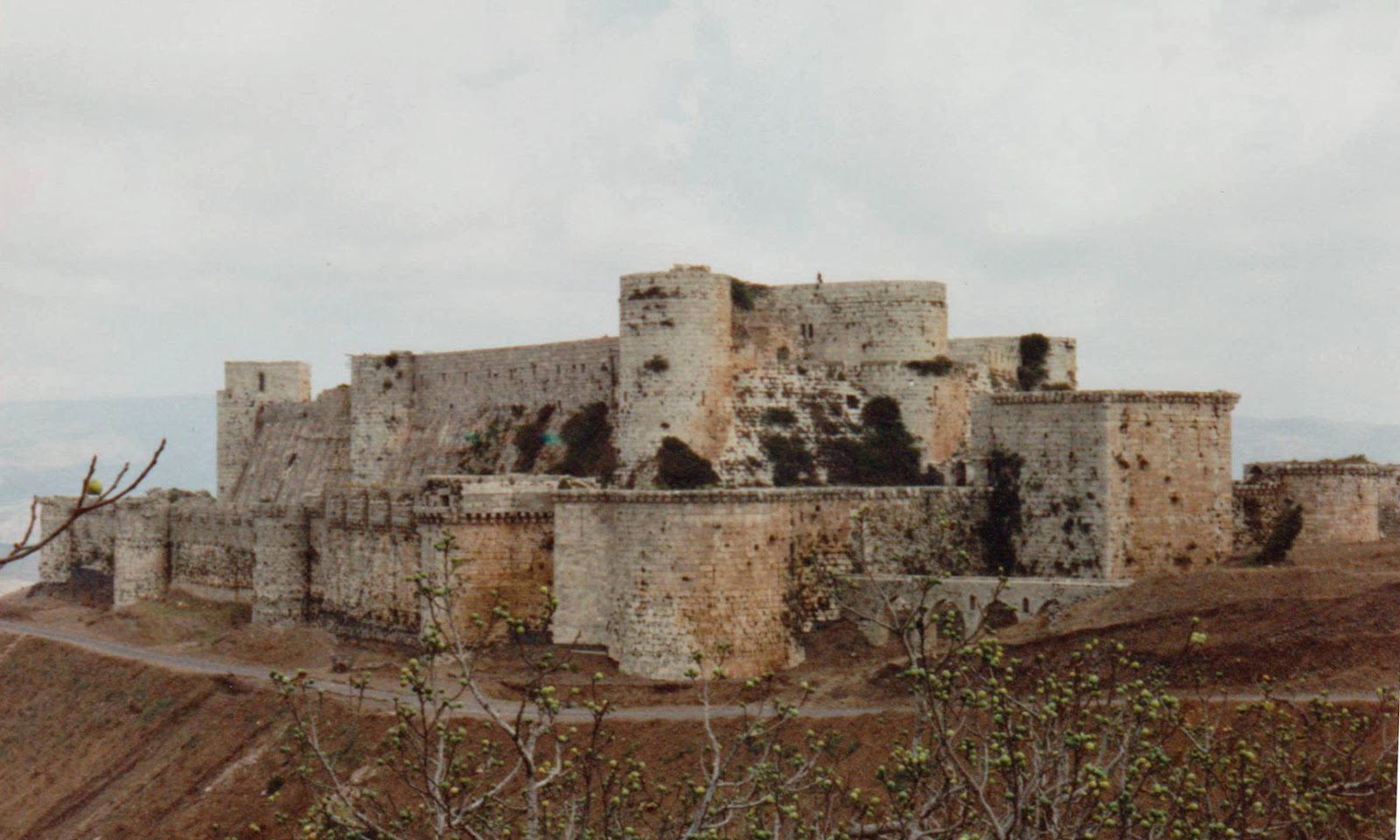
Under the Mamluke Sultan Baibars the onslaught began. In 1265, Baibars captured Caesarea and Haifa. The following year, the first assault on Acre was defeated, but at very high cost. In 1268 Jaffa and then the mighty Christian city of Antioch fell to the Mamlukes. In 1271, the Hospitallers lost their mightiest fortress, Krak de Chevaliers, and the Templars lost Safita. Each time, the defeated, whether they had offered terms or not, were slaughtered (if an adult male) or enslaved (if female or underage). The brutality of the conquering troops appalled the contemporary world.

Krak de Chevaliers today. Copyright H.Schrader

St. Louis' last crusade, although it stalled in Tunis due to the King's death of dysentery, temporarily diverted Baibar's attention, and the arrival of Edward of England with a strong force in Acre induced Baibars to sign a ten year truce.  Edward provided funds to help fortify the defenses of Acre before returning to England to take up the English crown as Edward I

Baibars died during the truce in 1277, and by now the Mongol threat was so great that his successor Kalaun (also spelled Qalawun and Kalavun) renewed the truce for another ten years. After defeating the Mongols, however Kalaun felt strong enough to turn his attention back to the Franks. In 1289, despite the truce, he attacked and took the city of Tripoli, instituting slaughter and destruction on a scale comparable to the Mongols. Tragically, the Templar Master William de Beaujeu, had received a message from a Muslim friend, Emir al-Fakhri, warning that Tripoli was about to be attacked. He had sent the warning onto Tripoli -- but had not been believed. 


 Remnants of the Citadel in Tripoli today. Copyright Michelle Foltz

The next year, with the truce still allegedly in effect,  newly arrived crusaders killed some Muslims in Acre in a general fight. Kalaun immediately demanded "reparations."  Beaujeu proposed that the city empty its jails of men already condemned to death and send them to the Sultan; the city rejected his proposal indignantly.  Kalaun responded by mobilizing his army while assuring the Franks it was being raised to attack enemies in Africa. Again, Beaujeu heard from al-Fakhri that the real target was Acre and he again warned the citizens, and, according to some sources, suggested the citizens pay a ransom to buy off Kalaun. Again, they refused.

In November 1290 Kalaun died, but his son al-Ashraf was only more determined to destroy the Christian footholds in the Levant. He was not even prepared to talk, throwing all emissaries, including Templars, in prison. In March 1291, al-Ashraf announced his intention to "avenge all wrongs done" in a letter to Master de Beaujeu, and on April 5 his army took up its position around Acre.

Acre had long been the economic heart of the crusader states. It had a natural harbor that had been improved upon with break-waters and it was a busy port for all goods transiting from the Europe to the Orient. It was home to all the Italian merchant communities and the three militant orders. 


Modern Tourist Map depicting Medieval Acre

The Mamluke army has been estimated at 60,000 horse and 160,000 infantry (Howarth, p. 226.) While the numbers seem incredible, the reality was that the force was more than sufficient to doom the city. That much was obvious.  Particularly since the Mamlukes also brought up numerous siege engines and, of course, had engineers capable of undermining the walls. 

The Genoese, who had negotiated a separate peace with the Sultan, evacuated the city at once and with them went the women, children and infirm of those who could afford to pay the passage to Cyprus; the poor, of course, remained.  And so did the fighting men of this last remaining remnant of the once proud Kingdom of Jerusalem remained. So did the the Venetians and Pisans, and, of course, the Knights Templar and Knights Hospitaller, both under the command of their respective Masters. The total forces available to the Franks have been estimated at 600-700 knights and 13,000 infantry including crusaders still in the city. (Edbury, p. 99)

The Knights Templar and Hospitaller took over the defense of the most vulnerable salient of the city: the northern walls around the suburb of Montmusard, the Hospitallers beside them. The assaults began at once, supported by the siege engines that both hammered the walls to shake them to their foundations and sent death and fire over them into the city. 


On the night of April 14-15, Masater William de Beaujeu personally led a Templar sortie against the Mamluke camp by moonlight.  Although initially successful, the horses were tripped-up by the tent-ropes and 18 knights were killed. The Hospitallers attempted a similar sortie days later when there was no moon, but with no better results. Thereafter, the defenders made not further sorties and conducted a purely defensive battle. 

On May 4, Henry II, King of Cyprus and Jersualem, arrived from Cyprus with between 100 and 200 knights (probably the entire chivalry of Cyprus) and at most 500 infantry (Edbury, p. 99.) Clearly these forces were insufficient to alter the balance of forces. Furthermore, by now the walls were beginning to crack, while mines were being driven under them. King Henry wisely tried to negotiate, and sent two envoys to the Sultan. They were sent back with a negative reply. 

On May 18, the "Accursed Tower" located at an angle of the wall collapsed from being undermined. The defenders had to abandon the large outer suburb of Montmusard and retreat behind the walls of the old city. Soon, however, the Muslims had forced their way into the streets of the city and now the fighting was hand-to-hand. Pisans and Venetians, Templars and Hospitallers, bitter rivals in both cases, fought side-by-side "centuries of rivalry suddenly effaced." (Howarth, p. 227)

It was not until this phase of the fighting that the Master of the Hospital was wounded and -- protesting that he could still fight -- was carried to a Hospitaller ship in the harbor.  King Henry II likewise retreated to his ships with the bulk of his nobles, and withdrew to his other (stronger and more prosperous) kingdom: Cyprus. The English crusaders commanded by Otto de Grandson also broke at this point and fled. The Patriarch of Jerusalem, who had remained with the defenders until this point, likewise tried to depart but as he was rowed out to a galley, he allowed so many swimmers to climb aboard his boat that it capsized and sank. 

William de Beaujeu, Master of the Temple, was wounded in the armpit while trying to defend a breach in the walls. As he fell back, defenders still fighting begged him: "For God's sake, Lord, do not abandon us or the city is lost!" To which Beaujeu replied: "I am not fleeing, I am hurt to death -- see the wound." (Pernoud, p. 83). Two of his brothers carried him on a shield to the Temple, where he died. 

Meanwhile, with so many men fleeing, the defense collapsed completely, and the Muslims flooded into the city. They slaughtered anyone they could lay hands on, including many still on quays desperately trying to escape.  Others, civilians and fighting men both, fled behind the walls of the Temple itself.  The mighty Templar headquarters was located in the southwest corner of the city wall, backed up against the sea on the south and west.

We have no estimate of how many people were trapped inside the Templar fortress at Acre by nightfall of May 18, but it must have been hundreds and more likely more than a thousand. For five days they remained there while around them the Muslims looted, burned and slaughtered. 

On May 25, Peter de Sevrey, Marshal of the Temple and the senior officer in Acre, negotiated the surrender of the Temple at Acre on honorable terms. All those within, women and children as well as fighting men, were to be allowed to depart in exchange for the surrender of the fortress without resistance. The gates were opened and an emir with roughly 100  men entered to take control of the fortress and raise the Sultan's banner. However, either the emir did not have control of his troops or the Muslims believed the surrender terms had only applied to the fighting men. In any case, they began to sexually molest the women and children. The Templars, still armed, reacted with outrage -- killing all the Saracens within their headquarters. Knowing they now had no hope of surrender, they again raised the black-and-white Beacent defiantly over the ramparts. 


That same night, Peter de Sevrey ordered the Commander of the Temple, Tibald Gaudin to sail for Sidon from the sea gate with the "treasure" and as many civilians as could be bordered on the available boats. As the Templar headquarters had a water gate but no harbor as such, this could not have been more than a few score of people crammed in long-boats that could be pulled up inside the building itself. As for the "treasure," this may have included any cash on hand, but was far more likely Templar archives and records, and above all any holy relics from the chapel. 

At dawn the next day, the Sultan sent for Peter de Sevrey, allegedly to renew the offer.  The Templar Marshal, foolishly or defiantly, went out to meet his fate. He was beheaded within sight of those still behind the walls of the Temple. On May 28, the eastern wall of the Temple collapsed after being undermined. Thousands of Saracens rushed into the breech to slaughter the remaining Franks -- Templars, other fighting men and civilians -- but the "timbers supporting the mine could not take their weight -- and with a thundrous roar, the entire Temple of Acre collapsed, and crushed all within it." (Howarth, p. 229.)

The last Frankish city in the Holy Land, Beirut, surrendered without a fight on May 31. The remaining Templar properties in the Holy Land, Sidon, Tortosa and Castle Pilgrim (Athlit) , were evacuated on July 14, August 3 and 14th respectively. Unlike 1187, the Mamluke victory of 1291 was complete and absolute. There was not a foothold to which crusaders from the West might have returned, and, unlike the defeat of 1187, the loss of the Holy Land did not awaken a new crusade. The crusading spirit had died. 

And the Templars had just lost their very reason for existence.

Sources: 
Barber, Malcolm. The New Knighthood: A History of the Order of the Temple. Cambridge University Press, 1994.
Edbury, Peter. The Kingdom of Cyprus and the Crusades, 1191-1374. Cambridge University Press, 1991.
Howarth, Stephen. The Knights Templar. Barnes and Noble, 1982.
Pernoud, Regine. The Templars: Knights of Christ. Ignatius, 2009.
Robinson, John J. Dungeon, Fire and Sword: The Knights Templar in the Crusades. Michael O'Mara Books, 1991.
 
 
"The Tale of the English Templar" is a fictional work that depicts the destruction of the Knight's Templar. 


An escaped Templar, an old knight, and a discarded bride embark on a quest for justice in the face of tyranny. 


The Knights Templar were at the height of their popularity in the late 12th century and appear in my novels set in this period. 


 Buy now!                                                           Buy now!                                                            Buy Now!

Saturday, December 20, 2025

Knights Hospitaller - The Oldest Military Order

Of the many "militant orders," the Knights Hospitaller, were the oldest and the most enduring.  Today I pay a tribute to them with a short summary of their history. 


The roots of the Knights of St. John of Jerusalem go back before the First Crusade. In about 1070, a hospice for pilgrims was established near the Church of the Holy Sepulcher with funds from Italian merchants and staffed by Benedictine monks and nuns. Although the Benedictines were expelled from Jerusalem before the arrival of the first crusaders, they returned after Jerusalem was in Christian hands, and with help from the Christian secular authorities, re-established a hospital. Soon, further grants of money and land from the Christian lords enabled the monks to establish a chain of hospitals throughout the Holy Land and to set up hospices at the embarkation ports for pilgrims setting out from Europe or returning from Outremer. The monks and nuns running these hospitals and hospices soon became known as the “Hospitallers.”

In 1113, the monks of the Hospital (also referred to as the Brothers of St. John and the Brothers of the Holy Sepulcher) requested and received from the Pope the right to become an order in their own right. This new order, as with the Templars a decade later, was made directly subordinate to the Pope, and in or about 1130 it adopted the Augustine Rule. Meanwhile, this new order was rapidly acquiring significant donations in land and treasure in both the West and in the Holy Land, a reflection of the undiminished support for a Christian-controlled Holy Land.

The "Hospital" in Acre is still massive and impressive; the Hospital in Jerusalem was much larger.
Photo by H. Schrader 
Nevertheless, the Hospital of St. John remained a traditional monastic order. Although it had been granted the explicit right to defend its properties and pilgrims, members of the Order were prohibited from bearing arms. As a result, throughout the 12th century the Hospital was dependent for its protection on knights who owed feudal duty to the Hospital via their landholdings, voluntarily offered their services, or were hired mercenaries. These defensive forces, whatever their source, must have been substantial, however, because the Hospital was given very powerful fortresses, notably the most impressive crusader castle of them all: Krak des Chevaliers.

Krak de Chevaliers in Modern Day Syria. Photo by H Schrader
It would have been pointless to turn over such vitally important military resources to an order incapable of maintaining and defending them, but the exact status of the Hospital’s fighting men remains obscure until 1206 when the Hospitaller Rule was changed to allow for fighting monks. Thereafter, the Hospitallers began to recruit fighting men, probably starting with those who were already associated with it in some way, and like the Templars, they had both knights (men of noble birth) and sergeants. Within a very short time, the knights dominated the Order. The Hospitallers, however, continued to have priests, monks, and nuns devoted solely to the care of the sick, and the network of hospitals was not abandoned. At about this time, the entire Order adopted black robes (reminiscent of their Benedictine origins) adorned with a white cross. One notable difference with the Templars, however, was that there was no distinction in dress between the knights and the sergeants of the Hospital.

The Hospitallers, like the Templars, warned new recruits that “… when you desire to eat, it will be necessary for you to fast, and when you would wish to fast, you will have to eat. And when you would desire to sleep, it will be necessary for you to keep watch, and when you would like to stand on watch, you will have to sleep. And you will be sent this side of the sea and beyond, to places which will not please you, and you will have to go there. It will be necessary for you, therefore, to abandon all your desires to fulfill those of another and to endure other hardships in the Order, more than I can describe to you.” (Barber, Richard, The Knight and Chivalry, p. 275) Like the Templars, the Hospitallers vowed poverty and chastity as well as obedience.

Austere Monastic Accommodation; in this case the Cistercian Monastery of Fontfroid
The similarity between the two powerful militant orders led to open rivalry between them for recruits, resources, and power in the first half of the 13th century. This led on occasion to open fighting between members of the orders on the streets of Acre and Tripoli, but more often to subtle maneuvering behind the scenes. For decades, the Hospitallers and Templars consistently backed rival claimants to the throne of Jerusalem and rival Italian trading communities. As the end of Christian Palestine neared, however, the Hospitallers and Templars put aside their differences and jealousies to rally to the now lost cause. In the last decades of Christian Palestine, Hospitallers and Templars fought side by side, ferociously and futilely, at Antioch, Tripoli, and finally Acre.

After the fall of Acre, the Hospital also relocated its headquarters to Cyprus, but conflict with the King of Cyprus convinced the leadership of the Hospital (evidently more flexible, imaginative, and analytical than the tragic Jacques de Molay) of the necessity for independence from secular authority. The Hospitallers undertook the capture of the island of Rhodes from Turkish forces in 1306, finally seizing the capital city in 1309. With this move, the Hospitallers removed themselves, and the bulk of their movable treasure, from the grasp of Philip IV – or any king inclined to follow his example. Even more important, however, from this island base the Hospitallers built up a powerful fleet capable of challenging the naval power of the Turks and of launching hit-and-run raids into Saracen territory. The Hospitallers had “reinvented” themselves and had found a new justification for their existence.

Hospitaller Castle at Kolossi, Cyprus. Photo by H. Schrader
The Hospitaller fleet remained a significant force protecting Christian shipping and commerce throughout the next two and a half centuries. The base of this fleet on Rhodes, so close to the Turkish coast, was a constant provocation to Turkish, rulers. Numerous attempts were made to capture Rhodes, notably in 1440, 1444, 1480, and 1522. During the first 3 sieges, the Hospitallers withstood vastly superior numbers, in one case (1444) driving off the enemy with a daring sortie from within the city. On the other two occasions, they were rescued by the timely arrival of a relieving fleet from the West. In 1522, an army allegedly 100,000 strong attacked a force of just 600 knights and 4,500 local auxiliaries. After 2 months of bombardment a breach in the landward wall was made, yet 3 assaults through the breach, carried out with complete disregard for casualties, failed. Sultan Suleiman called off the costly assaults and settled down for a long siege, cutting Rhodes off from all relief. Recognizing the hopelessness of their situation, the surviving Hospitallers, now more commonly called Knights of St. John, surrendered on honorable terms.


When the Hospitallers withdrew on their ships from Rhodes, they were effectively homeless, but Emperor Charles V offered them the island of Malta as their new headquarters. From here they continued to operate their fleet so effectively that Sultan Suleiman decided he had to dislodge them from their new home. In 1565 he again assembled a large siege force. The Knights of St. John had 500 knights of the Order and 10,000 other troops. The Turks launched their first attack in May and after a month of fighting captured an outlying fort, slaughtered the garrison, and floated their mutilated bodies across the harbor to the main fortress as a warning of what was to come. The Hospitallers replied by executing Turkish prisoners and catapulting their heads into the Turkish camp. A Turkish assault on the main fortifications was undertaken on July 15, and a breach in the walls effected by August 7. Yet two assaults through the breach, on August 19 and 23, both failed. On September 7 a Spanish fleet arrived from the West and scattered the demoralized Turkish forces. The defense of Malta had cost the Hospitallers half their knights and 6,000 of the other defenders.

A dramatic 19th century of the Hospitaller defense of Malta.

Thereafter, the Knights of St. John focused again on making the seaways of the Mediterranean safe for Christian shipping, a task that became increasingly easy as Turkish naval power declined. But this victory, like the defeat in Acre 300 years earlier, robbed them of their raison d’être. The Knights of St. John, now commonly known as the Knights of Malta, slid into a slow decline. They became more involved in commerce than warfare, and their fortresses turned into palaces. When Napoleon laid siege to Malta in 1798, the last frail remnants of the once mighty Hospitaller Order surrendered in just two days.


The Hospitallers played an important role in the Holy Land in the 12th century and so also figure in my biographical novel about Balian d'Ibelin and the fall of the Kingdom of Jerusalem. 


  Buy now!                                                                  Buy now!                                                             Buy now!
 

"The Tale of the English Templar" is a fictional work that depicts the destruction of the Knight's Templar. 


An escaped Templar, an intrepid, old crusader, and a discarded bride
embark on a quest for justice in the face of tyranny. 
 
 
"St. Louis Knight" is a novel set against the backdrop of the Seventh Crusade and St. Louis' sojourn in the Holy  Land. It is now available in audiobook as well as paperback and ebook:

 
 A crusader in search of faith --
A lame lady in search of revenge --
And a King who would be saint.

St. Louis' Knight takes you to the Holy Land in the 13th century, and a world filled with knights, nobles, prophets -- and assassins. 
(Available in Audiobook)


Thursday, May 2, 2019

The Finest Crusader Castle - Crac de Chevaliers


Crac (also Krak) de Chevaliers is arguably the most famous and most iconic of all remaining crusader castles. It is a World Heritage Site and one of the most impressive medieval castles still visible today, despite recent damage in the Syrian civil war. It seemed the fitting end to my short series on crusader castles.


Crac de Chevaliers is located in what is now Syria near the Lebanese border. It sits at an elevation of 650 meters or 2,100 feet, atop a hill in the so-called “Homs Gap.” The latter is the most accessible route between the crusader city of Tripoli and the then important Muslim city of Homs, just 54 miles away. It dominates a fertile valley with abundant rainfall (for the region), which gave it double importance as a bulwark against invasion and a defensive structure to protect the local farmers.

The first fortification on this site was constructed in 1131 by the Kurdish Emir of Homs as a defense against the Shiite Fatimids. It was known as Hosn al-Akrad, the Castle of the Kurds. During the first crusade, Raymond of Toulouse’s foragers came under attack from the garrison of fortress. The next day Raymond’s main force drove the attacks off and briefly occupied the castle itself before continuing south toward Jerusalem.

The crusaders did not attempt to establish their own fortification here until 1110, when Tancred, Prince of Galilee, took control of the site. Although we know a castle of some sort was constructed at this time, nothing remains of it. The castle passed at from Tancred to the Count of Tripoli at an unrecorded date.

 Copyright Stephan Reinsch

In 1144, the Count of Tripoli, recognizing his vulnerability to Saracen attack and the limits of his own purse, made the strategic decision to what we would now call “out-source” a large part of the defense of his county to the Knights Hospitallers. He transferred to them four castles on the borders of his county, Felicium, Castellum Boschee, Lacum, and Crac de Chevaliers. The Hospitallers were in a far better position to construct, maintain and man these castles because they could draw on immense resources donated to them from across Christendom as opposed to being dependent on the revenues of a single, vulnerable county in the Holy Land.

The Hospitallers made Crac de Chevaliers their principal base for the defense of the north of the crusader states, and construction began at once on a much more extensive castle. Unfortunately, serious earthquakes in 1157 and again in 1170 badly damaged these early structures. Nevertheless, they were each time able to rebuild successfully. By 1187, when disaster struck at the Battle of Hattin, the Hospitallers had a castle so strong that Salah ad-Din by-passed it altogether, making no attempt to even besiege it. Yet this castle was not yet the castle as we see it today.

 Copyright Stephan Reinsch

The Hospitallers continued to expand Crac de Chevalier’s defenses and its interior throughout the 13th century. At its height it a garrison of 2,000 men including 60 knights, and one of the towers was designed as the residence of the Hospitaller Master. It had an aqueduct filled reservoir. Particularly impressive are the chapel and the Hall of the Knights. Both are beautiful examples of crusader architecture. In addition, fragments of wall paintings highlight the degree to which its interior was decorated and the high quality of the workmanship.


Copyright: Stephan Reinsch                                                     Copyright: CC BY-SA 3.0


 Hall of the Knights. Copyright: CC by 3.0 DE

Yet it was less the beautiful finishing of the interior than the power of the defenses and harmonious and effective layout of the castle that has impressed tourists, archaeologists and historians alike. Even Thomas Edward Lawrence (more famous as “Lawrence of Arabia”) who was highly critical of crusader castles generally loved Crac de Chevaliers. He claimed it was the “most wholly admirable castle in the world.”[i] Hugh Nigel Kennedy, the modern British medieval historian, concluded that Crac was "the most elaborate and developed anywhere in the Latin east ... the whole structure is a brilliantly designed and superbly built fighting machine.”[ii]

Plan of Krak des Chevaliers from Guillaume Rey Étude sur les monuments de l'architecture militaire des croisés en Syrie et dans l'île de Chypre (1871). North is on the right.


Crak represented the incorporated the very best military architecture of its day. On the one hand, it made the most use of the natural topography by being sited atop a hill. But it added man-made defenses to those given it by nature to an extraordinary extent. These included two complete and concentric walls reinforced by towers that provided overlapping fields of fire to any salient of the wall. The use of round towers is particularly noteworthy as they were a comparatively new “invention,” first employed by Richard the Lionheart in his innovative castle Chateau Galliard, which was built between 1196 and 1198. The entire castle was surrounded by a moat up to 27 meters wide.

The outer wall was 16 meters high and 6.5 meters thick. There were two firing levels inside the wall as well as on the top, giving a total of three levels from which defenders could hurl missiles at attackers.  The outer wall was situated somewhat higher up the hill and was over 30 meters high and 12 meters thick. Defenders on this wall could shoot over their own colleagues to reach the enemy. The distance between the two walls was furthermore small enough so that should any enemy manage to breach the outer wall, they would come under fire from remaining defenders on both the inner and outer walls simultaneously. Interior walkways enabled the reinforcement of any sector under attack.

After the failure of Louis IX’s ill-fated Seventh Crusade and the rise of the Mamlukes, the situation around Crac began to deteriorate. The resurgent Saracens made frequent raids that caused the bulk of the peasants to abandon their land, leaving the countryside around the castle largely deserted. In 1270, the Mamluke Sultan Baybars brought a large force to reduce Crac but abandoned the siege on receiving word that King Louis IX was again on his way to attack Egypt. However, Louis died while still in Tunis, and in March 1271 Baybars returned. The Hospitallers had too few defenders for the dimensions of their great castle. The siege began March 3 and by March 29 the Mamlukes had succeeded in undermining the corner tower in the southwest and breaching the outer wall.  The garrison retreated into the inner ward and a lull of ten days followed, after which the Sultan conveyed a letter to the garrison allegedly from the Hospitaller Master authorizing the surrender of the garrison at their discretion. Understanding that no relief was on the way, the garrison negotiated a surrender of the Hospitaller’s proudest castle and abandoned it without a real fight. The letter was a forgery.


Discover the crusader kingdoms in all their complexity in my novels set in the Holy Land during the crusader period.


                                                                                                                               Best Biography 2017

 Buy now!                                       Buy now!                                               Buy now!


Buy Now!

                                                            Buy Now!


Dr. Helena P. Schrader holds a PhD in History.
She is the Chief Editor of the Real Crusades History Blog.
She is an award-winning novelist and author of numerous books both fiction and non-fiction. Her three-part biography of Balian d'Ibelin won a total of 14 literary accolades. Her most recent release is a novel about the founding of the crusader Kingdom of Cyprus. You can find out more at: http://crusaderkingdoms.com


[i] T.E. Lawrence quoted in Boas, Adrian. Crusader Archaeology. Routledge, 1999, p. 112.
[ii] Kennedy, Hugh. Crusader Castles.  Cambridge University Press, 1994, p. 153