COPYRIGHT

All content on this blog is protected by copyright.
Content used elsewhere without attribution constitutes theft of intellectual property and will be prosecuted.
Showing posts with label Byzantine Empire. Show all posts

Saturday, July 19, 2025

Leprosy in Crusader Times

King Baldwin IV of Jerusalem was a leper. This was so exceptional in the history of Western monarchies that he has gone down in history simply as “the Leper King.” Most people know nothing else about him, not even his Christian name.  Yet not only was he a king, he was an effective, respected and beloved king -- as I described last week. Today I want to look more closely at how it was possible for him to become king at all.

  
The Mask of Baldwin IV in the Hollywood Film "The Kingdom of Heaven"
 
Without doubt, leprosy is one of the most appalling diseases known to man. Victims of the disease suffer from symptoms including a loss of feeling in their affected limbs, a discoloring and hardening of the skin, disfiguring growths or nodules that deform the face, hands and legs, open ulcers, particularly on the soles of the feet, and, in its most virulent form, the disease can deform even the skeleton and skull, while progressively triggering a deterioration of control over one’s limbs, leading finally to the loss of toes, fingers, ears, noses, and eyesight. Because of this gradual decay of the body lepers were sometimes referred to the “living dead” or “walking corpses.”

Medieval carving showing a leper
 
Leprosy is a global phenomenon, present today on every continent.  While some scientists suggest it originated in East Africa (along with mankind and horses), the oldest anthropological evidence of the disease is a nearly 3,000 year old skeleton found in India. Certainly it was known in ancient Egypt, ancient Greece, ancient China, and is recorded in the Old Testiment as well.
 
In Western medical texts, Hippocrates described symptoms that match leprosy as early as 460 BC, but no cure was found for leprosy until the 20th century. Furthermore, modern medical research shows that as much as 30% of a population may become infected during an epidemic, yet once endemic, only 5% of any given population is likely to contract the disease. Yet that research was not available until the last century.
 
Throughout most of human history, the leprosy was believed to be not only incurable but also highly contagious.  At the extreme, some medical tracts (including Arab ones) suggested that just breathing the same air as lepers could result in infection. It was this terror of catching such a horrible and incurable disease that led many societies to ostracize lepers, notably the Jews and the Germanic tribes of northeastern Europe, both of which expelled lepers from their societies.
 
 
So how could a leper become a king? 
 
Because he lived in a Near Eastern, Christian monarch in the twelfth century. By this time Eastern Christianity had come to view leprosy not as a curse nor as an outward expression of sin nor a form of divine punishment nor even something unclean. Rather it viewed leprosy as a symbol of divine grace. 
 
According to the gospels, Christ cured a leper following the Sermon on the Mount, and in the gospel of Luke (16:19-31) a poor beggar “covered with soars” called Lazarus is scorned by a rich man but finds favor with God. In the Medieval tradition, this man was a leper and Lazarus became the patron saint of lepers. The significance of lepers in the New Testament is twofold. First, leprosy was at the time incurable, so that healing a leper could only be a miracle, a divine act, and Christ demonstrates his divinity by curing the leper. Second, and often overlooked today, lepers were outcasts in Jewish society, prohibited from entering the Temple, so in curing the leper Christ was extending his grace even to outcasts.


By the 4th century AD, Church leaders in both the East and the West had seized upon these biblical references to argue that the greatest Christian virtue was to demonstrate love and charity toward the outcasts of society — something best demonstrated by love for those most commonly rejected in heathen societies: lepers. Within a short space of time, the sufferings of Job were associated with leprosy, and leading theologians reminded the Christian community that each leper (no less than any other man) had been made in God’s image and been redeemed by Christ. 

The argument went farther: Disease humbled even the proudest and wealthiest, bringing them closer to God, and no disease did that more thoroughly than leprosy. Far from being a punishment for sin, therefore, leprosy was the ultimate test of righteousness. While the victims were, it was argued, already marked by God for salvation, those willing to show them Christian love and charity would also win the favor of God. Legends started to evolve in which Christ appeared on earth as a leper, and the disease started to be referred to as “the Holy Disease.”

A monk treats a child with leprosy; a sign of charity.
 
Furthermore, the lives of saints often highlight acts of charity or kindness toward lepers, including kissing them. Likewise, from this period onward, we can trace the development and spread of hospitals especially established for the care of lepers, particularly in the Byzantine Empire. They are recorded in Constantinople itself and all the way to Alexandria. Notably, there was an important leper hospital in Jerusalem as well.


The Leper Hospital at Jerusalem no longer exists; this is the Hospitaller HQ at Acre
 
The establishment of leper hospitals enabled the removal of lepers from homes, markets, and work-places and so to a degree isolated lepers from mainstream society. No matter what the Church preached about the Christ-like nature of loving lepers, most ordinary humans preferred not to undergo the ultimate test of holiness by suffering such a debilitating and humiliating disease! A degree of segregation was therefore both rational and understandable. However, these new establishments were not isolated and cut off from society, nor were they places of detention or  characterized by horrible living conditions. On the contrary, they were large complexes with their own churches, dormitories, kitchens, water reservoirs, orchards and land. People, whether the wealthy relatives of victims of the disease, or men and women anxious to gain credit in heaven were willing to endow leper hospitals or make charitable gifts to them in coin or kind.

Furthermore, leper hospitals were not prisons, in which lepers were incarcerated against their will. The lepers could come and go as they pleased, and if they remained it was because they benefited from the charity and care they received rather than from compulsion. Furthermore, the lepers in these hospitals largely governed their own affairs, electing their own officials, who they then obeyed as in the monastic tradition. Likewise, they had chapter meetings, like monks, and female lepers appear to have had the same rights as their male counterparts. In at least one case a woman is recorded as a “commander” of a leper hospital. 

A "Chapter House" where collective decisions would have been made.
 
Significantly, however, it was in Jerusalem that a leper hospital grew into a religious order in its own right, the Order of St. Lazarus. The leper hospital had been established during Byzantine rule of the Holy City but after the establishment of the Latin Kingdom of Jerusalem, it was taken over by the Knights Hospitaller. By in 1147, the leper hospital had broken away from the Hospitallers and was recognized as a religious order in its own right. Initially referred to as the Leper Brothers of Jerusalem, the members of this new religious order soon came to be called the Knights of St. Lazarus, and adopted a green cross as their symbol. (Note: the Templars wore red crosses on white, the Hospitaller at this time white crosses on black, and the Teutonic Knights adopted a black cross on white.) 

Membership in the Order of St. Lazarus was mandatory for knights of the other militant orders who developed leprosy after taking holy vows, and for members of the nobility of Outremer, who came down with the disease, but was not confined to these individuals. Any leper, of course, could join the community, and healthy individuals, intent on showing Christian love and charity, could do so by joining the order and serving the lepers. Enough healthy knights belonged to the Order by the 13th century for knights to have fought at the Battle of Gaza in 1244, the Battle of Ramla in 1253, and during the defense of Acre in 1291. They may also have fought at Hattin in 1187.

All the above battles post-date the death of Baldwin IV and while that may be pure chance, it seems more likely that it was Baldwin IV’s steadfast service to his kingdom on the battlefield that inspired knights to join the Order of St. Lazarus and encouraged the Order itself to take on a more militant role. Baldwin initially led his armies on horseback, despite being unable to use his hands, and later led from a litter. A greater example of courage from a man suffering from such a debilitating disease can hardly be imagined. 

King Baldwin IV leads his army on horseback in the film "The Kingdom of Heaven"
  
But it is equally significant that his powerful barons, their knights, and all the free burghers of the Kingdom of Jerusalem were willing to do homage to and obey a leper. Baldwin IV could not have defeated Saladin repeatedly (as he did!), if he had not commanded the undivided and unquestioning loyalty of his subjects. This fact, more than his own actions, tells us that leprosy in the crusader Kingdom of Jerusalem was indeed recognized as a “holy disease.” Baldwin IV’s leprosy, far from evoking contempt or even revulsion, as Hollywood and many modern writers would have us believe, inspired awe among his contemporaries. 


Contemporary attitudes toward leprosy in the Kingdom of Jerusalem are reflected in Schrader's award-winning Jerusalem Trilogy, particularly the first and second books in which Baldwin IV is an important character:


 Buy now!                                                       Buy now!                                                    Buy now!

"The Tale of the English Templar" is a fictional work that depicts the destruction of the Knight's Templar. 


An escaped Templar, an intrepid, old crusader, and a discarded bride
embark on a quest for justice in the face of tyranny. 
 

"St. Louis Knight" is a novel set against the backdrop of the Seventh Crusade and St. Louis' sojourn in the Holy  Land. A Templar novice and King Louis are the central characters. 
It is now available in audiobook as well as paperback and ebook.
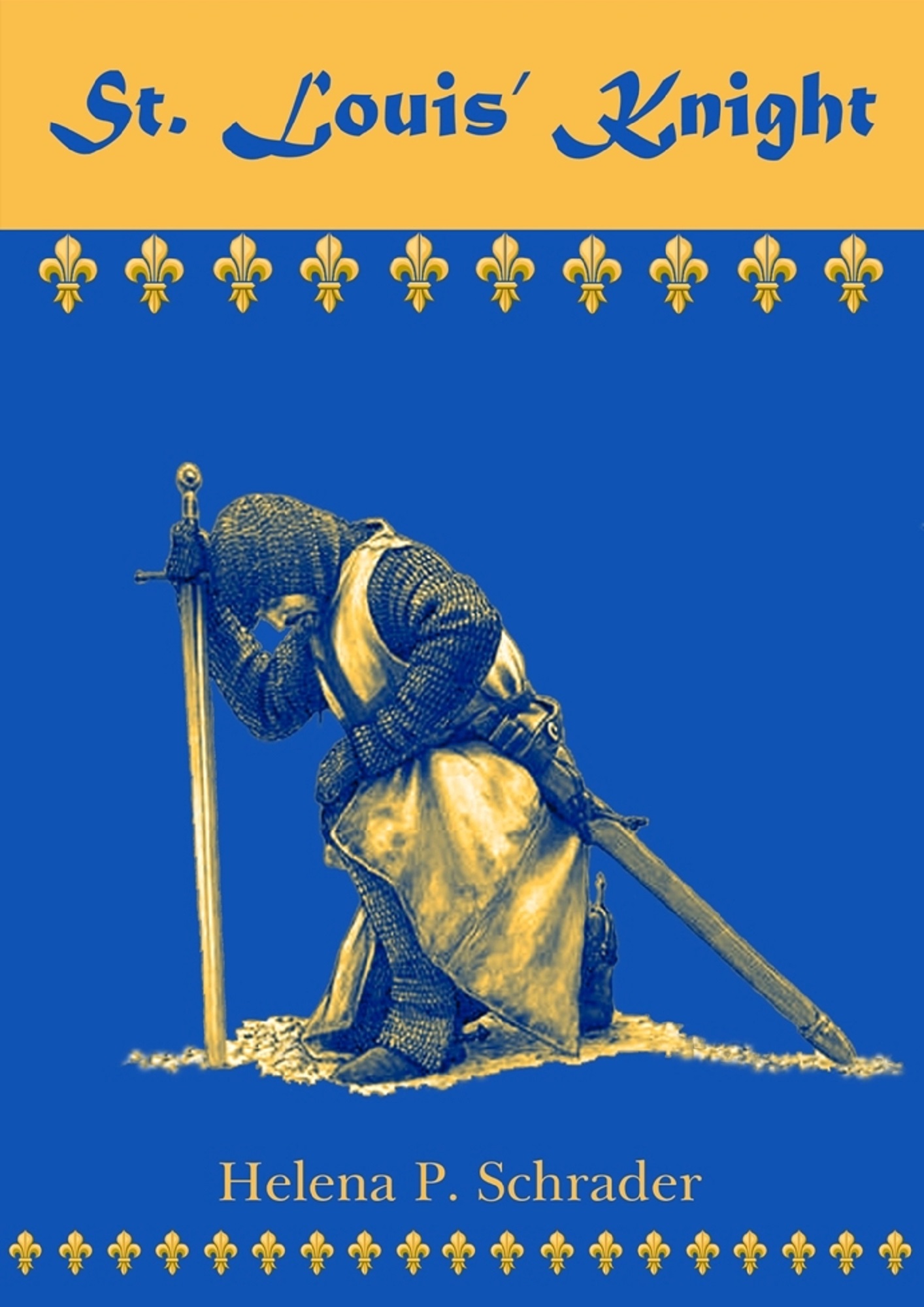
 
 A crusader in search of faith --
A lame lady in search of revenge --
And a King who would be saint.

St. Louis' Knight takes you to the Holy Land in the 13th century, and a world filled with knights, nobles, prophets -- and assassins. 
(Available in Audiobook)

Thursday, April 9, 2020

Saladin and Byzantium - An Unholy Alliance

The brutal sack of Constantinople in 1204 dominates discourse about the relationship between the crusaders and the Byzantine Empire. Yet, as important and shocking as it was, this one episode should not be allowed to obscure everything that preceded and followed it. Relations between Byzantium and the crusader states were complex and fraught with misunderstandings and mutual misconceptions, but they were also punctuated by periods of cooperation. 
Equally important: the Byzantines were not innocent lambs devoured by evil Latin wolves. Rather, the attack on Constantinople had its roots in actions taken by the Byzantines themselves, one of the most important of which was an alliance forged with Saladin with the goal of destroying the Crusader States. 

 
Andronicus I Comnenus swept into power on the back of fervent anti-Latin feelings, directed against the Dowager Empress Marie of Antioch, who was regent for her underaged son Alexius II, the son of Manuel I. Following anti-Latin riots in Constantinople in 1182 in which the Genoese and Pisan residents of the city were slaughtered, Andronicus seized power. He had Empress Marie and her lover murdered, and in September 1183 had himself crowned co-emperor with Alexius. Within two months, he had strangled Alexius and seized sole power for himself, "legitimizing" his actions by marrying the murdered Alexius' 13-year-old bride.

While his domestic policies included attempts to fight corruption and reform the administration of the Empire particularly in the provinces, his foreign policy consisted fundamentally of a repudiation of Manuel I Comnenus' pro-Western policies and alliances with the crusader states. Significantly, Andronicus had been an exile from Manuel's court and had fled to Damascus and Baghdad, where he had been well-received by Nur al-Din. 


In June 1185, two years into his reign as Byzantine Emperor, Andronicus sent an envoy to Saladin, Nur al-Din's successor, proposing a treaty of alliance between their empires. The purpose of the proposed alliance was the destruction of the crusader states. After a successful conquest of the crusader states, the Byzantine Emperor generously offered to divide the spoils, by retaining Jerusalem and all the (wealthy) coastal cities for himself and giving the rest (Transjordan?) to Saladin. All Andronicus required of Saladin was an oath of homage and the promise to render assistance to the Eastern Roman Empire whenever requested. One can only imagine Saladin's response for it is not recorded, but it is not hard to imagine that he laughed out loud at so much unfounded insolence.

Before Saladin's ambassadors with his official response could reach Constantinople, Andronicus was savagely torn to pieces by the mob in Constantinople and replaced by a  man who had rebelled against him and himself faced arrest and execution: Isaac Angelus. The latter had also sought refuge in the court of Damascus along with his elder brother, Alexis, who was still there at the time Isaac was acclaimed emperor by the mob. Isaac used this fact to renegotiate the treaty with Saladin, which was duly confirmed by an imperial decree. 

Isaac then recalled his brother, but Alexis foolishly chose to return to Constantinople by way of Acre. It was now 1186, the King of Jerusalem was Baldwin V, a child, and the regent of the kingdom was the savvy Raymond of Tripoli -- who was himself well-connected in Saladin's court. He certainly had wind of the new alliance between Isaac and Saladin targeting Jerusalem, and he promptly imprisoned Alexis. 


An outraged Isaac pressured Saladin to attack Jerusalem and free his brother. Saladin did both -- although it is unlikely he did so as a favor to the Byzantine Emperor. By January 1188, Saladin was in control of the entire kingdom except for Tyre, and the terms of the treaty with Constantinople were completely irrelevant. Saladin made no move to surrender any territory to the Byzantines, but he did allow the Greek Orthodox Church to take control of the Christian shrines in the newly occupied territories. 

Meanwhile, the Western European powers were preparing to mount a major campaign to re-take the Holy Land. Arab accounts suggest that Saladin was genuinely unsettled. He was particularly concerned about the prospect of the Holy Roman Emperor, Friederick Barbarossa, bringing a large army to the Near East. It was now Saladin's turn to make demands based on the alliance with Byzantium: he sent ambassadors to Constantinople to re-negotiate the terms of the anti-Western alliance. He expected the Byzantines prevent -- or at least harass, delay, and impede -- the passage of any crusading armies entering Byzantine territory. Isaac happily agreed to the new terms.


The contents of the treaty did not remain secret. By September of 1188, Conrad de Montferrat sent letters to the West detailing the extent of Byzantine treachery. It must be remembered, that Conrad had himself been married to a Byzantine princess and his brother Rainier had been Emperor Manuel I's son-in-law, the husband of Manual's daughter Maria. Both Rainier de Montferrat and his imperial wife had been murdered in Constantinople at the same time as Marie of Antioch. Conrad had friends in Constantinople, because many there opposed Isaac's anti-Christian alliance. Allegedly, in return for preventing any crusading armies from reaching the Middle East, Saladin promised to restore Jerusalem and Palestine to Constantinople. In addition, a clause envisaged a joint campaign to reconquer Cyprus, which had rebelled and was independent, not yet a Latin kingdom. 

Isaac, however, maintained a facade of friendliness toward the West, negotiating with Frederick Barbarossa for the passage of his armies "unmolested," and promising to provide markets and ensure a "fair exchange" of currency.  Just before the Holy Roman Emperor set out on crusade in May 1189, he sent envoys to Constantinople to announce his impending arrival. They were promptly imprisoned and their horses and possessions turned over to Saladin's representatives in the Byzantine capital. 

That did not stop Frederick Barbarossa. When the German crusaders found no markets ready to sell them provisions, they 'foraged' for whatever they needed. When units of the Byzantine military poorly disguised as 'bandits' harassed them, they destroyed them. From Nish to Sofia, Barbarossa drove the Byzantines out if their fortifications and at Philippopolis defeated them soundly. He ravaged Thrace from Enos to Thessalonica demanding the release of his ambassadors, but he resisted pressure from within his own ranks to turn his army on Constantinople. Barbarossa remained true to his vow and his aim, which was the liberation of Jerusalem, not the conquest of a Christian country. 


In February 1190, Isaac finally recognized that Saladin wasn't going to do anything to help him stop Barbarossa and that without help he wasn't able to stop him. He signed the Treaty of Adrianople, which again promised markets and fair exchange rates. Isaac helped Barbarossa cross into Asia -- and reneged on all other aspects of the agreement. 

It didn't matter. The German Emperor soon crossed into the Sultanate of Rum, where he promptly and decisively defeated the Seljuk army at the Battle of Iconium. His tragic death four months later put an effective end to the German contribution to the Third Crusade -- but it was hardly Isaac's doing.

Saladin recognized this. Arab sources summarized the alliance with Constantinople as follows: "In truth, the Greek king has never succeeded in his enterprises; we gain nothing from his friendship, and need fear nothing from his enmity." (1)

But the damage to Byzantine relations with the West had already been done. Although the alliance between Damascus and Constantinople ended in 1192 it left a legacy of bitterness and mistrust. The West, particularly the Holy Roman Empire, viewed the Byzantines as duplicitous traitors to Christianity. Here, along with the massacres of the Italians in 1177 and again in 1182, are the seeds of the Fourth Crusade.


(1) Abu Samah, quoted in Charles Brand, "The Byzantines and Saladin, 1185-1192: Opponents of the Third Crusade," Journal of Mediaeval Studies, Vol. XXXVII, # 3, April 1962, 178.

The Third Crusade is the focus of "Envoy of Jerusalem," recognized as the Best Biography 2017 by Book Excellence Awards and as Best Christian Historical Fiction 2017 by Readers' Favorite Book Awards. Find out more at: https://www.helenapschrader.com/envoy-of-jerusalem.html


Wednesday, June 13, 2018

Venice and Byzantium: The "Back-Story to the Fourth Crusade"

The Fourth Crusade, in which a host originally raised to relieve the Holy Land was instead deployed to attack and sack the Christian city of Constantinople, is usually described as an act of perfidy, barbarity and Western arrogance. Even at the time, it was highly controversial, with many of the initial crusaders, (e.g. Simon de Montfort the Elder and his sons) refusing to take part.


But no historical event is without its antecedents, and the Fourth Crusade is no exception. There was a long and complex history of interaction between the West and the Byzantine Empire that included both periods of cooperation and periods of deep suspicion, hostility and conflict. While that long history is beyond the scope of a blog entry, two important incidents of that history go a long way to explaining the Fourth Crusade.

After a long and mutually productive alliance between the Eastern Roman Empire and the city-state of Venice, tensions began to develop in the mid-12th century.  The Venetians opposed the Byzantine Emperor’s expansion in Dalmatia and his aggressive policies in Southern Italy. Meanwhile, the Venetian enclaves in the Byzantine Empire and especially in Constantinople were increasingly resented by the local population, who considered them arrogant and insufferable — largely because they were exempt from certain taxes and had become extremely wealthy.  So, in a move reminiscent of Philip IV of France’s arrest of the Templars 147 years later, on March 12, 1171, Emperor Manuel I ordered the simultaneous arrest of all Venetians in his realm by the local authorities.  He then confiscated all their property and held the captives prisoner.  


Venice launched a naval expedition to free the prisoners, but it was repelled and negotiations for the release of the prisoners got nowhere. For the time being, Venice had to capitulate, but the insult, the massive loss of wealth and loss of freedom for thousands of citizens was not something proud Venice was prepared to forget. Venice had good reason to hate the Byzantine Empire and to want revenge in 1204.

Meanwhile, Venice’s rivals Pisa and Genoa initially benefited from the abrupt elimination of Venetian presence in the Byzantine Empire.  For just over a decade, they basked in the sun of Imperial favor, expanding their own trading empires, especially after the death of Manuel I with the ascension of his 11 year old son, Alexius II.  Alexius II was the son of a Latin princess, namely the Princess Maria of Antioch, and she and her lover pursued a decidedly “pro-Western” policy — which soon aroused the hostility of the bureaucracy and the people in Constantinople. The anti-Western faction in the capital found an ally in the ambition of an uncle of the late Manuel I, and in April 1182 the mob was set loose on the Latin population in Constantinople.


According to Charles M. Brand in his history Byzantium Confronts the West, 1180-1204, (Harvard University Press, 1968): “The populace turned on the merchants, their families, and the Catholic monks and clerics who lived in the crowded quarters along the Golden Horn…. When the mobs attacked, no attempt at defense was made. The crowds raced through the streets seeking Latins. The choicest victims were the helpless: women and children, the aged and the sick, priests and monks. They were killed in streets and houses, dragged from hiding places and slaughtered. Dwellings and churches full of refugees were burned, and at the Hospital of the Knights of St. John, the sick were murdered in their beds.  The clergy were the particular objects of the crowd’s hatred. The pope’s emissary, Cardinal John, was decapitated and his body dragged through the streets on the tail of a dog…. The Orthodox clergy took the lead in searching out concealed Latins to deliver to the killers.”

Does this massacre of a few thousand people justify the Sack of Constantinople in 1204? Certainly not! But if the terror attacks of September 11, 2000 could fill a modern democracy with rage and the desire for revenge — including the willingness to conduct long, drawn-out and expensive wars in distant places and undertake state-sanctioned assassinations — than it is only reasonable to factor in the anger this massacre incited in the West when analyzing the causes of the Fourth Crusade.

Balian d'Ibelin's wife was a Byzantine Princess, Maria Comnena and the relationship between the Latin Kingdom of Jerusalem and the Byzantine Empire plays a minor role in my biographical novel of Balian d'Ibelin. 


 Buy now!                                       Buy now!                                          Buy now!
 

Dr. Helena P. Schrader holds a PhD in History.
She is the Chief Editor of the Real Crusades History Blog.
She is an award-winning novelist and author of numerous books both fiction and non-fiction. Her three-part biography of Balian d'Ibelin won a total of 14 literary accolades. Her most recent release is a novel about the founding of the crusader Kingdom of Cyprus. You can find out more at: http://crusaderkingdoms.com

Friday, September 16, 2016

Jerusalem Forgotten? The Struggle for the Holy City before the First Crusade


Jerusalem fell to invading Muslim forces in 638 AD. It was conquered by force of arms, not by gentle persuasion and enlightened preaching (as some modern commentators suggest) after a year long siege. It would be 1099 AD or 461 years before it was returned to Christian hands. That over four hundred year gap between the Muslim conquest and the Christian liberation has led  many to argue that 1) Christianity didn't really care all that much about Jerusalem, 2) after so  much time it has become a Muslim city, and so 3) the First Crusade was not defensive or liberating but rather offensive and aggressive. It is, therefore, worthwhile to look at that "461 year gap" and see what happened between the Muslim conquest and the Christian re-conquest of Jerusalem.

But first, let us recall just how Christian Jerusalem was.  First and foremost, of course, it was the site of Christ's crucifixion and resurrection, and a small Christian population lived in the city from the time of Christ onwards. Admittedly, it remained a predominantly Jewish city, despite the destruction of the Second Temple in 70 AD, until the Romans expelled the entire Jewish population after renewed insurrection in 135. 

Jerusalem was then rebuilt by Hadrian, given a new name (Aelia Capitolina) and Roman temples were built on the site of the old Jewish Temple and on the sites sacred to Christians. The objective was to humiliate Jews and Christians alike and, in the case of the Christians, to wipe out the association with Christ's life and certain sites. Furthermore, both Jews and Christians were expelled from Jerusalem and persecuted. Aelia Capitolina was a pagan city, and as such it was nothing more than provincial backwater of little importance to the Roman Empire.

All that changed after the Emperor Constantine came to the Imperial throne. His mother, Helena, was Christian, and she persuaded him to end the persecution of Christians in 313 and to allow her to make a pilgrimage to Palestine. She is credited with locating the sites of Christ's nativity, execution and resurrection. Little more than a decade later, a massive construction project was undertaken to turn Jerusalem into a major Christian capital. In 326 work began on two magnificent basilica: one in Bethlehem over the site of the nativity and the other in Jerusalem over the site of Christ's grave (the Holy Sepulcher).


For nearly 300 years thereafter, Jerusalem was one of the most important cities of the Eastern Roman Empire. Although unable to compete with Constantinople and Alexandria in terms of trade and industry, it was revered for its sacred traditions. Pilgrims flooded to the sacred sites providing a strong economic base that was reflected in construction of churches, monasteries, shops, inns and residences. The inhabitants of this revitalized city were primarily Christian, although Jews were allowed to return as well. The population exceeded 60,000 -- a very substantial population for this period.

In 614 disaster struck. A Persian army surrounded Jerusalem and took it after a 21 day siege. Aided by Jewish allies, the Persians slaughtered an estimated 26,500 Christian inhabitants and enslaved an additional 35,000. The Church of the Holy Sepulcher was raised to the ground. In an ironic twist, the Church of the Nativity in nearby Bethlehem escaped destruction because the mosaic Adoration of the Magi over the portal depicted the Magi as Persian kings; the Persian troops stayed their hand out of respect for the "Persian" kings.

Thirteen years later in 627, Emperor Herakleios wrested control of Jerusalem back from the Persians after defeating them decisively at the Battle of Ninveh. The treaty following the battle required the Persians to withdraw from all conquered territories, including Palestine and so Jerusalem. Yet while Byzantine control over Jerusalem was thus restored, the destruction of the city's sacred monuments and the slaughter or enslavement of the inhabitants could not be so easily overcome. All the Emperor could do was start a rebuilding and resettlement program. In punishment for their role in the slaughter and destruction of the Christian population thirteen years earlier, however, the Jews were again expelled from Jerusalem and prohibited from entering.

Thus at the time of the Muslim conquest, the city was exclusively Christian. Furthermore, the fact that despite the terrible losses and destruction, the city held out for a whole year before surrendering to the armies of Caliph Omar I is a testimony to how vigorously the Christian defenders resisted the Muslim attack. In the end, they were too weak -- as was the entire Eastern Roman Empire. 

For the next three hundred years, Islam continued to expand -- by the sword. Indeed, within the next fifteen years alone Syria, Persia, Anatolia, Egypt and Libya fell. These loses crippled the economy of the Eastern Roman Empire, and in 655 the Byzantine navy was also effectively destroyed in a major engagement that left Constantinople incapable of providing support to the far-flung outposts of the Eastern Empire.  


The following year, however, the Shia-Sunni split led to the first civil war within the Dar al-Islam (the House of Islam) lasting from 656-661. At roughly the same time, Arab invaders encountered serious resistance from the Berbers in North Africa.  

By 678, however, the forces of Islam were again so powerful that they launched an assault on Constantinople itself. The Byzantines fought off the assault with the aid of their massive walls and the use of a new weapon which became known as "Greek fire" - a napalm-based substance that was delivered in pottery vessels that broke on impact resulting in fires that could not be extinguished by water. The attacking Arabs suffered such severe losses that they agreed to a thirty year truce in the wake of defeat. Constantinople was temporarily saved, but the Eastern Roman Empire was in no position to defend its remaining Mediterranean territories, much less undertake an offensive to regain what had been lost. In 698, the mighty (Christian) city of Carthage fell to the advancing Muslim forces and by 700 Islam was ready to turn its violent tactics of "conversion" on Western Europe. 

A Crusade-Era container for "Greek Fire." Photographic credit: Amir Gorzalczany, Israel Antiquities Authority
Attacks on Sicily and Sardinia are recorded as early as 704 and Corsica fell in 713. More important, of course, the invasion of the Iberian peninsula began in 711. By 720 the Muslims had forced the Christian defenders into the mountains of the northwest and, dismissing them as a no longer viable fighting force, crossed the Pyrenees to start subjecting the land of the Franks

In 732, outside of Tours, a Frankish army decisively defeated the invading Muslims in a desperate defensive battle. The Franks furthermore continued fighting the invaders, finally driving them back across the Pyrenees a generation later in 769. By 795 Charlemange had taken his forces over the Pyranees to assist the Spanish Christians in regaining their territories as well. The Reconquista had begun. In short, in the 8th century Western Christians joined Eastern Christians in opposing the brutal invasions conducted against them in the name of Islam. 

Meanwhile, Constantinople as still fighting for its very survival. In 717 a new Muslim force by land and sea appeared outside of Constantinople and a year-long siege ensued. After a desperate fight, the capital of the Eastern Roman Empire fought off the besiegers, but it remained mired in a struggle for survival. There could be no thought of freeing something as distant as Jerusalem when Anatolia was constantly raided and plundered. It was not until 740 that the Byzantine victory at Acroinon provided the Eastern Roman Empire with a degree of security in the Anatolian heartland. 


The Byzantine victory at Acroinon notably coincided with a general decline in the power and strength of the Umayyad dynasty, which was also beset with problems on its eastern frontiers. This allowed the Eastern Roman Empire to at last start a "reconquista" of its own. In 746, Constantinople regained control of Syria and Armenia, but already by 781 the Byzantines were again on the defensive. For the next half century, the Byzantine Empire was locked in yet another bitter struggle in Anatolia

Meanwhile Arab rule of the conquered Christian territories from Syria to Spain was characterized by brutality, oppression and humiliation for their majority Christian subjects.  (See The Myth of the Andalusian Paradise.) The small Arab elite ruled initially over populations that were overwhelmingly Christian. Due to the burdensome taxes, humiliations and oppression, however, more and more people chose to abandon their faith for the sake of economic gain. Yet conversion is a far slower process than invasion and occupation. To this day, even after 1,400 years of Muslim rule, there are significant Christian minorities in Syria, Lebanon, and Egypt. Historians estimate that after four hundred years of occupation the inhabitants of formerly Christian territories was still roughly half Christian.

The plight of the oppressed Christians population (whether majority or large minority) remained, therefore a motivation for the recovery of lost territory and by the mid-9th century, the Eastern Roman Empire had recovered sufficient strength to launch a sustained "reconquista." In 853 Constantinople sent a fleet to attack Damietta in the Nile Delta. Thereafter, despite some setbacks, the Byzantines continued to regain lost territory right through the middle of the next century. In 943 they liberated Mesopotamia with its overwhelmingly Christian Armenian population. In 961 they recovered Crete and in 965 Cyprus. In 969 Antioch was at last freed from Muslim rule and Aleppo offered tribute to Constantinople to avoid a similar fate. 

The recovery of Jerusalem now seemed possible, and Constantinople was determined to regain this most sacred of all Christian cities. A series of campaigns were launched that systematically recovered the coast of the Levant including Beirut, Sidon, Tiberias and Nazareth. Acre and even Caesarea were returned to the Eastern Empire, but Jerusalem remained just out of reach. As the tenth century came to a close, the Byzantines lost momentum and their attempt to regain their lost territories faltered.

What followed was the worst phase yet for subject Christians in Palestine. The new and powerful Shia Fatamid Caliphate pushed back their Sunni rivals and took control of Palestine, including Jerusalem. The Caliph al-Hakim, who ruled from 996-1021, persecuted Christians and Jews and destroyed what was left of the Church of the Holy Sepulcher. 

In the West, however, the set-backs had started sooner. In 827 the Muslim conquest of Sicily commenced and although it would take until 902 to complete it would eventually be successful. Meanwhile, in 837 a Muslim army had landed on the Italian mainland, ironically at the request of the Duke of Napes who wanted help in his squabbles with his local enemies. Throughout the rest of the century, the various Italian cities remained divided among themselves and all too ready to accept Muslim assistance, which in turn opened the doorway to Muslim mercenaries sacking, pillaging and pirating from bases in Italy. In 846 Rome itself was attacked by a Muslim raiding force and the basilica of St. Peter was looted but not destroyed.  

When three years later a larger Muslim fleet set out to attack Rome again, however, it was met by a combined Christian fleet that defeated it. What followed, however, was not peace but rather a long struggle for control of the Italian mainland. Indeed, the Muslims succeeded in establishing a base for raiding on the coast of Provence at La Garde-Freinet in about 888. While neither the raids from Italy or the base in Provence were comparable to the great Muslim conquests of the 7th century, they posed a menace to travel and trade and kept Western Christendom on the defense.

This did not end until 915 when an alliance of Roman and Byzantine forces drove the last Muslim strongholds off the Italian mainland. For a time, however, the Muslims continued to raid the Italian coastal cities. In 934/35 Genoa was sacked, its male population massacred and the women and children carried off into slavery. Pisa beat off attacks in 1004, 1011, and 1012. Four years later, Salerno came under siege and was only rescued by a band of Normans -- notably on an armed pilgrimage to Jerusalem.

It was only now, at the start of the 11th century, that the tide began to turn in favor of the Christians in the West. The Italian city states were gaining sufficient wealth to finance stronger defenses. In 1034, the Pisans launched an attack on Muslim North Africa. A generation later the Pisans again raided Muslim territory, this time Palermo in 1062 and 1063. Finally, in 1087, a combined force raised from Pisa, Genoa, Rome and Amalfi struck at the main base for many Muslim pirate attacks on Italian ships and cities: Mahdia in what is now Tunisia. The expedition was so successful that it enabled the victors to free prisoners, obtain huge reparations payments, and gain trading privileges. Most important, after the raid on Mahdia, Muslim attacks on Italy ceased almost entirely.

But just as the Western Christians were gaining strength again, the Eastern Roman Empire underwent a new crisis. The Seljuk Turks had converted to Islam and with the passion of the newly converted and the skills of nomadic warriors they set about establishing their domination over Syria and then turned on Armenia, Cilicia, and the Levant, driving the Byzantines out, before striking at Anatolia. The Byzantine Emperor Romanus IV Diogenes assembled his forces and rushed to the defense of this vital heartland -- only to be decisively defeated on August 26, 1071 at the Battle of Manzikert. Shortly afterwards the embattled Byzantines started sending appeals for help to the apparently now stronger West. That aid would, a quarter century later, materialize in the form of what we have come to call the First Crusade.

In summary, Christendom did not "wait" four hundred years to respond to the loss of Jerusalem. On the contrary, throughout the four hundred years between the fall of Jerusalem in 638 and the First Crusade in 1095, Christendom had been fighting perpetually -- and often desperately -- for its very survival. The First Crusade was not "late" response to the fall of Jerusalem, but rather the first viable -- and even so highly risky and audacious -- attempt to retake the city of Christ's passion that had never, for a single day, been forgotten by Christendom.

Knowing the history of Jerusalem is useful in understanding the thinking and attitudes of people in the Crusader Kingdom of Jerusalem -- the context of my "Jerusalem" trilogy.


 Buy now!                                       Buy now!                                   Buy now (paperback)
                                                                                                                or Kindle!