COPYRIGHT

All content on this blog is protected by copyright.
Content used elsewhere without attribution constitutes theft of intellectual property and will be prosecuted.
Showing posts with label Cyprus. Show all posts

Saturday, October 18, 2025

The Establishment of the Kingdom of Cyprus

 The Kingdom of Jerusalem had survived -- just barely. Yet it is hard to imagine this fragile kingdom, stretching along the coast from Jaffa to Tyre, surviving for long, if Richard the Lionheart had not left another legacy: Frankish control of the island of Cyprus. This formerly Byzantine island had suffered the first Muslim attacks in 649 and in the succeeding centuries been fought over and exploited by both Constantinople and Cairo until firm Byzantine control was re-established in 965. How Cyprus came into crusader hands is the subject of this post.


 In 1185, a renegade from the Comnenus family arrived in Cyprus claiming to have been appointed governor. A year later, after the fall of the Comnenus dynasty, he proclaimed himself the ‘true’ Emperor and began a reign of terror. Contemporary Byzantine chroniclers claim that ‘he defiled himself by committing unjustifiable murders…[and] inflicting, like some instrument of disaster, penalties and punishments that led to death. The hideous and accursed lecher illicitly defiled marriage beds and despoiled virgins.’[i] While we can assume that much of this is polemical exaggeration, the fact remains that Isaac’s rule was viewed in Constantinople and by his subjects as illegal and tyrannical. The bulk of the aristocratic elites abandoned the island for the safety of Constantinople, leaving behind a cowed but discontented urban middle class and rural population.

Isaac was also known for preying on Frankish shipping, so it was not surprising that when three of Richard the Lionheart’s ships washed up on Cyprus in distress that the crews were captured and the cargoes seized. A fourth ship sought refuge in Limassol harbor having suffered severe storm damage. Aboard that vessel were Richard’s sister Joanna, the widowed Queen of Sicily, and his bride-to-be Berengaria of Navarre. Fearing what would happen if they went ashore, the royal women refused Isaac’s invitations to disembark.

On 5 May 1191 Richard sailed into Limassol harbor searching for his lost ships, only to find his bride-to-be and sister aboard an unseaworthy vessel running out of water, but afraid of being held for ransom or worse if they went ashore. Richard sent an envoy to Isaac Comnenus requesting that his men be set free, compensation be paid for the property seized from his wrecks, and seeking permission to come ashore for water and provisions. According to all contemporary accounts, Isaac Comnenus returned an extremely rude reply.

Richard responded as could only be expected of the proud Plantagenet: he attacked.
The exact sequence of events varies according to which chronicle one follows, but there is no disagreement on the results: Richard seized control of Limassol without notable casualties. I
saac Comnenus’ army, however, was still largely intact. Richard had to eliminate this latent threat, so he off-loaded some of his warhorses, exercised them through the night to restore their land-legs, and then attacked Isaac Comnenus’ army at dawn the next day. Richard’s early morning attack caused panic among the despot’s troops. While Isaac took flight, Richard’s men overran the enemy camp, capturing huge quantities of booty — again without casualties. 

Richard returned to triumphant to Limassol. On 12 May he married Berengaria and had her crowned Queen of England. Still in a hurry to get to the Kingdom of Jerusalem, however, he granted comparatively mild terms for Isaac’s surrender. Isaac agreed to reparations for Richard’s ships and treasure, and promised to accompany him on crusade with a force of 1,000 men. In his absence, the strategic castles on the island were to be held by men appointed by Richard.

While these terms were undoubtedly humiliating for a self-styled emperor, they were a far cry from ‘unconditional surrender.’  Had Isaac complied with the terms of the agreement, the last crusader kingdom might never have come into being. Isaac, however, was not interested in the crusade and assumed that Richard was in too great a hurry to get to Acre to come after him.  He fled during the night.  

Perhaps encouraged by the fact that local noblemen, dignitaries and the Italian merchant communities were already doing homage to him, Richard chose to grasp the huge opportunity offered by Isaac’s betrayal and seize control of the entire island. This decision to take Cyprus was not a ‘diversion’ from crusading much less an act of greed. Rather, the conquest of Cyprus was Richard’s greatest contribution to the crusader cause.

To obtain his goal, Richard divided his army into three parts, and while a small group pursued Isaac over land, the bulk of his army re-embarked on the fleet. This split in two and, moving in opposite directions, systematically secured the surrender of coastal cities and castles. Due to Isaac’s unpopularity, this was achieved bloodlessly. At Famagusta Richard disembarked his troops and advanced on the capital Nicosia. Expecting an ambush, Richard personally commanded the rear-guard of his army. Isaac obliged and Richard handily defeated him a third time. Isaac again escaped, this time to the nearly impregnable mountain fortress of Buffavento.

Perched on the top of a steep, rocky corniche so narrow that it was not possible to build courtyards or wide halls, the castle could be held as long as supplied lasted by a very small garrison. Isaac assumed Richard would not waste time with a siege, but rather continue to Acre, leaving him to re-take his island at leisure. Unfortunately for Isaac, Richard’s fleet had not already taken the castle of Kyrenia and with it Isaac’s only child, a daughter. Fortunately for the crusader cause, Isaac’s love for her was so great that he abjectly surrendered on 1 June. In less than a month and with the loss of only two men, Richard the Lionheart had taken complete control of the rich and strategically important island of Cyprus. 

Cyprus is an island encompassing nearly 10,000 square kilometers of mostly fertile land including extensive forests. It has ample water resources, significant mineral deposits, notably copper, and a mild Mediterranean climate. The port of Famagusta is only 198 kilometers from Beirut and 295 kilometers from Acre.  Furthermore, Cyprus was capable of producing grain, sugar, olives, wine and citrus fruits in abundance. Its location made it an ideal staging platform for future crusades and a strong base for ships to interdict any Saracen warships intent on preying on the coast of the Levant. Cyprus was thus both a breadbasket and a military base for the existing crusader states.

That Richard’s goal in capturing Cyprus was purely strategic (not dynastic) is demonstrated by the fact that he almost immediately sold the island to the Knights Templar for 100,000 pieces of gold. Templar rule on Cyprus, however, was one of the most ignominious episodes in the history of the Order. Fully engaged in the Third Crusade, the Templars sent only 14 knights supported by less than a hundred other men. They were evidently not the best men. Within six months they had provoked riots. On 5 April 1192, a violent mob forced the Templars to take refuge inside their commandery in Nicosia. Greatly outnumbered, the Templars offered to surrender the entire island in exchange for a safe-conduct to the coast. The Greek rebels refused.

The French Continuation of William of Tyre tells happened next.

When … their commander and the brothers realized that the Greeks would have no mercy, they commended themselves to God and were confessed and absolved. Then they armed themselves and went out against the Greeks and fought them. God by His providence gave the victory to the Templars, and many Greeks were killed or taken. [The Templars] immediately came to Acre and explained what had happened to the master and convent. They took counsel among themselves and agreed that they could no longer hold the island as their property, but…would return it to King Richard in exchange for the security that they had given him.[ii]


The Templar surrender of Cyprus coincided almost exactly with the High Court’s election of Conrad de Montferrat as King of Jerusalem. King Richard cleverly offered to sell Cyprus to the deposed King of Jerusalem, Guy de Lusignan. Lusignan accepted the ‘consolation prize’, although it is doubtful he sailed for Cyprus before the end of the Third Crusade since few knights, sergeants or turcopoles would have been likely to go with him as long as Richard the Lionheart was still in the field.  Whatever the exact date of his arrival on Cyprus, Guy was accompanied by a small group of Frankish lords and knights whose lands had been lost to Saladin in 1187/1188 and not recaptured in the course of the Third Crusade. Guy arrived on an island that was either still in a state of open rebellion or completely lawless.

Due to the scarcity of sources recording what happened next, most histories today repeat a charming story which probably originated in the now lost chronicle of Ernoul, a client of Balian d’Ibelin.  According to this source, as soon as Guy arrived on Cyprus he sent to his arch-enemy Saladin for advice on how to rule it. What is more, the ever chivalrous and wise Sultan graciously responded that ‘if he wants the island to be secure he must give it all away.’[iii] Allegedly, based on this advice, Guy invited settlers from all the Christian countries of the eastern Mediterranean to settle on Cyprus, offering everyone rich rewards and making them marry the local women. Accordingly, the dispossessed peoples of Syria, both high and low, flooded to Cyprus and were rewarded with rich fiefs, until Guy had just enough land to support twenty household knights. And everyone lived happily ever after.

This is a fairy tale. Guy did not arrive on an empty island; the population of Cyprus at this time was roughly 100,000. While most inhabitants were apolitical peasants, there were significant urban and ecclesiastical elites still on the island. These had welcomed Richard the Lionheart in order to rid themselves of a tyrant, but rapidly shown their mettle in a revolt against Richard’s administrators and again by their successful rebellion against Templar Rule. The Knights Templars had just abandoned the island because they believed it would be too costly, time-consuming and difficult to pacify.  In short, the large Greek Orthodox population on the island identified themselves as Romans (Byzantines) and most were not waiting to welcome ‘good King Guy’ as their overlord. Indeed, we know the names of two Cypriot patriots, who led continued resistance to Latin rule until nearly the end of the century, namely Isaac of Antiochetta and Kanakes.[iv] We also have references to abandoned villages and population flight in the accounts of the contemporary Cypriot abbot and later saint Neophytos the Recluse.[v] All of this suggests that a period of unrest and violence preceded the ‘happily ever after’ ending of the popular fairy tale.

Guy de Lusignan died either in April or toward the end of 1194 and was replaced as lord of Cyprus by his elder brother Aimery. By the end of Aimery de Lusignan’s reign in 1205, the island had both been pacified and transformed by the steady influx of immigrants from Syria, Antioch and Armenia. Furthermore, Aimery obtained a crown by submitting the island to the Holy Roman Emperor and also established a Latin church hierarchy on the island. Last but not least, Aimery founded the dynasty that would rule a prosperous and independent Cyprus for the next two hundred years.


[i] Galatariotou, Catia. The Making of a Saint: The Life, Times and Sanctification of Neophytos the Recluse. [Cambridge: University Press, 1991] 42.

[ii] The Old French Continuation of William of Tyre, chapter 133, 112.

[iii] The Old French Continuation of William of Tyre, chapter 133, 113.

[iv] Galatariotou, 220.

[v] Galatariotou, 203.


The bulk of this entry is an excerpt from Dr. Schrader's comprehensive study of the crusader states.

Dr. Helena P. Schrader is also the author of six books set in the Holy Land in the Era of the Crusades. The situation in Outremer following the end of the Third Crusade and the creation of the Kingdom of Cyprus is depicted in detail in The Last Crusader Kingdom.


           Buy Now!                                                  Buy Now!                                                    Buy Now!
 

          Buy Now!                                               Buy Now!                                                      Buy Now!

"The Tale of the English Templar" is a fictional work that depicts the destruction of the Knight's Templar. 


An escaped Templar, an intrepid, old crusader, and a discarded bride
embark on a quest for justice in the face of tyranny. 
 
"St. Louis Knight" is a novel set against the backdrop of the Seventh Crusade and St. Louis' sojourn in the Holy  Land. A Templar novice and King Louis are the central characters. 
It is now available in audiobook as well as paperback and ebook.

 
 A crusader in search of faith --
A lame lady in search of revenge --
And a King who would be saint.

St. Louis' Knight takes you to the Holy Land in the 13th century, and a world filled with knights, nobles, prophets -- and assassins. 
(Available in Audiobook)

Monday, July 26, 2021

Conquest of Cyprus - Part I

 The last and most enduring of the crusader states was established on the island of Cyprus at the end of the twelfth century. It lasted for over 300 years, thriving long after the Kingdom of Jerusalem had disappeared from the political map -- if not from memory. In a seven-part series, I'll be looking at this important -- but often forgotten -- crusader state. It all began by accident --

Richard's Tomb at the Abbey of Fontevrault

After a tempestuous winter on Sicily, the men of the Third Crusade led by the Kings of England and France were ready to sail for the Holy Land. The kings, however, had quarreled with one another and so departed separately. Philip II departed with his contingent of crusaders on March 30. He arrived off Tyre without incident three weeks later on April 20.

Richard was not so lucky. His fleet of a hundred ships did not set sail until April 10 — and almost immediately encountered a vicious storm. The fleet was scattered as the vessels, some large, some small, some oared and some pure sailing ships, each struggled to survive as best it could.  Richard’s galley with a portion of the fleet eventually made safe harbor on the island of Rhodes on April 22, but the ship carrying his betrothed, Princess Berengaria of Navarre, and his sister Joanna, the widowed Queen of Sicily, was missing.  

For the next ten days, Richard remained at Rhodes while ships scoured the seasto find and round-up the stragglers and damaged ships were made seaworthy again.   On May 1, with the ships he had collected, Richard set out in search of the remaining lost vessels and his bride. He made for Cyprus, the largest of the islands in the eastern Mediterranean. His hope was that many of his missing ships, including the one with his bride and sister, might have found refuge there.

And indeed they had! But their reception had been far from welcoming. Rather than receiving the charity expected from a Christian monarch (Cyprus was ruled at this time by a self-styled Byzantine “Emperor”), the crews of three ships wrecked on the coast of the island were –- in Richard’s own words –- “robbed and despoiled.”  The ship carrying the royal ladies had avoided shipwreck, but ir had taken refuge in the harbor of Limassol in a state of distress.  The knights aboard this vessel somehow received word of what had happened to their comrades, and Joanna of Plantagenet (a woman who deserves a book of her own!) was clearly not buying the assurances offered by “Emperor” Isaac Comnenus about her safety if she came ashore.  She smelt a rat and stayed aboard her damaged vessel.

Thus when Richard sailed into Limassol harbor on the evening of May 5, he found his bride-to-be and sister in a precarious situation aboard an unseaworthy vessel running out of water, but afraid of being held for ransom or worse if they went ashore.  Richard at once sent an envoy to Isaac Comnenus requesting that his men be set free, compensation paid for the property seized (from the wrecks), and permission to come ashore for water and provisions. According to all contemporary accounts, the envoy returned with a very rude reply.

Richard responded as could only be expected of the proud Plantagenet: he attacked.

The exact sequence of events varies according to which chronicle one follows.  One version has Richard ordering his galleys to break through a blockade of ships at the mouth of Limassol harbor and then storming ashore on foot.  Another version claims he landed on a beach beyond Limassol harbor against opposition, and then took Limassol from landward. Either action (and the latter appears the most likely) was extremely risky.

Indeed, an amphibious operation from small ships and boats against a defended shore is one of the most dangerous in warfare. Period. Think of the beaches of Normandy — and Gallipoli. Unlike the Allies on D-Day in WWII, Richard did not have protective artillery fire from big battleships hammering the shore with shells. Instead, Richard had to rely upon cross-bow men kneeling or sitting on boats bobbing up and down in the waves — not a good platform for accurate fire with any kind of small arm, let alone a bow and arrow! The enemy archers, in contrast, would have been firing their bows from solid earth. Furthermore, as Richard and his men approached the shore, he had to jump overboard into the sucking surf, not in combat boots but chainmail leggings. He then had to fight his way up the rolling stones of the beach in the face of both enemy fire and attacks. To put it simply: the fact that Richard pulled this off is remarkable and unquestionably heroic.

He was helped, however, by the fact that his opponent was highly unpopular with his own subjects and relying primarily upon mercenaries.

Cyprus, an integral part of the early Byzantine Empire, had become a target for expanding Islam in the mid-7th century. Although it was not conquered and incorporated into the Muslim world, it was partially occupied, frequently raided, and forced to pay tribute to various Muslim overlords until 965, when Constantinople re-established control over the island. The three hundred years of turmoil had made it poor, and it remained a Byzantine back-water until the establishment of the crusader states following the First Crusade. Thereafter, Cyprus benefitted from the flood of Western pilgrims heading to the Holy Land and prospered from trade with the booming cities of the Levant. In 1126, the Venetians obtained trading concessions on the island and contributed to its commercial revival. After the death of Manuel I Comnenus, however, Constantinople drifted into chaos as first his son was murdered and then his son’s murderer was torn to pieces by a mob. Constantinople was too pre-occupied with this succession crisis to pay much attention to Cyprus, and into the vacuum stepped Isaac Comnenus.
A Portrait of Isaac's Great Uncle Manuel I
Isaac, a member of the Imperial family (a great-nephew of Emperor Manuel I), who had previously been governor of Byzantine Cilicia, arrived on Cyprus in 1182 or 1183. He claimed to have been appointed governor.  Some sources claim his letters of appointment were forged, but it is also possible he was indeed legitimately appointed by Manuel I’s son Alexus II or the latter’s mother and regent, Maria of Antioch. In any case, when Alexis II and Maria of Antioch were murdered and Andronicus Comnenus became Emperor in Constantinople, Isaac rebelled against Andronicus. He thereafter claimed Cyprus as his personal domain. Andronicus didn’t take this sitting down. He prepared a fleet to reclaim the island for Cyprus. Isaac responded by forging an alliance with Sicily, which sent a fleet. In a naval engagement, the Sicilians fighting for Isaac defeated the Byzantine fleet. By the time Richard of England arrived in 1191, Isaac had been in effective control of Cyprus for roughly 8 years. In that short space of time, however, he had so ruthlessly exploited, taxed and terrorized his subjects that they did not want to fight — much less die — for him. Lack of morale on the part of Isaac’s forces was probably the most decisve factor enabling Richard to successfully land his troops. 

Nevertheless, although Richard had taken the beach and then the city of Limassol, Isaac Comnenus still had his army largely intact. He had simply withdrawn with the bulk of his troops farther inland. This situation was obviously precarious, and Richard knew he had to eliminate this latent threat. So he off-loaded some of his warhorses, exercised them through the night so they could get back their land-legs, and then attacked Isaac Comnenus’ army at dawn the next day. The location is sometimes identified as Kolossi, the later site of a lovely Hospitaller commandery.

The Hospitaller Commandery at Kolossi as it looks today. (Photo by the author)


Richard’s early morning attack allegedly caused panic among the self-styled Emperor’s forces. Isaac Comnenus took flight again, and Richard’s men overran the enemy camp, capturing huge quantities of booty without casualties.  As at the earlier engagement, the self-styled “Emperor” had little support among the population or his mercenaries. 

Richard returned to Limassol and on May 12. Lent now being over, he married Berengaria and had her crowned Queen of England. The exact location is unknown, and several churches in Limassol claim the honor.
These churches for the Hospital (left) and Temple (right) built much later but incorporate many features typical of church architecture on the island. (Photo by the author)


At this point, Richard was still in a hurry to get to the Kingdom of Jerusalem. The crusader kingdom was in desperate straits, having been reduced to the city of Tyre after the defeat at Hattin.  Richard had taken the cross three and a half years earlier, and all sources attest to his burning and sincere desire to recapture Jerusalem from the Saracens. That it had taken him so long to get this far was more a function of prudent preparation and bitter politics than to lack of ardor. The urgency to continue now, however, was increased by the fact that his hated rival, Philip II of France, had already joined the Christian siege of Muslim-held Acre with his large contingent of troops.  Richard had every reason to expect these massive reinforcements of the Christian army would tip the scales and lead to the capture of Acre; Richard had no desire to see Philip take all the glory for a victory of this magnitude.

As a result, Richard accepted Isaac Comnenus’ surrender on comparatively mild terms. He made no claim to Cyprus at this point. He simply demanded reparations from Isaac’s treasury (a welcome infusion of cash to Richard’s war chest so he could finance his crusade for Jerusalem) and, significantly, 100 knights, 500 light cavalry(turcopoles), and 500 infantry from Cyprus for the crusade. Isaac was to accompany Richard on the crusade, surrender his only child as a hostage of his goodwill, and place his castles under the control of Richard’s lieutenants.
The Castle of Kantara, Cyprus (Photo by the author)

The terms might have been humiliating for a self-styled “emperor,” but they were a far cry from “unconditional surrender.” Nor did they constitute the conquest or confiscation of the island.  Instead, they were clearly intended to bolster Richard’s ability to re-capture Jerusalem. Richard had not lost sight of his primary goal and had Isaac complied with the terms of the agreement the last crusader kingdom might never have come into being.

But Isaac Comnenus reneged.  That same night he fled inland. On the sharp and narrow ridge that ran roughly east-west like a backbone through the island stood three impregnable castles. These offered refuge and defiance. Isaac was clearly not about to become a crusader and was banking instead upon Richard being in too much of a hurry to get to Acre to come after him.  
The Ruins of St. Hilarion Castle, Cyprus (Photo by the author)

Richard had to choose between letting him get away with this treachery and hurrying to join the siege of Acre or trying to take control of the entire island by force. Up to now, Richard had responded to unexpected developments, taking advantage of a situation that presented itself to him. What followed was far more calculating. Read more next week.


Monday, May 24, 2021

The Castle of the Queen - Kantara Castle

 Kantara, like St. Hilarion, is located on Cyprus. Its foundations stretch back before the crusader period, but it played an important role in crusader times. It is also shrouded in mystery and legends in addition to being located in a spectacular landscape.


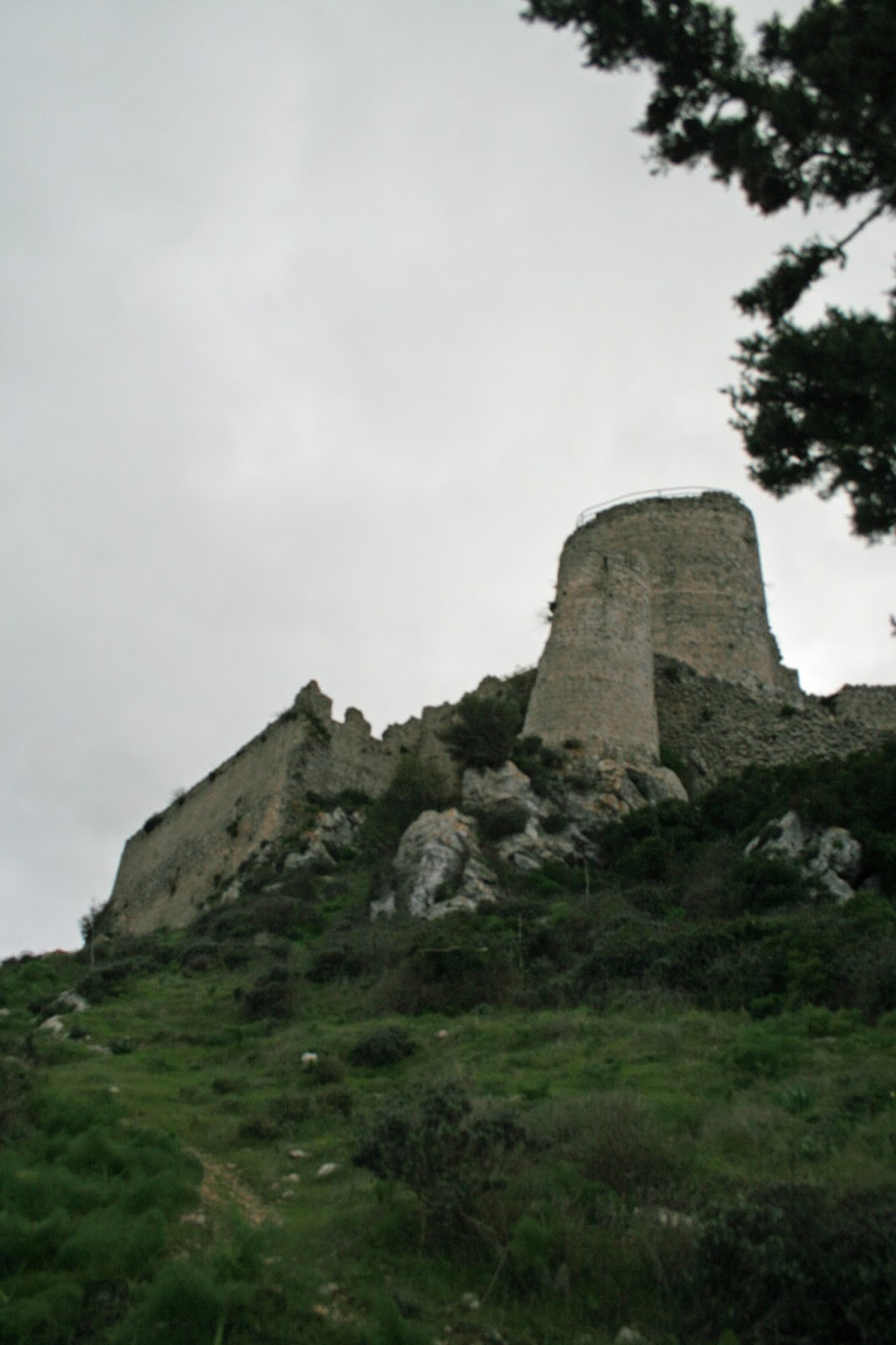
 The view up to the castle.

Kantara is located on the tip of a long, narrow ridge as the Kyrenia mountain range comes to an abrupt end overlooking the plain of Karpas. It sits 630 meters (2,067 feet) above the Mediterranean.


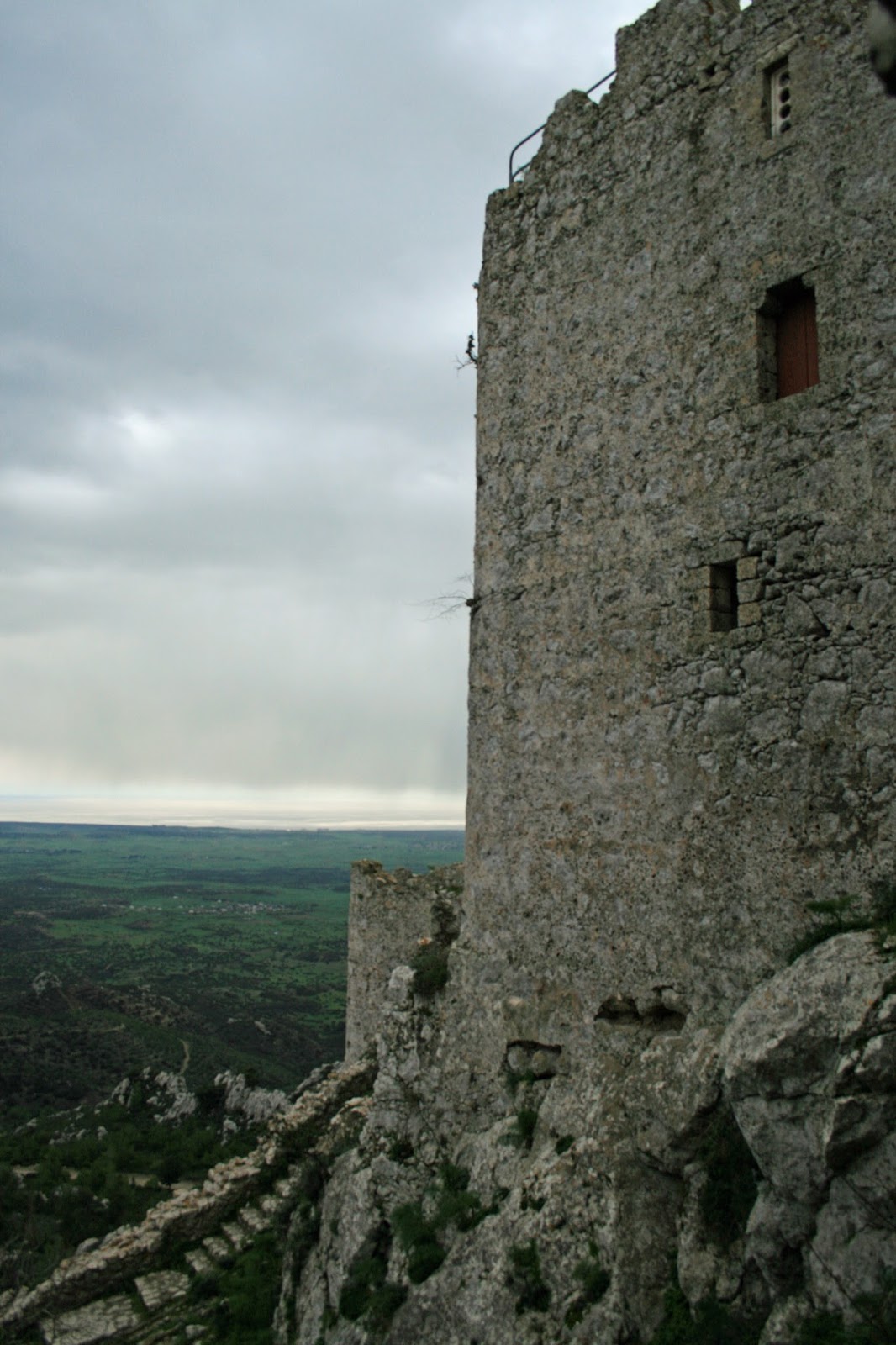
 And the View Down to the Sea

Although the fundamental structure was constructed under the Byzantine Emperor Alexius I Comnenus  after the Greek Empire re-established firm control over the island of Cyprus, the name is thought to derive from Arab the words "kandara" (high building) or "kandak" (castle).  This suggests there may have been an earlier structure, an outpost or watch tower, that occupied this strategic location before the Comnenus Emperor constructed a full-fledged castle. 

During Richard the Lionheart's invasion of Cyprus in 1191, Kantara served as a temporary refuge for the Greek tyrant Isaac Comnenus, and not even the great Lionheart made any attempt to take it.  Then again, he didn't need too. He captured the seaside fortress of Kyrenia instead and with it Isaac's beloved daughter. The tyrant submitted without any further resistance after his daughter's capture.

 
During the bitter wars between Emperor Friedrich II and the barons, on the other hand, the castle of Kantara was subjected to a long and brutal siege.   Defended by men loyal to the German emperor, the barons of Cyprus besieged the castle. Their forces were commanded by Anseau de Brie.  Brie built a trebuchet that, according to the contemporary chronicler and witness Philip de Novare (a fighting man in the service of the Ibelins), "battered down nearly all the walls."  While this was doubtless an exaggeration, Novare also reports that the bedrock on and into which the castle was built defied destruction.  Multiple attempts to assault the castle were successfully repulsed.


The castle only surrendered after ten months of siege due primarily to dwindling supplies and the demoralization of the garrison after the death of their commander, Gauvain de Cheneche. The latter was one of the five baillies appointed by Frederick II. (See: The Emperor's Men)

During the Genoese occupation of Cyprus in late 15th century, the castle was held for the crown and was twice attacked by Genoese forces. It resisted both assaults successfully, and became the base for counter-attacks, preventing Genoese control of the Karpas peninsula.


After the collapse of Lusignan rule on Cyprus and the establishment of Venetian control in the 16th Century, the castle was abandoned and began to decay.


Left behind were the impressive structures that gradually became ruins and the legends. The locals started to call it "the castle of a hundred chambers" -- although according to legend the 101st chamber contained a treasure that no one had ever found. Or, alternatively, the 101st chamber was enchanted and if one fell asleep in it, one woke up years later in a lovely garden. Another local name for the castle was "the house/residence of the queen" -- although no specific queen appears to be associated with the castle historically. 

The 19th century traveler D. Hogarth combines these themes suggesting: "...the traveler might imagine it the stronghold of a Sleeping Beauty, untouched by change or time for a thousand years."

Kantara certainly captured my imagination and my heart. It is the setting of many episodes of the (unpublished) "Lion of Karpas" and has a modest role in "The Last Crusader Kingdom" and is an important venue of key events in "Rebels against Tyranny."


 Buy Now!                                             Buy Now!

Thursday, December 26, 2019

Worshiping Christ in Frankish Cyprus

 During the last century, the assumption was that during the reign of the Lusignans the Latin elite oppressed and despised the Greek Orthodox majority. However, historians of the 21st century have uncovered a wealth of evidence that suggests rather than tensions or mere tolerance, the dominant feature of religious life in Frankish Cyprus was mutual respect and joint worship. 


The key to understanding the religious situation on Cyprus is to recognize that the Catholic Church in the 12th and 13th centuries did not view Greek Orthodoxy as either heretical or schismatic. Throughout the period of Frankish rule in Cyprus, a succession of popes confirmed that the differences between the churches were ones of "rites" (i.e. practice) rather than doctrine.   


The tensions that misled historians of the last century into hypothesizing hostility and oppression were -- on closer examination -- competition between the clergy of the respective churches, not tensions between the believers of either church. Rather than dogma and theology, the two issues that agitated the Latin Church were access to Greek Orthodox lands and other sources of income and the primacy of the pope. The resident Greek clergy, on the other hand, was primarily concerned about retaining control over the lives of their flock and autonomy from Rome. 

The Latin church hierarchy on Cyprus incessantly nagged the crown and Latin nobles for more land and more income sources not from greed alone. It was also a reflection of the fact that the Greek church had, contrary to popular assumptions, suffered very few expropriations in the course of the conquest.  Furthermore, the land that was taken away was never that on which churches or monasteries stood, but rather the productive estates that had generated income for those institutions. The beneficiary of those land-grabs, however, was not the Latin Church but rather secular lords during the first decade of Lusignan rule. 

The Greek Orthodox Church was undoubtedly impoverished by the exodus of wealthy Greek aristocrats who had been it's most lavish patrons. It lost some of its economic land-holdings as well, but it retained all its churches and the tithes of the Orthodox population. The Latin Church, in contrast, had a very small population of Latins which it could tithe and otherwise had to live from donations. Notably, the secular lords of Cyprus repeatedly backed the Orthodox Church in stopping the Latin Church from claiming the lands of the Greeks -- in large part to protect their own properties!


The other principal point of tension, the primacy of the pope, was superficially doctrinal, but in practice an issue of prestige. Initially, the Cypriot clergy steadfastly refused to take an oath of fealty to the pope in Rome. Eventually, after a series of negotiations, the Cypriot clergy opted to swear fealty in exchange for effective autonomy. Professor Schabel summarized the deal as follows: 
Greek Orthodoxy survived the Frankish period not so much because of a successful national struggle against complete absorption as because the Greeks always remained the majority and neither the Franks nor the Latin Church ever attempted any Latinization. The Latin Church required what it thought was the bare minimum from the Greek clergy -- nothing from the Greek laymen -- and the Greek clergy gave the Latin Church what it required, including by the end of the thirteeth century, an oath of obedience from the bishops and an end to active opposition concerning unleavened bread. Almost all other particulars of the Greek rite, what we now call Greek Orthodoxy, were allowed to remain the same. [Chris Schabel, "Religion" in Cyprus: Society and Culture 1191 - 1374, editor Angel Nicolaou-Konnari and Chris Schabel, 201; italics addded by HPS]
The drawn-out struggle between the Latin and Greek clergies, however, had very little impact on daily life or popular attitudes. Only on three occasions in the history of Frankish rule on the island did the inter-clerical disputes rise to the level of popular unrest. Two of these instances, both from the fourteenth century, were riots "lasting only a matter of hours and directed successfully at the actions of a single outsider." [Schabel, 207] The other incident was far more serious and shocking. It entailed the burning at the stake of thirteen Orthodox monks in the mid-13th century.


The execution of thirteen Orthodox monks dates to either 1231 or 1232 -- in either case to a period of "chaos" when King Henry I was not yet of age. Indeed, King Henry was very probably not even present in his kingdom as from February until June 1232 he was in Syria with his regent and all his barons. Furthermore, the Latin Archbishop of Nicosia was also absent from the kingdom much of 1231 and early 1232. Most significantly, from May to mid-June, the Kingdom of Cyprus was occupied by the forces of the Imperial Marshal Riccardo Filangieri. 

In short, Cyprus was effectively without its legal rulers either secular or ecclesiastical for this critical period.  It appears that this fact was exploited by outsiders with no history of peaceful co-existence. At the urgings of a certain Dominican friar -- the Order of the Inquisition and possibly fresh from fighting the Alibigensians -- the Greek Orthodox monks were condemned to die a heretic's death. Yet, as the documents prove, they were not condemned because they used leavened bread, but rather "because for years they refused to stop calling the Latins heretics for using unleavened bread." Schabel suggests that despite knowing that the pope did not consider the use of leavened bread heretical, the Dominicans could "not tolerate the Greek accusation that they were heretics for their practice." (Schabel, 196). 

Sadly, these images of intolerance and violence, isolated and unrepresentative as they were, have dominated the popular image of the relationship between the churches on Cyprus. In fact, Frankish rule was characterized not only by tolerance but by patronage that fostered an expansion of Orthodox building. 


For example, the Frankish period saw a flourishing of Greek Orthodox monastic activity on the island. The number of monasteries on Cyprus more than doubled from 40 under Byzantine rule to over 100 by 1363. While a number of these monasteries were Latin (the Hospitallers, Dominicans, Franciscans, Benedictines, Cistercians, and Augustinians all had three to four houses on Cyprus), Orthodox monasteries undoubtedly made up the vast majority of these religious houses. Furthermore, Orthodox parish churches, even in rural areas, also experienced an inflood of donations that enable renovations and redecoration. Far from languishing in oppression, the Orthodox church flourished under the Lusignans.

There were a number of reasons for this. First and foremost, the Lusignans viewed themselves as the kings of all Cypriots, not just the Latin Cypriots. The Lusignans and their (often Ibelin) wives regularly made generous donations to Greek Orthodox institutions. The nobility also made significant gifts to Greek Orthodox institutions, and there are recorded instances of Italian merchants doing the same. Indeed, by the fourteenth century at the latest, Latin prelates were complaining about "the noble and plebeian women" frequenting the churches of the Greeks, while their husbands "barons, knights, and burgesses" preferred to attend mass in private chapels. 

This situation arose primarily because of the large number of marriages between Latins and Greeks. With the Greek population so dominant, many immigrants found their wives among the local Greek population. The Italians, notoriously, left their wives at home, and one wonders how many took local "wives." Meanwhile, the rising Greek middle class that dominated the bureaucracy and increasingly merged into the gentry made good matches for younger daughters of poorer knights.

Another factor in the gradual slide toward Orthodoxy on the part of the Frankish population was the sheer lack of Latin parish churches. Even in Nicosia, the capital and heart of Frankish Cyprus, the Latin Cathedral was the only parish church. The suffragan bishops also had their cathedrals, but for Franks living outside the main cities, those living on their estates, there were no Latin churches at all. As a result, we have instances of Latin knights and ladies buried in Orthodox churches. The assumption must be that during their lives they also regularly attended mass at these churches, confessed their sins to the Orthodox priests, and possibly married and baptized children there as well. 


Even those Latins who remained true to their traditions gradually absorbed elements of Greek religious culture into their lives and churches. Cypriot saints such as Barnabas, Hilarion, and Epiphanios were worshiped in Latin as well as Orthodox churches. Latin patrons developed a taste for icons, particularly the vita icons that surrounded a portrait of the saint with scenes from his/her life. Frankish artisans became adept at producing icons. Indeed, icons have been found with labeling in the same hand in both Greek and Latin, suggesting that they hung in churches used by both Greek and Latin congregations.


In short, despite the bickering between the Latin and Greek clergy over hierarchy and income, for the average Cypriot whether Greek and Latin the shared belief in Christianity was paramount. Rather than hostility or tensions, the people of Cyprus worshiped Christ and his saints together evolving a distinctive form of almost ecumenical sacred architecture and other art forms. 

For more on the disputes between the Cypriot clergy and the pope as well as the evolution of unique art forms see: Nicolaou-Konnari, Angel and Chris Schabel (eds). Cyprus: Society and Culture 1191 - 1374 (London: Brill, 2005).

My most recent novels set in medieval Cyprus reflect this overall atmosphere of inter-faith cooperation punctuated by moments of tensions:


                                                    Best Christian Historical Fiction 2019
                                                                   
         Buy Now!                                                   Buy Now!                                             Buy Now!


Dr. Helena P. Schrader holds a PhD in History.

She is the Chief Editor of the Real Crusades History Blog.
She is an award-winning novelist and author of numerous books both fiction and non-fiction. Her three-part biography of Balian d'Ibelin won a total of 14 literary accolades. Her current series describes the civil war in Outremer between Emperor Frederick andthe barons led by John d'Ibelin the Lord of Beirut. Dr. Schrader is also working on a non-fiction book describing the crusader kingdoms. You can find out more at: http://crusaderkingdoms.com