COPYRIGHT

All content on this blog is protected by copyright.
Content used elsewhere without attribution constitutes theft of intellectual property and will be prosecuted.
Showing posts with label Medieval Cyprus. Show all posts

Saturday, October 4, 2025

The Templar's Fateful Failure in Cyprus

The Templar interlude on Cyprus not only ended ignominiously, it had fateful consequences for the powerful order.  

The Cypriot Coast from the Byzantine Castle of Kantara 
 
In the summer of 1191 Richard I of England, cognizant of his inability to govern Cyprus, made the strategic decision to sell the island to the Knights Templar. It was a wise decision because he was fully engaged in a struggle to regain the Holy Land itself and also had a vast empire back in Europe that would inevitably require his attention sooner or later. By selling Cyprus to the Knights Templar for 100,000 gold bezants, Richard not only replenished his war-chest to ensure adequate resources for the task at hand (the war against Saladin for the Holy Land), he also ensured that the strategically critical island of Cyprus was in the hands of Christians fanatically devoted to the cause of securing and defending Christian control of Holy Land in the long run. It seemed like a perfect solution.

Professor Malcolm Barber in one of the best books on the Knights Templar ever written (The New Knighthood: A History of the Order of the Temple, Cambridge University Press, 1994), notes that this was an opportunity for the Order to “establish their own independent state,” something later achieved by the Teutonic Knights in Prussia and the Hospitallers on Rhodes/Malta. It goes without saying, that had the Knights Templar controlled Cyprus from this date onward, they would have concentrated their treasure and forces there and so have been better positioned to withstand Philip IV’s attack on them in 1307. Cyprus is an island encompassing nearly 10,000 square kilometers of mostly fertile land including extensive forests. It has ample water resources, significant mineral deposits, notably copper, and a mild Mediterranean climate. It is located 65 km south of modern Turkey and 95 kilometers from the Syrian coast. Given its wealth and location, it the Templars had established themselves here in a sustainable manner the Order might still exist today. 


However, far from establishing a strong, independent state, the Knights Templar returned the island to Richard of England less than a year after they had purchased it. Barber explains their failure with the fact that “the project proved too ambitious,” (p. 119) while another historian of the Templars, John Robinson (Dungeon, Fire and Sword: The Knights Templar in the Crusades, Michael O’Mara Books, 1991) noted that the Templars “totally committed to an active military campaign [on the mainland], could spare only a few men….” (p. 187). All sources agree based on common primary sources that the Templars committed only 14 knights, while George Hill (A History of Cyprus, Volume 2: The Frankish Period 1192 – 1432, Cambridge University Press, 1948) adds that the knights were supported by 29 sergeants and 74 infantry. But the Templars didn’t just give up; they were driven from the island by a rebellion.

Given the fact that Richard of England had taken the island so rapidly in May 1191 (see Conquest of Cyprus I and II) largely because of widespread support from the population, an uprising against Templar rule was anything but inevitable.  Although he’d expropriated for himself half the royal revenues of the island, along with all the personal treasure taken from the self-styled “Emperor” Isaac Comnenus (who was widely viewed as a “tyrant” if not also an “usurper”), the English King's regime was not viewed as “oppressive” ― at least not in the very brief period he spent on the island. This may have been because he had promised a restoration of the laws as they had been under the Byzantine Emperor Manuel I Comnenus.


It is possible that after the euphoria of defeating “the tyrant” had worn off, the inhabitants of Cyprus began to resent foreign domination. The population was overwhelmingly Greek Orthodox by faith, and had been part of the Byzantine Empire for since 330 AD, with only sporadic periods of Muslim rule. An indication of possible popular disaffection is the fact that, at least according Hill, there was one uprising against Richard’s administration by a Greek monk, related to the deposed tyrant.

However, it appears that Richard’s men (and only two knights are ever listed as being left on the island by him, Richard de Camville and Robert de Thornham) were able to put this rebellion down very easily, hanging the pretender, without any losses or apparent bloodshed. This rather suggests that the pretender had virtually no support. This is hardly surprising when we consider that Richard’s two knightly administrators would not have been in a position to institute any widespread changes in the laws and taxes of the island, but rather had been tasked to restore the laws of widely respected Manuel I.  Since Camville and Thornham could hardly have known what these Byzantine laws entailed, they would have been compelled to depend upon the existing bureaucracy to collect traditional taxes owed the monarch. In short, from the point of view of the population of Cyprus, Richard the Lionheart’s rule was a restoration to the period of good governance that had preceded the usurpation of power by the tyrant Isaac Comnenus and there was truly little to rebel against. 
 
 
Cyriot Coast - "The Birthplace of Aphrodite" - on a calm day.

That was not the case under the Templars. On the contrary, when rebellion broke out on April 5, 1192 it was apparently supported by such a large number of people that the most effective fighting force in the Holy Land, famous for their discipline in attack and retreat and for overwhelming the best professional soldiers of Islam, took refuge from the angry mob in their commandery in the city of Nicosia. Furthermore, an offer to surrender the entire island in exchange for a safe-conduct to a port, was rejected by the mob. This strongly indicates that the Templars were not just unwelcome ― they were hated. Clearly something had changed. So what exactly had they done?

Barber suggests the Templars “alienat[ed] the population with their heavy taxation and arbitrary rule.” (p.119). Robinson is more colorful (as usual) saying: “Their arrogance in taking whatever they wanted, and their insulting treatment of the local barons and people, had generated increasing animosity….” (p. 191.) Hill argues that the Templars imposed fresh dues on the markets, in addition to the existing taxes, in order to pay the balance of the 100,000 bezants still owed to Richard of England. But people have a tendency to find ways to evade taxes, especially when the tax-collectors are in cahoots with the taxpayers as would have been the case here, given the small size of the Templar garrison and the continued need to rely on the existing bureaucracy. All we can say with certainty is that the Templars appear to have attempted to impose new taxes not traditional to the period of Manuel I (and so representing a breach of Richard’s promise), and more important treated the Greek Orthodox population (and one suspects their priests) disrespectfully. 


What happened next has unfortunately become very distorted in some modern accounts. While sober accounts like that of Barber refer only to a “desperate charge” to free the Templars trapped in Nicosia, Robinson adds that they engaged in a “fierce attack on the local population.” Hill, an otherwise serious historian, indulges in a dramatic account, claiming:
On Easter Sunday morning, therefore, having heard mass, they sallied forth, completely surprising the Greeks, who had never suspected so small a force of so audacious an enterprise. The Latins slew the Greeks indiscriminately like sheep; the mounted Templars rode through the town spitting on their lances everyone they could reach; the streets ran with blood….The Templars rode through the land, sacking the villages and spreading desolation, for the population of both cities and villages fled to the mountains. (Hill, p. 37)
Really? With 14 knights and 29 sergeants? Against a population that had successfully hemmed them into their commandery in the first place? And then, despite this complete and utter victory they gave the island up? Obviously not. This is sheer hyperbole, and significantly Hill does not provide a single source for his dramatic and exaggerated account. It appears more a device to set up the island as ripe for the arrival of Guy de Lusignan.

Turning instead to The French Continuation of William of Tyre we find an account that without whitewashing or minimizing the violence of the Templars nevertheless keeps things in perspective. Namely:
When Brother Reynald Bochard who was their commander and the brothers realized that the Greeks would have no mercy, they commended themselves to God and were confessed and absolved. Then they armed themselves and went out against the Greeks and fought them. God by His providence gave the victory to the Templars, and many Greeks were killed or taken. They immediately came to Acre and explained what had happened to the master and convent. They took counsel among themselves and agreed that they could no longer hold island as their property, but…would return it to King Richard in exchange for the security that they had given him. (Edbury, Peter. Crusades Texts in Translation: The Conquest of Jerusalem and the Third Crusde. Ashgate, 1998. p. 112)
This account makes clear that the Templar sortie was a hard-fought battle (not a slaughter of “sheep”), and while the Templars managed to cut their way out at considerable cost to the Greeks, they headed straight for the coast to take ship for Acre and wash their hands of the entire island! The Templars did not leave behind a “desolated” and depopulated island, with the inhabitants cowering in the mountains. They left behind an island in the hands of the local elites. This is a very significant point and one to keep in mind when examining the establishment of Frankish rule on Cyprus under the Lusignans. 

However, there is also an element of tragedy in this short episode in the history of the Knights Templar. Had they handled the situation in Cyprus better, the Knights Templar would not have been vulnerable to King Philip IV's machinations just over a century later.  Although Templars might have been arrested  and properties confiscated in France, the Order itself would have survived -- just as the Hospitallers did from their independent bases of Rhodes and then Malta -- to decay at its own pace. The nonsensical conspiracy stories and allegations of heresy etc. would never have taken root, and, who knows, perhaps the Templars would have proved  a stronger bastion against the Ottomans. 

Sources: 
Barber, Malcolm. The New Knighthood: A History of the Order of the Temple.University of Cambridge Press, 1994.
Edbury, Peter. Crusades Texts in Translation: The Conquest of Jerusalem and the Third Crusade. Ashgate, 1998.
Hill, George. A History of Cyprus: Volume 2: The Frankish Period 1192-1432.  Cambridge University Press. 1948.
Robinson, John J.. Dungeon, Fire and Sword: The Knights Templar in the Crusades. Michael O'Mara Books, 1994.

The facts depicted here are the basis for the novel "The Last Crusader Kingdom"

 
"The Tale of the English Templar" is a fictional work that depicts the destruction of the Knight's Templar. 


An escaped Templar, an old knight, and a discarded bride embark on a quest for justice in the face of tyranny. 

 
"St. Louis Knight" is a novel set against the backdrop of the Seventh Crusade and St. Louis' sojourn in the Holy  Land. A Templar novice and King Louis are the central characters. 
It is now available in audiobook as well as paperback and ebook.
 
 A crusader in search of faith --
A lame lady in search of revenge --
And a King who would be saint.

St. Louis' Knight takes you to the Holy Land in the 13th century, and a world filled with knights, nobles, prophets -- and assassins. 
(Available in Audiobook)
 
 
The Knights Templar were at the height of their popularity in the late 12th century and appear in my novels set in this period. 


 Buy now!                                                           Buy now!                                                            Buy Now!


Monday, December 19, 2022

Frankish Rule in Cyprus: The Fate and Status of the Greeks

 Whereas the crusader states in Syria/Palestine were populated by a patchwork of minorities adhering to various faiths, the Kingdom of Cyprus at the time of the crusader conquest was a homogenous state inhabited almost exclusively by Greeks. There were only comparatively small Armenian, Maronite, Jacobite, Coptic, Ethiopian and other Christian communities. Greek was the primary language, and most important, Cyprus had never been fully conquered and occupied by the Muslims. As a result, while the population had paid tribute, it had not been subjected to systematic decimation and humiliation in the form of deportations, enslavement and Islamisation. In short, the Greeks of Cyprus had not yet been ‘dhimmis’; a fate that did not overtake them until the Ottoman occupation. This necessarily impacted their reaction to the Franks and their interactions with them.


As in Syria and Palestine, however, most of the former elites, in this case, the Byzantine aristocratic class, emigrated before the establishment of Frankish rule. The despot Isaac Comnenus had driven most of the Greek landowning class back to Constantinople with excessive taxes, expropriations and tyrannical behaviour before Richard I’s conquest. Of those that remained, some left during the period of transition, while a few aristocratic families remained. Initially, the latter retained land and wealth but did not owe military service and were not feudal vassals. By the fifteenth century, however, even this distinction began to blur, and Greeks were enfeoffed.

In the era of the crusades, Cyprus was overwhelmingly agricultural, and rural inhabitants made up about 95 per cent of the population. The peasants of Cyprus were divided into two categories in accordance with Byzantine practice. There were ‘paroikoi’, unfree peasants tied to the land, similar to serfs in Western Europe, and ‘francomati’, free tenant farmers. The status of these lower classes was not substantially altered under Lusignan rule. For the most part, the new Frankish landowners employed Greek stewards on their estates. They also drew on the services of Greek ‘jurats’, who represented the interests of the communities, analogous to the ‘rais’ that represented the Muslim peasants in the Kingdom of Jerusalem. For the vast majority of peasants, the change of regime was hardly noticeable. While it was no worse than what had gone before, it was also not dramatically better, as in the case of former ‘dhimmis’ on the mainland. With time, increased prosperity brought benefits and growth in the urban population. This, in turn, increased the prices of agricultural products, benefitting the peasant class as well.

The small Greek middle-class was composed of professionals and bureaucrats who had administered the island for Constantinople ever since the Arabs were expelled in the tenth century. The civil servants were often members of the Orthodox clergy and sometimes belonged to ecclesiastical families with generations of government service. (Greek priests could marry, so a career in the church was often a family tradition). Others were remnants or lesser members of the old aristocracy. Otherwise, the middle class consisted of well-educated secular professionals such as doctors, lawyers, translators, accountants and the like. 

All these men were invaluable to the Lusignans, who had the sense not only to employ them but to retain the very institutions that the Byzantines had used to administer the island. Thus, although the language of the Lusignan court was French, the Greek administrative class remained in place, evolving into a new Greek ‘aristocracy of the pen’. By the fifteenth century, some members of this wealthy Greek elite had been accepted into the Frankish nobility, although conversion to Latin Christianity was necessary to hold a fief.

As in Latin Syria, the native — in this case, Greek — elites contributed to the defence of the realm by providing the vitally important horse archers of the Cypriot army, misleadingly called ‘turcopoles’.  These are recorded not only in royal service but in the service of individual lords, an indication of considerable prosperity for at least some rural Greek families. In the civil war against Emperor Frederick II’s lieutenants (1229-1232) and the Genoese war (1373-1374), the Cypriot Greeks sided with the Franks against the outsiders from the Holy Roman Empire and Italy.

Culturally and socially, the Greeks remained dominant. Although a Latin church was established on the island, the Orthodox Church retained its hierarchy and clergy. The Latin church siphoned off income in the form of land and tithes from the Latin landlords, but the vast majority of the population, including many wealthy patrons, remained Orthodox, enabling the Greek Orthodox Church to prosper throughout Lusignan rule. There was only one incident of persecution of Orthodox clergy in the entire Lusignan era. It was during a civil war in which the ruling king was a minor (and probably not in control) and possibly not present on the island at all.

Furthermore, there was no segregation based on religion or ethnicity. Greeks and Latins lived side-by-side, although the Italian communities voluntarily congregated in the coastal cities. The Latin feudal elite was most heavily concentrated in the capital of Nicosia, while the Italians were present primarily in the ports. Already by the late thirteenth century, the Latin population was commissioning Greek artists to paint icons for personal worship, while in the fourteenth century, the Greek Orthodox were happy to borrow Gothic style elements such as flying buttresses when building a new Orthodox cathedral.

Despite attempts by the pope to prevent intermarriage celebrated according to the Greek rites, by the fourteenth century, such marriages were so common that the Latin Archbishop of Nicosia could only attempt to impose some restrictions over them. Likewise, although Latin remained the language of the High Court, Greek was the language of the streets and much  diplomatic correspondence. Greeks learned French and Latin to advance their careers in the Lusignan bureaucracy, while the Franks learned Greek to conduct business on their estates, engage in trade and commerce and participate in cultural activities. Over time, a unique Cypriot dialect evolved, which borrowed many words from French and became the language of the island. 

The overall satisfaction of the natives with Frankish rule is reflected in the fact that there was not a single uprising after the establishment of the Lusignan dynasty, nor are there any reports of Frankish landlords being murdered or held for ransom. This was not due to ‘passivity’ on the part of an oppressed population, which had risen twice in the short period between the departure of Richard I and the arrival of the Lusignans. Crete provides an illuminating comparison. Here, there were seven major rebellions against Latin (Venetian) rule in the thirteenth century and another three in the fourteenth century. In contrast to the Venetians, however, Lusignan rule was not designed to exploit a colony for the benefit of a distant power. The Lusignans lived in Cyprus among their people and identified with them.


The bulk of this entry is an excerpt from Dr. Schrader's comprehensive study of the crusader states.

Dr. Helena P. Schrader is also the author of six books set in the Holy Land in the Era of the Crusades.


           Buy Now!                                                  Buy Now!                                                    Buy Now!
 

          Buy Now!                                               Buy Now!                                                      Buy Now!


Friday, October 24, 2014

The Lionheart's Greatest Conquest


Tomb of Richard I in Fontevrault

Richard I has gone down in history as the “Lionhearted” because of his military prowess, but most of his victories were ephemeral. The bulk of the Angevin Empire was lost in the reign of his brother and successor John, and the Kingdom of Jerusalem that Richard salvaged from obliteration in 1191-1192 was wiped off the map roughly a century after his death. But one conquest, an almost incidental conquest, proved enduring:  it was the conquest of Cyprus in 1191. In just four weeks, Richard I seized control of the entire island, and within a year he had established a Latin kingdom that endured almost four hundred years until the second half of the 16th century.  

In 1191, after a tempestuous winter on Sicily, Richard I of England and his assembled crusader army of vassals and mercenaries set sail for the Holy Land.  Philip II, also on crusade, had quarreled with Richard on Sicily and proceeded with his contingent of crusaders without the English/Angevin forces. Richard’s fleet set sail on April 1, but encountered a storm that blew the vessels off course and scattered the fleet.  Richard’s galley eventually made safe harbor on the island of Rhodes on April 22, but the ship carrying his betrothed, Princess Berengaria of Navarre, and his sister Joanna, the widowed Queen of Sicily, was missing.  When Richard was well enough (he fell ill at Rhodes) and his ships were again seaworthy, he set out once more for the Holy Land collecting his fleet as he went.  He sailed deliberately for Cyprus, the largest of the islands in the eastern Mediterranean in the hope that many of his missing ships, including the one with his bride and sister, might have found refuge there.

And indeed they had, but their reception had been far from welcoming. The survivors of three ships wrecked on Cyprus, far from receiving the charity expected of a Christian monarch (Cyprus was ruled at this time by a self-styled Byzantine “Emperor”) were – in Richard’s own words – “robbed and despoiled.”  The ship carrying the royal ladies had avoided shipwreck, but in distress had taken refuge in the harbor of Limassol.  The knights aboard this vessel somehow received word of what had happened to their comrades, and Joanna of Plantagenet (a woman who deserves a novel of her own!) was clearly not buying the assurances offered by “Emperor” Isaac Comnenus about her safety.  She smelt a rat and stayed aboard her damaged vessel.

Thus when Richard sailed into Limassol harbor on the evening of May 5, he found his bride-to-be and sister in a precarious situation aboard an unseaworthy vessel running out of water but afraid of being held for ransom or worse if they went ashore.  Richard responded as could only be expected of the proud Plantagenet: he attacked.

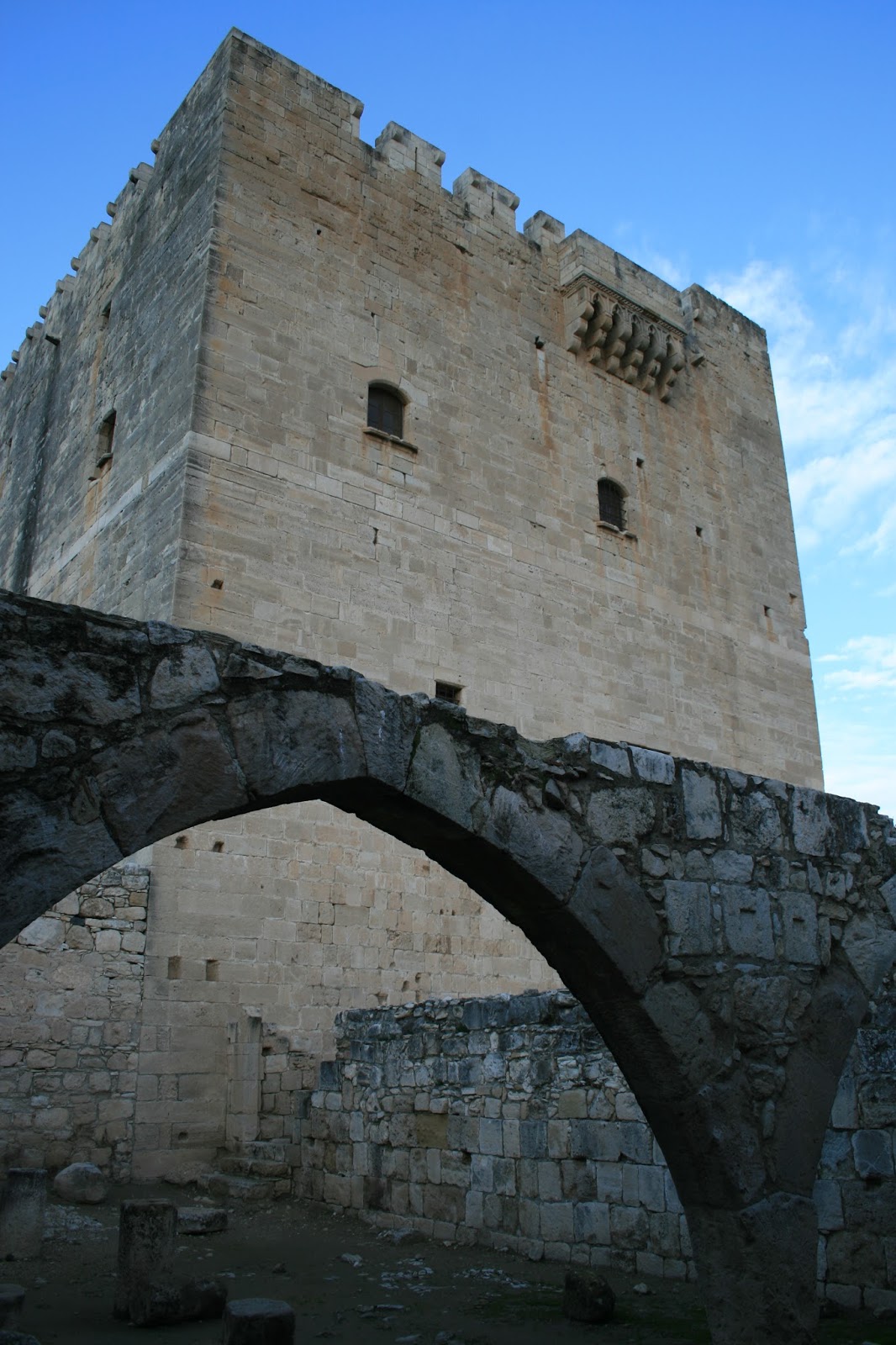
The exact sequence of events varies according to which chronicle one follows.  One version has Richard order his galleys to break through a blockade of ships at the mouth of Limassol harbor and then storm ashore on foot, without waiting for horses to be off-loaded.  Another version claims he landed on a beach beyond Limassol harbor against opposition, and then took Limassol from landward, again without horses. In either case,  Isaac Comnenus was not captured with the city, and so the English King and the Byzantine “Emperor” faced off in battle at a location sometimes identified as Kolossi, the later site of a lovely Hospitaller commandery.

 The Hospitaller Commandery at Kolossi

Where ever it was, Richard put the forces of Isaac Comnenus to flight with no casualties of his own because, as at the earlier engagements, the self-styled “Emperor” little support among the population.  He had been appointed (if at all) by a Byzantine Emperor, who had himself since been deposed.  Furthermore, his despotic rule had earned him only the hatred of the native population. In short, Richard the Lionhearted did not need much of his vaunted military skill to win a victory here. After Isaac had surrendered to him, Richard returned to Limassol and on May 12 married Berengaria and had her crowded Queen of England. The exact location is unknown, and several churches in Limassol claim the honor.


This Templar Church in Famagusta is of a later date, but incorporated some architectural features typical of the Byzantine churches on the island.

Since Richard was in a hurry to get to the Kingdom of Jerusalem, where only the city of Tyre remained in Christian hands although a Christian siege of Muslim held Acre was underway, he probably would have sailed shortly after this happy event if Isaac Comnenus had not made the mistake of breaking his promise to sail with Richard on crusade. Infact, Isaac fled to the mountains in a transparent attempt to re-establish his rule of the island, and Richard responded by an all-out campaign of conquest – which again took little time or effort because of the hostility of the population to Isaac Comnenus. After landing at Famagusta, Richard marched on Nicosia, handily defeated Isaac’s mercenaries in the field and continued on to the capital where he also took custody of Isaac’s only child, a girl, who has remained nameless in history.  By the end of May, Isaac Commenus had surrendered to Richard a second time – despite having three unassailable castles in which he might have sought refuge.  Apparently, he could not trust the garrisons of these castle or muster enough loyal men to replace the existing garrisons.


The still dramatic ruins of the Castle of St. Hilarion, one of the three castles built by the Byzantines.

Isaac set only one condition to his surrender: that he not be placed in irons.  Richard therefore had shackles made of silver especially for him.  He was to die three years later in Syria trying to incite the Sultan of Konya to attack the Byzantine Empire. 

Richard was still in a hurry to get to the Holy Land (and join the siege at Acre before his rival King Philip II of France could claim credit for victory), but he also saw the strategic importance of Cyprus to the crusader kingdoms.  The port of Famagusta is only 118 miles from Tripoli, the closest of the crusader cities, and just 165 miles from Acre.  Furthermore, Cyprus was a fertile island capable of producing grain, sugar, olives, wine and citrus fruits in abundance.  Although Richard recognized that he could not possibly rule Cyprus himself, he wanted to secure it as resource for the crusader states and a base for operations against the Saracens.  So, although he left Cyprus on June 4, 1191, exactly a month after he arrived, shortly afterwards Richard sold the island to the Knights Templar for 100,000 pieces of gold.

Unlike Richard, who had come to an agreement with the Greek nobility on the island to let them retain their laws and customs, the Templars allegedly sought to impose Latin rites and tax the population at excessive rates. Within six months the island was in rebellion against them and the Templars, were forced to face the fact that they did not have the manpower to quell this rebellion and fight for the Holy Land at the same time; they returned the Island to Richard.

Richard promptly sold it a second time, this time to his vassal and former King of Jerusalem, Guy de Lusignan.  Guy de Lusignan had a long and colorful past -- which included seducing a Princess (Sibylla of Jerusalem) and losing a Kingdom (on the Horns of Hattin above the Sea of Galilee), but he was now a landless widower.  Guy came to Cyprus in the spring of 1192, probably accompanied by other knights and barons from the once proud Kingdom of Jerusalem who had lost their lands to Salah ad-Din.  Two years later he was dead, and Cyprus passed to his elder brother, Aimery de Lusignan, who founded a stable, Latin dynasty that lasted three hundred years.


The Premonstratensian Monestary of Bellapais was founded by the Lusignans.


Several of my novels set in the Age of Chivalry feature the Crusader Kingdom of Cyprus. St. Louis' Knight opens in Cyprus during the VIIth Crusade:


A crusader in search of faith --

A lame lady in search of revenge --
And a king who would be saint.

St. Louis' Knight takes you to the Holy Land in the 13th century, and a world filled with knights, nobles, prophets -- and assassins.