COPYRIGHT

All content on this blog is protected by copyright.
Content used elsewhere without attribution constitutes theft of intellectual property and will be prosecuted.
Showing posts with label pilgrims. Show all posts

Saturday, February 28, 2026

Crusaders, Pilgrims and Militant Monks

 One of the unique features of the population of the Holy Land in the crusader era was the number of transients. In almost any year, tens of thousands of people who did not intend to remain in the Holy Land were temporarily present. Yet despite the itinerant status, they all contributed to the face of the crusader states. 

The first Franks in the Holy Land were the participants of the First Crusade, and the vast majority of these returned to the West. In the succeeding 200 years, waves of crusaders periodically swept over the Holy Land. The overwhelming majority of these men likewise returned to their homes after the military campaign ended. In addition to the participants in organised military expeditions, individual fighting men made the journey to the Holy Land as ‘armed pilgrims’ for reasons of personal penance, sometimes voluntarily and other times imposed by a confessor. These men joined in ongoing military actions or participated in local operations before returning home when their penance was completed. All of these men can be called ‘Franks’ yet need to be distinguished from the permanent Frankish population of the crusader states because of the transient character of their stay in the Holy Land. While they temporarily swelled the military forces available to the armies of the Frankish states, they retained Western European perspectives and identities.

The same is true of the many unarmed pilgrims who flooded the Holy Land between 1100 and 1291. The numbers of pilgrims who made the long and dangerous journey to the Holy Land in this period are astounding. Just three years after Jerusalem returned to Christian control, more than one thousand pilgrims were killed in a single storm when twenty-three pilgrim ships were wrecked off Jaffa harbor. Yet that was a period when most pilgrims travelled on cargo ships, which could take no more than fifty passengers. Within a few decades, special pilgrim ships with a passenger capacity of 200 were in operation, and by the thirteenth century, the pilgrim ships could take up to 1,500 passengers. The military orders transported 6,000 pilgrims per year from the port of Marseilles alone. Presumably they transported similar numbers from the Italian ports and Sicily, while the bulk of the pilgrim traffic traveled in commercial vessels. The number of religious tourists to the Holy Land easily exceeded fifteen thousand annually.

The pilgrim ships left Western Europe in two waves each year, one in the spring and another in the fall. Although ships generally travelled independently, within a few weeks of one another, hundreds of ships brought thousands of pilgrims to the ports of the Levant, predominantly Acre, but also Haifa, Caesarea and Jaffa. Pilgrims also came overland. They came from every Christian country in the world. There were Ethiopians, Egyptians and North Africans, Armenians and Georgians, Norwegians, Scotsmen, Hungarians, and citizens of the semi-independent Italian city-states and all the component parts of the Holy Roman Empire. Unlike the crusaders, who were by definition fighting men, many pilgrims were women. Some women accompanied their husbands, fathers or brothers; others came solo, many as widows and nuns. Male or female, most pilgrims remained in the east only one season, i.e., about six months; very few stayed more than a year. They contributed considerably to the local economy, yet they were visitors, not residents.

Members of the military orders were the last type of transient resident in the crusader states. The military orders were a new form of religious institution that enabled men to be both monks and knights. While members of these orders were expected to renounce all wealth, attend mass multiple times a day, fast, pray and eat in silence, and for the most part live in controlled communities segregated from the secular world (especially women), members were not required to give up the profession of arms. Rather, these orders were designed to capture the religious zeal of the time and funnel the fervor and energy of fighting men into religious channels. This spirit of militant Christianity gave birth to no fewer than seventeen military orders, eight on the Iberian Peninsula, two in what is now Italy, and two in German-speaking Europe in addition to the orders founded in the Holy Land. The most famous and powerful of the militant orders were the Templars, the Hospitallers, the Teutonic Knights and to a lesser extent the Knights of St. Lazarus, all of which were established in the crusader states.

The individual history of these orders is beyond the scope of this book. The point here is that, although the raison d’ĂȘtre of both the Templars and Hospitallers was to defend of the Holy Land and the Christian pilgrims that visited it, they were not subject to local ecclesiastical or secular authority; neither the King nor the patriarch could command the Templars, Hospitallers, or Teutonic Knights. Furthermore, while these orders maintained a standing presence in the Holy Land and garrisoned key castles, the individual members of these orders were drawn from around the world, and their sojourn in the Holy Land was temporary. The affiliation and loyalty of members of the militant orders were to their respective order, not the crusader states.

The bulk of this entry is an excerpt from Dr. Schrader's comprehensive study of the crusader states.
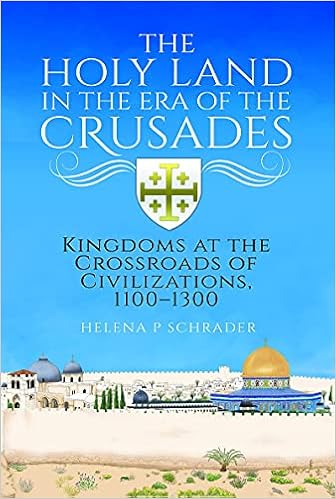
Dr. Helena P. Schrader is also the author of six books set in the Holy Land in the Era of the Crusades.


           Buy Now!                                                  Buy Now!                                                    Buy Now!
 

          Buy Now!                                               Buy Now!                                                      Buy Now!


Thursday, April 12, 2018

Jews in the Crusader States

Everyone has heard how the crusaders slaughtered all the inhabitants of the Jerusalem when they captured the city by storm on July 15, 1099. Among the dead were allegedly the entire Jewish population of Jerusalem at the time.  We also know that long before the first crusaders reached Jerusalem, in 1096, Jewish communities in the Rhineland were attacked and massacred mercilessly, and that all subsequent crusades were likewise accompanied by greater or lesser outbreaks of violence against Jews in Western Europe. It may therefore come as a surprise that Jews in the crusader states themselves suffered no persecution. On the contrary, by the end of the 13th century, the crusader kingdom of Jerusalem had become home to a flourishing community of Jews and a major center of Talmudic studies.


How was this possible and how did it come about?

Although Robert Chazan[i] traces the roots of anti-Semitism to the start of the 11th century, when the Jews were complicit in the destruction of the Church of the Holy Sepulcher by the Fatimid caliph in 1009, there is strong evidence that the crusades intensified anti-Semitic feelings among large portions of the population of Western Europe. Daniel P. Franke[ii] rightly points out that the Popes ― right into the 15th century ― maintained a policy of tolerance, quoting from a papal bull in 1120, which states:

We decree that no Christian shall use violence to force [Jews] into baptism while they are unwilling and refuse… Moreover…no Christian shall presume to wound their persons, or kill them, or rob them of their money… Furthermore, while they celebrate their festivals, no one shall disturb them in any way.[iii]

Yet the very fact that 23 popes of the 12th to 15th centuries felt compelled to re-issue this directive underlines the fact that violence against the Jews continued across Western Europe. Certainly the attacks on Jews by the first crusaders spread from Speyer to Worms, Mainz, Trier, Metz, Regensburg, and Prague.  Some historians argue they were not confined to the German-speaking world, but also spread to France. Certainly, England saw a terrible outbreak of violent anti-Semitism in association with Richard I’s coronation in 1190. King (Saint) Louis IX went so far as to elevate Jewish persecution to state policy, although there were less spontaneous acts of violence against them than elsewhere in Europe. So why not in the Holy Land itself?

The initial contact between crusaders and Jews had been bitter. The Jews actively supported the Muslim defenders of Jerusalem, Haifa, and other cities of the Holy Land. When these cities fell to assault, the Jews were massacred along with the Muslim defenders; when the cities agreed to terms, they were allowed to withdraw with their portable goods and chattels. Within ten years, most Jews, who were predominantly urban-dwellers, had been driven out of the territories held by the crusaders. In Jerusalem itself, a ban prohibited Jews from ever re-settling in the Holy City.

Yet there is ample evidence of the fact that the Jews remained or returned to other cities ― or never left at all. Records show there were large Jewish communities in Tyre and Acre, smaller communities in Ascalon and elsewhere.  Furthermore, there were two dozen villages occupied entirely by Jews in Galilee, between Tiberias and Nablus.

Even more astonishing and significant: the First Crusade sparked a Jewish messianic movement.  According to Prawer, “in some communities the Jews sold their property and waited for the Messiah who would bring them to Jerusalem.” [iv] Certainly, the establishment of the crusader states and regular trade and pilgrimage traffic between the Holy Land and Western Europe allowed European Jews to undertake the pilgrimage to Jerusalem and other sacred places in the Holy Land.  The pilgrim traffic to the crusader states included a significant portion of Jews ― and like their Christian counterparts, many of these chose to stay in the Holy Land after they arrived.

They were encouraged to do so not merely by the proximity to their holy sites, but by the prevailing atmosphere of tolerance in the crusader states ― in sharp contrast to the situation “at home” in Western Europe. Precisely because the Frankish elite was a minority in the crusader states, they were dependent upon the cooperation and contribution of a variety of native inhabitants. The majority of these were other kinds of Christians ― Melkites, Maronites and Jacobites, Armenian, Abyssinians and Copts ― but there was also a large Muslim population. People in the Holy Land had to learn to deal with all of them; Jews were just one more “flavor” in the mix.

This social tolerance was underpinned by the laws of the crusader states that did not discriminate against Jews either. Rather, Jews were treated the same way as Muslims and non-Latin Christians in that they were allowed to retain their own laws and customs, living according to their own traditions and celebrating their festivals and rites without interference. In consequence, there were rabbinical courts in both Acre and Tyre (and possibly Tiberias), and Palestine in the crusader period was one of only three centers in the world for Talmudic Study.

Furthermore, the Jews continued to pursue respected professions such as medicine, and took part in commercial activities. There is no evidence that they were required to wear distinctive clothing or live in segregated communities, although it is almost certain that, like the remaining Muslim population, they were subject to additional taxes.

In addition, there was still a large Samaritan population. (Note: Samaritans accept only the first five books of the Hebrew bible as divinely inspired.) Although many Samaritans had been driven into exile across the Middle East, the center of Samaritan worship and scholarship was located in Nablus, and this was where the largest Samaritan population was concentrated in the crusader era. The Samaritans appear to have flourished under crusader rule and a large number of Torah scrolls produced by Samaritans have survived, suggesting a flourishing of activities rather than the reverse.

To be sure, the Jews welcomed Saladin’s victories because he allowed Jews to re-settle in Jerusalem, but within a few decades the situation there had become too precarious. In 1229, the Sultan al-Kamil handed Jerusalem back to Fredrick II Hohenstaufen for ten years, and the Emperor immediately re-imposed the anti-Jewish ban. The Turkoman invasion of 1244 resulted in the sack of Jerusalem, and the Mongol raids of the 1260s made life in and around Jerusalem dangerous. Yet tellingly, the Jews moved not further east to Damascus and Aleppo, but rather preferred to live in the remaining crusader cities, notably Tyre and Acre.

As a result, from the second quarter of the 13th century until its fall, Acre became a vibrant Jewish center, a “cross-section of the different communities of the Diaspora. The leading elements were Jews from Spain and from northern and southern France, in addition to eastern Jews, whether Palestinian-born or from neighboring Moslem, countries…Here a Talmudic academy continued the tradition of the French Tosafists, whereas rabbi Salomon Petit expounded the Kabbala and Spanish Jews continued their own tradition.”[v]

Tragically, despite Islam’s vaunted “tolerance” for Judiasm, this Jewish center and the entire Jewish community that fed and surrounded it were exterminated mercilessly by al-Ashraf Khalil when he captured Acre in 1291.

 Daily life, including tolerance for Jews, is depicted as accurately as possible in my award-winning novels set in Outremer:


       Buy now!                                       Buy now!                                         Buy now!


[i] Chazan, Robert. “1007-1012: Initial Crisis for Northern European Jewry,” in Proceedings of the American Academy for Jewish Research 38/39. 1970-1971, p. 101.
[ii] Franke, Daniel P.. “The Crusades and Medieval anti-Semitism: Cause or Consequence” in Seven Myths of the Crusades. Editors Andrea, Alfred J. and Andrew Holt. Hackett, 2015
[iii] Franke, p. 61
[iv] Prawer, Joshua. “Social Classes in the Crusader States: the ‘Minorities” in A History of the Crusades Volume 5: The Impact of the Crusade on the Near East. Editors Hazard, Harry M. and Norman P. Zacour. University of Wisconsin Press, 1985, p. 97.
[v] Prawer, p. 101.

Friday, October 30, 2015

Clash of Cultures: Crusaders vs the Crusader States

Acre, the commercial heart of the crusader states, where the clash of culture often occurred.
Last week I described some of the urban architecture in the crusader states that inspired admiration — but also envy — on the part of visitors from the West. Throughout the existence of the crusader states, pilgrims from the West flocked to the Holy Land, some in search of salvation, some simply “sight-seeing,” and some as “armed pilgrims” to offer their sword (or bow or ax) in the defense of the Christian territories. Many of these pilgrims wrote accounts of their travels, and many chroniclers in the West, whether they had personally been there or not, included impressions of the Holy Land obtained second (or third, or fourth) hand from these travelers in their works. From the mid-12th century on, a hefty strain of critique and censure of the settlers in “Outremer” runs through many of these works. Each defeat, each unsuccessful crusade, was routinely attributed to the sins of those involved: that is the crusaders and the residents of the Holy Land.


Medieval Depiction of a Godfrey de Bouillon, the first pious and devout Ruler of Jerusalem,
often contrasted to the later "degenerate" kings.
By the Third Crusade Westerners clearly viewed the residents of Outremer with suspicion. No previous set-back was comparable to the loss of the entire kingdom, including, obviously, the most sacred site of all, the Holy Sepulcher in Jerusalem. Although men flocked to take the cross and the largest armies led by the most prominent rulers of the age set out on the Third Crusade, their objective was to rescue the Holy Land — not the kingdom or people who had occupied the Holy Land since the First Crusade. On the contrary, most of the crusaders appear to have blamed the residents of Outremer collectively (rather than just Guy de Lusignan personally) for losing the Holy Land. These people were at the latest by this time given the derisive name of poulain, which derives from the French for foal and imputed mixed blood. They were viewed as the sinners to blame for the catastrophe, which the (by inference) virtuous men from the West now needed to rectify.
Crusaders
These were the beliefs held before setting out on crusade, but they were reinforced by confrontation with life in Outremer.

The first problem was the widespread use of stone building materials, something that was still pretty much a luxury in the West. The extensive use of stone, therefore, made the cities of Outremer appear exotic to the pilgrim arriving by sea before he or she even set foot on land.  Admittedly, those coming by land would have already adjusted to the use of stone and brick. Still, the physical differences in the architecture and the heat of the summer sun (most pilgrims came in the spring and departed in the fall), undoubtedly created a sense of being in a very different world, and most people are suspicious of things that seem very different from home.


White Limestone and Palms -- so different from Northern Europe
The second problem, of course, was that the majority of the natives (Orthodox Christians, Jews, and Muslims) dressed in “oriental” styles. Although the Latin elites still followed Western fashion for the most part, the climate alone dictated some adaptation of Western clothing. In temperatures approaching 40 degrees Centigrade (100 degrees Fahrenheit), it was unthinkable to wear the heavy furs and wools, or the layers of clothing common in the West. While Latin women never adopted “the veil” in the Arab tradition of black robes completely concealing a woman’s figure including arms and face, Latin women would certainly have protected their faces from the ravages of the Palestinian sun with sheer silks, probably short enough to be thrown back over their head when indoors.  More shocking to the new-comers, however, the very same fashions if worn in gauze and silk rather than wool and linen would have resulted in gowns that clung and revealed more of the female figure. Meanwhile, while neither knights nor sergeants went around in turbans and kaftans (as some modern writers would have you believe), again the fabrics used for shirts, tunics, hose, and surcoats would have been considerably lighter and sheerer than fabrics common in the West. Easy access to some of the more powerful dyes (saffron for yellow, the sea snails (porphyra) for purple, etc.) may have made these clothes brighter and more vivid as well. The result was undoubtedly a somewhat mind-boggling mixture of styles and colors that seemed extravagant and exotic to the newcomer.


Hollywood's Interpretation of Mixed Styles and Opulence in the Crusader States
Sibylla of Jerusalem as depicted in "The Kingdom of Heaven"
The third problem was the discovery that the majority of the population in Outremer, including the Orthodox Christian natives, spoke Arabic. Regardless of religion, this was the lingua-franca of Outremer, used by merchants across the region alongside Greek. The poulains born in Outremer, living side-by-side with Arabic speaking neighbors in the cities, trading with Arabic-speaking shopkeepers, or even lords dealing with Arab-speaking tenants and servants all had to acquire a degree of competency in Arabic just to conduct daily business.  To more recent arrivals this command of the “infidel's” language smacked of treason. The fact that many Latin Christians, who had come out as crusaders, later married Arabic- or Greek-speaking women reinforced the impression of ambiguous loyalty on the part of the poulains. At a minimum, it created suspicion simply because the newcomers could not hope to understand Arabic based on an understanding of Latin, the lingua-franca of the West.

Church Art was particularly influenced by Byzantine traditions and mosaics, for example, were more common.
This suspicion about the loyalty of the residents of the crusader states had been reinforced over the decades leading up to the Third Crusade by a series of truces the Kings of Jerusalem had made with their Muslim counterparts. While the residents in the crusader states recognized the sheer tactical utility of periodic truces and pauses in the fighting, newly arrived crusaders were often appalled to think they had come so far to fight the Saracens, only to be told:  “Oh, well, thanks for coming, but at the moment we have a truce and aren’t fighting the Saracens, we're trading with them instead.” Such armed pilgrims returned home embittered and told stories about how the poulains had “sold out” to the Saracens.

Another source of friction between Western visitors and permanent residents of the crusader states was the apparent “wealth” of the natives. As early as 1125, Fulcher of Chartres, one of the chroniclers of the First Crusade, had written that in the crusader states “he who was poor [at home in the West] attains riches here. He who had no more than a few deniers finds himself here in possession of a fortune. He who owned not so much as one village finds himself, by God’s grace, the lord of a city.” (Cited in Bartlett, Downfall of the Crusader Kingdom, p. 189.) Fulcher was trying to recruit settlers and was doubtless exaggerating, but his claims seemed to match what visitors encountered.

Because the Latin Christians in the crusader states were integrated into the upper and middle levels of society while the very bottom rungs were filled by native Christians or Muslims, travelers to the crusader states from the West were more likely to encounter and interact with men and women from a higher strata of society.  Furthermore, because items that were outrageously expensive in the West were produced in the crusader states (silk, glass, sugar, citrus fruits, pomegranates) these “luxury” items were accessible to people much farther down the social scale than in the West. Visitors were undoubtedly aghast to find common laborers and soldiers enjoying lemons and sugar, or wearing, if not pure silk, some of the mixed textiles that combined silk with cotton or linen.


This glass and enamel cup is believed to originate from the crusader states.
And then there was the issue of bathing. Not that bathing was not an integral part of Western culture in this period; it was. But in the West bathing was considerably more difficult and less convenient, at least during the winter months when a bath could only be enjoyed if the water was first heated up. Furthermore, for the upper classes, bathing was a private affair — a tub carried up to a bedchamber, filled with buckets of water hauled there by servants, and attended upon by a wife, daughter or squire. In the crusader states the public bath-houses of the Greeks and Romans had been taken over, rebuilt and supplemented by those of the Arabs and Turks. Bathing was not only easier and cheaper in a climate where cooler was better most of the time, but bathing was also a public affair with professional bath attendants rather than retainers and family in attendance. The public baths in the tradition of the Greeks, Romans, and Turks included massages with fragrant oils rubbed into the skin. All of this smelled, particularly clerics, like “dins of iniquity” reminiscent of Jezebel, Salome and the Queen of Sheba.


A 19th Century -- equally erroneous - depiction of a Turkish bath that reflects the same misconception about the mixing of sex with cleanliness.
Last but not least, the culture of West Europeans clashed with the culture of the crusader states because the crusader states were heavily urbanized and cosmopolitan at a time when most Western kingdoms were still predominantly agricultural and parochial. The poulains had little choice but to be tolerant of different customs, clothes, foods and even religions because they were surrounded by these things. To survive they traded with Cairo and Damascus, Aleppo and Constantinople. Jews were allowed to live throughout the kingdom except in Jerusalem itself. Muslims likewise lived -- and were allowed to follow their religion -- across the kingdom, again with the exception of Jerusalem itself. Muslims even had the right to the haj in some cities such as Nablus. Although taxed more heavily, neither Muslims nor Jews were subject to persecution, and some enjoyed wealth and administrative power. This was quite simply because poulains, who never made up more than 20% of the population, could not afford bigotry in any regard. Yet that very tolerance struck many newcomers as near-heresy. It was a short step from being scandalized at poulain tolerance and jealous of the poulain wealth to seeing in the poulains the sinners to blame for all the disasters that had befallen the Holy Land — reinforcing all the prejudices which with the crusaders had sailed from the West.

My novels set in the crusader kingdoms show Outremer through the eyes of the poulains rather than the crusaders:


 Buy now!                                       Buy now!                                   Buy now (paperback)
                                                                                                                or Kindle!