COPYRIGHT

All content on this blog is protected by copyright.
Content used elsewhere without attribution constitutes theft of intellectual property and will be prosecuted.

Friday, October 24, 2014

The Lionheart's Greatest Conquest


Tomb of Richard I in Fontevrault

Richard I has gone down in history as the “Lionhearted” because of his military prowess, but most of his victories were ephemeral. The bulk of the Angevin Empire was lost in the reign of his brother and successor John, and the Kingdom of Jerusalem that Richard salvaged from obliteration in 1191-1192 was wiped off the map roughly a century after his death. But one conquest, an almost incidental conquest, proved enduring:  it was the conquest of Cyprus in 1191. In just four weeks, Richard I seized control of the entire island, and within a year he had established a Latin kingdom that endured almost four hundred years until the second half of the 16th century.  

In 1191, after a tempestuous winter on Sicily, Richard I of England and his assembled crusader army of vassals and mercenaries set sail for the Holy Land.  Philip II, also on crusade, had quarreled with Richard on Sicily and proceeded with his contingent of crusaders without the English/Angevin forces. Richard’s fleet set sail on April 1, but encountered a storm that blew the vessels off course and scattered the fleet.  Richard’s galley eventually made safe harbor on the island of Rhodes on April 22, but the ship carrying his betrothed, Princess Berengaria of Navarre, and his sister Joanna, the widowed Queen of Sicily, was missing.  When Richard was well enough (he fell ill at Rhodes) and his ships were again seaworthy, he set out once more for the Holy Land collecting his fleet as he went.  He sailed deliberately for Cyprus, the largest of the islands in the eastern Mediterranean in the hope that many of his missing ships, including the one with his bride and sister, might have found refuge there.

And indeed they had, but their reception had been far from welcoming. The survivors of three ships wrecked on Cyprus, far from receiving the charity expected of a Christian monarch (Cyprus was ruled at this time by a self-styled Byzantine “Emperor”) were – in Richard’s own words – “robbed and despoiled.”  The ship carrying the royal ladies had avoided shipwreck, but in distress had taken refuge in the harbor of Limassol.  The knights aboard this vessel somehow received word of what had happened to their comrades, and Joanna of Plantagenet (a woman who deserves a novel of her own!) was clearly not buying the assurances offered by “Emperor” Isaac Comnenus about her safety.  She smelt a rat and stayed aboard her damaged vessel.

Thus when Richard sailed into Limassol harbor on the evening of May 5, he found his bride-to-be and sister in a precarious situation aboard an unseaworthy vessel running out of water but afraid of being held for ransom or worse if they went ashore.  Richard responded as could only be expected of the proud Plantagenet: he attacked.

The exact sequence of events varies according to which chronicle one follows.  One version has Richard order his galleys to break through a blockade of ships at the mouth of Limassol harbor and then storm ashore on foot, without waiting for horses to be off-loaded.  Another version claims he landed on a beach beyond Limassol harbor against opposition, and then took Limassol from landward, again without horses. In either case,  Isaac Comnenus was not captured with the city, and so the English King and the Byzantine “Emperor” faced off in battle at a location sometimes identified as Kolossi, the later site of a lovely Hospitaller commandery.
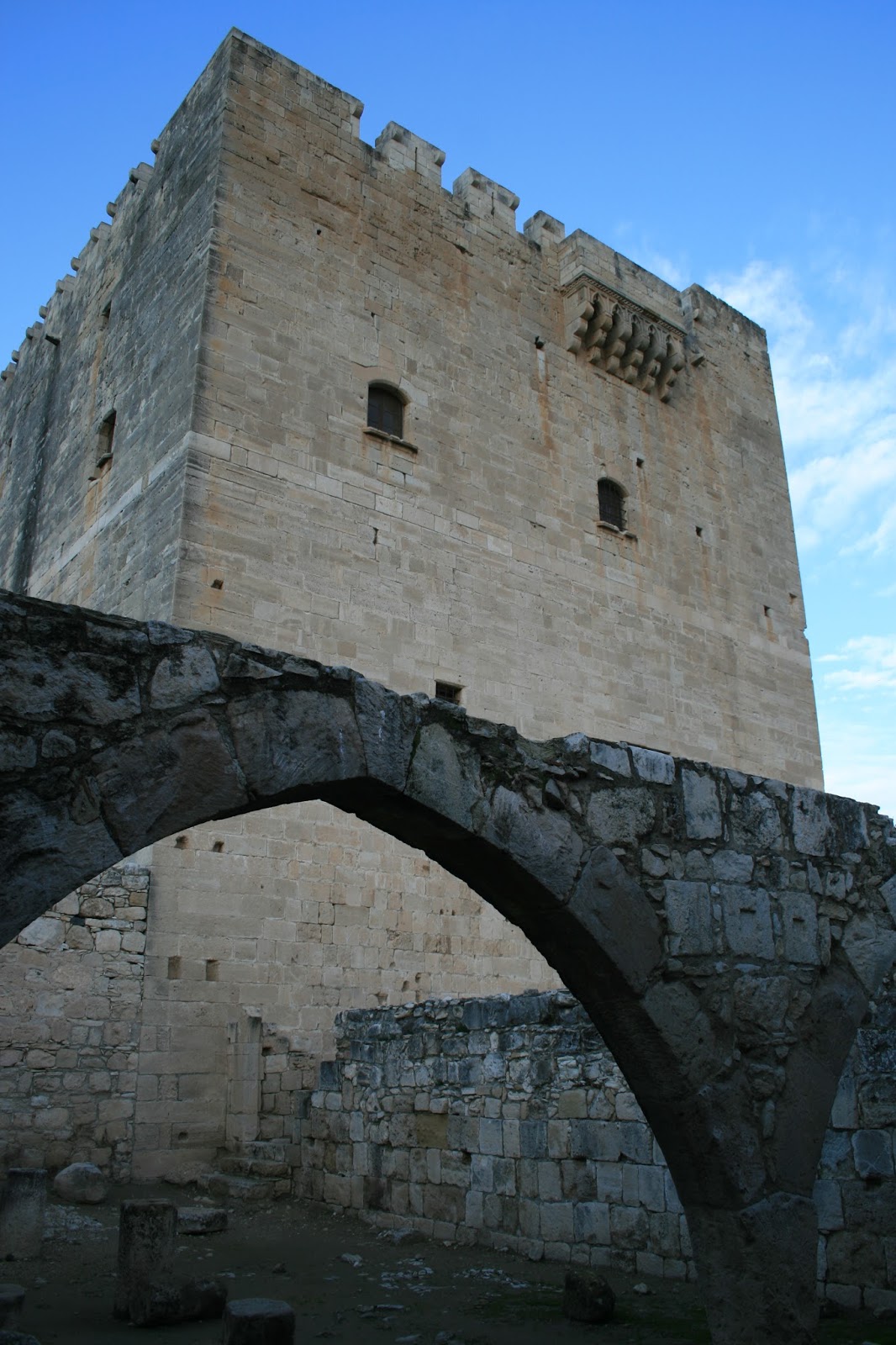
 The Hospitaller Commandery at Kolossi

Where ever it was, Richard put the forces of Isaac Comnenus to flight with no casualties of his own because, as at the earlier engagements, the self-styled “Emperor” little support among the population.  He had been appointed (if at all) by a Byzantine Emperor, who had himself since been deposed.  Furthermore, his despotic rule had earned him only the hatred of the native population. In short, Richard the Lionhearted did not need much of his vaunted military skill to win a victory here. After Isaac had surrendered to him, Richard returned to Limassol and on May 12 married Berengaria and had her crowded Queen of England. The exact location is unknown, and several churches in Limassol claim the honor.


This Templar Church in Famagusta is of a later date, but incorporated some architectural features typical of the Byzantine churches on the island.

Since Richard was in a hurry to get to the Kingdom of Jerusalem, where only the city of Tyre remained in Christian hands although a Christian siege of Muslim held Acre was underway, he probably would have sailed shortly after this happy event if Isaac Comnenus had not made the mistake of breaking his promise to sail with Richard on crusade. Infact, Isaac fled to the mountains in a transparent attempt to re-establish his rule of the island, and Richard responded by an all-out campaign of conquest – which again took little time or effort because of the hostility of the population to Isaac Comnenus. After landing at Famagusta, Richard marched on Nicosia, handily defeated Isaac’s mercenaries in the field and continued on to the capital where he also took custody of Isaac’s only child, a girl, who has remained nameless in history.  By the end of May, Isaac Commenus had surrendered to Richard a second time – despite having three unassailable castles in which he might have sought refuge.  Apparently, he could not trust the garrisons of these castle or muster enough loyal men to replace the existing garrisons.


The still dramatic ruins of the Castle of St. Hilarion, one of the three castles built by the Byzantines.

Isaac set only one condition to his surrender: that he not be placed in irons.  Richard therefore had shackles made of silver especially for him.  He was to die three years later in Syria trying to incite the Sultan of Konya to attack the Byzantine Empire. 

Richard was still in a hurry to get to the Holy Land (and join the siege at Acre before his rival King Philip II of France could claim credit for victory), but he also saw the strategic importance of Cyprus to the crusader kingdoms.  The port of Famagusta is only 118 miles from Tripoli, the closest of the crusader cities, and just 165 miles from Acre.  Furthermore, Cyprus was a fertile island capable of producing grain, sugar, olives, wine and citrus fruits in abundance.  Although Richard recognized that he could not possibly rule Cyprus himself, he wanted to secure it as resource for the crusader states and a base for operations against the Saracens.  So, although he left Cyprus on June 4, 1191, exactly a month after he arrived, shortly afterwards Richard sold the island to the Knights Templar for 100,000 pieces of gold.

Unlike Richard, who had come to an agreement with the Greek nobility on the island to let them retain their laws and customs, the Templars allegedly sought to impose Latin rites and tax the population at excessive rates. Within six months the island was in rebellion against them and the Templars, were forced to face the fact that they did not have the manpower to quell this rebellion and fight for the Holy Land at the same time; they returned the Island to Richard.

Richard promptly sold it a second time, this time to his vassal and former King of Jerusalem, Guy de Lusignan.  Guy de Lusignan had a long and colorful past -- which included seducing a Princess (Sibylla of Jerusalem) and losing a Kingdom (on the Horns of Hattin above the Sea of Galilee), but he was now a landless widower.  Guy came to Cyprus in the spring of 1192, probably accompanied by other knights and barons from the once proud Kingdom of Jerusalem who had lost their lands to Salah ad-Din.  Two years later he was dead, and Cyprus passed to his elder brother, Aimery de Lusignan, who founded a stable, Latin dynasty that lasted three hundred years.


The Premonstratensian Monestary of Bellapais was founded by the Lusignans.


Several of my novels set in the Age of Chivalry feature the Crusader Kingdom of Cyprus. St. Louis' Knight opens in Cyprus during the VIIth Crusade:


A crusader in search of faith --

A lame lady in search of revenge --
And a king who would be saint.

St. Louis' Knight takes you to the Holy Land in the 13th century, and a world filled with knights, nobles, prophets -- and assassins.


Friday, October 17, 2014

A Kingdom Divided

W.B Bartlett in his recent work, Downfall of the Crusader Kingdom: The Battle of Hattin and the Loss of Jerusalem (The History Press, 2007), writes in the Prologue:

During the latter decades of the twelfth century, Outremer was sleepwalking to disaster. Seemingly oblivious to the dangers of a resurgent Islam, the kingdom began to split apart. The nobles who governed with the king sought to outmaneuver one another, seeking to raise themselves up and bring their political opponents down.

This is by no means an isolated view, and most modern fiction about the period has followed the portrayal whether it is Cecilia Holland’s Jerusalem in which, according to the New York Times review, she brings to life the “atmosphere of conspiracy, betrayal…and political intrigue….” or Ridley Scott’s “Kingdom of Heaven” in which the fictional Tiberius condemns the struggles for power and land that he claims corrupted the ideals of the Holy City.

The character of Tiberius, loosely based on Raymond of Tripoli, in the film "The Kingdom of Heaven."

But let’s be realistic. There has never been a kingdom or state that has been entirely without factions — not even in monolithic and totalitarian dictatorships.  To expect a state to have perfect harmony and unity is not merely idealistic, it is naive. Where there is power, there will be differences of opinion on policy, and where there are competing policy options there will be factions — usually aggravated by personalities, rivalries and the prospect of personal gain associated with proximity to power or the execution of one policy over another.

It is, in short, absurd to expect the Kingdom of Jerusalem to be without factions supporting competing policies.  Whether these can be divided into “hawks” and “doves” or “insiders” and “outsiders” is not the issue here. The fact is that the mere presence of advisors advocating competing policies and/or even passionate rivalry between powerful noblemen in a medieval kingdom is neither unusual nor inherently self-destructive.

The question is whether the divisions within the Kingdom of Jerusalem in the second half of the twelfth century mortally crippled the kingdom to the point where the threat posed by Salah-ad-Din was ignored.  Let's look at the historical record.
The Arms of the Kingdom of Jerusalem

Although it is safe to say that no kingdom on earth would have welcomed the ascension of a man suffering from leprosy, the High Court of Jerusalem took no longer than usual to recognize Baldwin IV as his father’s heir.  Furthermore, a powerful regent was rapidly installed who peacefully surrendered the keys to the kingdom to the leper prince when he turned fifteen. No sign of exceptionally destructive factions here, despite the explosive situation of a leper boy being heir to the throne.

Just a little over a year after Baldwin IV came of age, the Kingdom of Jerusalem faced the first full-scale invasion led by Salah-ad-Din.  The Count of Tripoli, the Hospitallers and hundreds of other knights from the Kingdom were at the time laying siege to Hama in Syria; Salah-ad-Din invaded from Egypt and immediately invested Ascalon. It was a very dangerous situation. The sixteen-year-old king, with no experience of battle whatsoever, gathered his forces — some 376 knights — and rode to the relief of Ascalon. He then broke out of Ascalon, met up with a Templar force from Gaza and called up the army of Jerusalem. And they came. At Montgisard, under Baldwin IV’s personal leadership, the Christian army dealt Salah-ad-Din a devastating and humiliating defeat. The bulk of the Saracen army was killed or captured, and Salah-ad-Din barely escaped on a pack camel. Nothing about this suggests a kingdom divided against itself — nor blind to the threat posed by Salah-ad-Din.

A Depiction of Montgisard, Copyright Fireforge Games

The very next year, Baldwin ordered the construction of a castle at Jacob’s Ford — a clear indication that he recognized the threat posed by the Kurdish leader. Two years later, during the next invasion by Salah-ad-Din, Baldwin again successfully mustered his forces and successfully broke the Saracen vanguard.  Unfortunately, the Templars (who were not under Baldwin’s command) were routed by Salah-ad-Din’s main forces at the same time. When the Templars fell back, the entire Christian army withdrew. While the Templars lack of coordination is certainly to be condemned, it has nothing to do with internal rivalries or factions among the barons of Outremer.

The first hint of serious internal divisions surfaces in 1180. According to William Archbishop of Tyre, who was chancellor to Baldwin IV and so not only a contemporary but an insider, Baldwin IV’s illness had taken a dramatic turn for the worse by this time. It was clear, therefore, that the crown of Jerusalem would pass through Baldwin’s older sister Sibylla to whoever her husband might be; Sibylla in 1180 was a twenty-year-old widow. 

Sibylla as depicted in Ridley Scott's "The Kingdom of Heaven"

For whatever reasons (and they are controversial), the Baron of Ramla and Mirabelle with the backing of the Count of Tripoli and the Prince of Antioch considered himself the best candidate for Sibylla’s hand, but Sibylla — with or without her brother’s consent — married a young French noblemen of dubious character, Guy de Lusignan. 

Now Guy de Lusignan was a younger son with no title or wealth, and, more important, he had allegedly been expelled from the realm and territories of Baldwin IV’s first cousin, Henry II Plantagenet, for killing the Earl of Salisbury by stabbing him in the back.  Not a very savory character, to say the least, and I submit it is entirely understandable that the barons of Jerusalem did not think him a suitable man to become their liege lord — not to mention be crowned in the Church of the Holy Sepulchre and wear a crown of gold where Christ had worn a crown of thorns…..

The Church of the Holy Sepulcher in Jerusalem today.

And yet! The uproar did not tear the country apart. To be sure, Ramla refused to do homage to the new Count of Jaffa (the title given by Baldwin to his sister’s husband) — but he still brought his troops to muster at each of the subsequent invasions by Salah-ad-Din — as did the other barons. Admittedly, in 1182 during the full-scale invasion that led to the battle at La Forbelet, Baldwin IV was still personally in command of the army, leading from a litter. But a year later, in September 1183, Baldwin IV had officially abdicated his authority, retaining only the title of King, the city of Jerusalem and an annual income of 10,000 gold pieces, while naming Guy de Lusignan regent.  Yet the barons of Jerusalem all mustered — even Tripoli and Antioch and Ramla. It was allegedly the largest army ever mustered by the crusader kingdoms. Indeed, the force was so big that Salah-ad-Din preferred not to give battle and withdrew to lay siege to the castle of Kerak on his way home to Egypt instead.

View from Kerak Castle today.

Nevertheless, something happened here that has escaped the pages of history. William of Tyre had been passed over for the post of patriarch and apparently lost his insider knowledge. He was to die shortly afterwards, and with him we lost our window into what was happening inside the Kingdom of Jerusalem at this crucial moment. But one thing is clear, the barons of Jerusalem refused to go to the relief of Kerak under the leadership of Guy de Lusignan. Baldwin IV — whether reluctantly or furiously — dismissed him from the regency and had himself dragged in a litter all the way to Kerak with his army around him. Salah-ad-Din abandoned the siege rather than face the leper in a liter across a battlefield.

Baldwin IV returned from Kerak determined to find a way to dissolve his sister’s marriage to Guy de Lusignan. Why? Regardless of possible personal slights the most obvious reason is simply that the barons of Outremer, who had rallied readily enough in September of 1183, were by November of the same year not prepared to follow Lusignan. Baldwin IV knew he could not leave his kingdom in the hands of a man who did not command the respect of the barons. 

So here is a dangerous rift — but hardly one in which the kingdom is “sleepwalking to disaster.” Baldwin IV was obviously acutely aware of the danger. He sent out a desperate, indeed almost pathetic, plea to the most powerful Christian monarchs, the Holy Roman Emperor, the King of France, and the King of England, to come to Jerusalem’s aid. He offered whichever Western monarch would come to the defense of Outremer the keys to the Tower of David, effectively offering to abdicate — and bypassing both his sisters — turn the crown over to whoever would pick up the burden of defending Jerusalem.

The Tower of David in the Citadel of Jerusalem

Baldwin IV’s appeal went unheeded, and so to prevent Guy de Lusignan from becoming king he had his nephew, Sibylla’s son by her first husband, crowned in his own lifetime as Baldwin V. At Baldwin IV’s death, the crown passed seamlessly to Baldwin V and the Count of Tripoli was named regent by the High Court of Jerusalem. Again, there is amazing unity here.

Unfortunately, Baldwin V died within a year. Defying Baldwin IV’s wishes and without the consent of the High Court of Jerusalem, Sibylla had herself crowned Queen of Jerusalem and then placed the crown on her husband’s head as her consort.  This was a clear “coup d’etat,” a usurpation of the throne. And here — in the summer of 1186 — the Kingdom started to crack.  Faced with a usurpation, a number of barons considered crowning a rival king, the husband of Baldwin IV’s younger sister, Isabella. But the young man, Humphrey de Toron, rejected the role of rival-king and paid homage to Guy de Lusignan.  So, reluctantly, did all the other barons with two notable exceptions.

The key here is that despite a clear case of usurpation, the danger of division was fully recognized. Humphrey de Toron must be credited with putting the well-being of the kingdom ahead of his personal ambitions, and the bulk of the other barons likewise swallowed their distaste of Lusignan, and did homage. The two exceptions were the Baron of Ramla, Guy de Lusignan’s erstwhile rival for the hand of Sibylla, and the Count of Tripoli. Ramla took the unprecedented course of turning his entire inheritance over to his younger brother, Balian d’Ibelin, and leaving the kingdom, never to be heard of again. Tripoli simply withdrew to his own territories and concluded a separate peace with Salah-ad-Din.

This was an act that can best be described by the German term “Landesverrat.” In contrast to “Hochverrat” (treason against the state or government), Landesverrat is treason against the nation. Tripoli might have legally been correct not recognize Guy de Lusignan as his overlord, but by allying himself with the man who had vowed to drive the Christians from the Holy Land, he hurt more than King Guy, he hurt all the crusaders states and their inhabitants.

The Sea of Galilee, part of Raymond de Tripoli's lands by right of his wife.

King Guy threatened to invade Tripoli’s territories and “force” his submission, but the rest of the Christian leadership — from the Grand Masters of the Military Orders to the Patriarch of Jerusalem — recognized that this was suicidal in the face of Salah-ad-Din’s threat. No one was stumbling blindly to destruction here except, perhaps the two embittered protagonists themselves!  

Guy was prevailed upon to send mediators instead of troops. The Masters of the militant orders, the Archbishop of Tyre and two leading barons, including Balian d’Ibelin, whose brother had been such an inveterate opponent of King Guy, were sent to Tripoli to effect reconciliation between Tripoli and King Guy. They were ultimately successful.

When Salah-ad-Din again invaded the Kingdom of Jerusalem, Raymond de Tripoli was among the commanders who mustered, bringing with him a large contingent of troops. His voice in the war councils was a voice of reason, but it went unheeded. Despite this — and unlike the fictional characters of Tiberias and Balian d’Ibelin in “The Kingdom of Heaven,” when Guy de Lusignan marched the Christian army out onto the Horns of Hattin, he lead the entire army of Jerusalem including Tripoli and Ibelin. To destruction.


In retrospect, perhaps more division would have served the Christian kingdom better. If Raymond de Tripoli (with the men of Tripoli and Galilee) and Balian d’Ibelin (with the troops of Nablus, Ramla, Mirabelle and Ibelin) had not been at Hattin, the Kingdom — or at least Jerusalem — might have been defensible even after this devastating defeat. But no one believed that the combined forces of Jerusalem could be so poorly led that they would be obliterated by the same man the Leper King had forced to withdraw on no less than five occasions. And had Tripoli and Ibelin failed to muster, they would have been blamed for the defeat. With the benefit of hindsight, we know that Guy de Lusignan alone lost Jerusalem. 

My biographical novel of Balian d'Ibelin in three parts is set in the Kingdom of Jerusalem in the last quarter of the 12th Century.

A Biographical Novel of Balian d'Ibelin
Book I: Knight of Jerusalem was released in September 2014.

A landless knight,
                       a leper king,
                                    and the struggle for Jerusalem.

Buy now in Paperback or Kindle format!


Learn more about crusader society at: Balian d'Ibelin and the Kingdom of Jerusalem.

Friday, October 3, 2014

“Ruthless and scheming” – Maria Comnena or Agnes de Courtney

Bernard Hamilton (“Women in the Crusader States: Queens of Jerusalem 1000 - 1190” published in Medieval Women, ed. Derek Baker, Basel Blackwell, Oxford, 1978), argues that Baldwin IV's mother, Agnes de Courtney, had the “misfortune” to have “bad relations to the press.”  He notes that “all contemporary sources are hostile to her”, but argues that that “her influence was not as baneful as the Ibelins and the Archbishop of Tyre would like posterity to presume.” He then goes on to describe Agnes’ rival, Maria Comnena, as “a ruthless and scheming woman.” Now Bernard Hamilton is a noted historian, but my father taught me to judge a person by his/her deeds — not by what others said about them.

Sybilla of Jerusalem as portrayed in the film "Kingdom of Heaven"

So let us look at the record, not the reputation, of the wives of Amalric I of Jerusalem: Agnes de Courtney and Maria Comnena.

Agnes de Courtney was, according to Malcolm Barber, betrothed to Hugh d’Ibelin, but instead married Prince (later King) Amalric of Jerusalem. Whether she did this voluntarily is not recorded. She might have been seduced or abducted, or she might also have been very happy to give up the comparatively obscure and unimportant Hugh in favor of the heir apparent to the throne.  Whatever her motives at the time of her marriage, when Baldwin III died childless, the High Court of Jerusalem had such strong objections to Agnes that they refused to acknowledge Amalric as King of Jerusalem unless he set Agnes aside.

Why, we do not know. There was the issue of being married within the prohibited degrees on consanguinity, and the issue of the pre-contract with Hugh d’Ibelin, both of which were canonical grounds for divorce.  However, the objections of the High Court are not likely to have been legalistic in view of the fact that the High Court explicitly recognized Amalric’s children by Agnes as legitimate.  This strongly suggests that the High Court was not uneasy about the legality of Amalric’s marriage but about the character of his wife. Perhaps it was simply the fact that she was a powerful woman, or a notoriously grasping one, or perhaps, as the Chronicle of Ernoul suggests, she was seen as insufficiently virtuous for such an elevated position as queen in the Holy City. Such speculation is beside the point; the naked fact is that Agnes was found unsuitable for a crown by the majority of the High Court. That’s a pretty damning sentence even without knowing the reason, and that’s not just a matter of “bad press.”


The City of Jerusalem
Agnes then married (or returned to) her betrothed, Hugh d’Ibelin, and, when he died, married yet a third time. Until the death of King Amalric, she had no contact with her children by him, and even after Amalric’s death, during her son Baldwin’s minority, she appears to have been excluded from the court. Then in 1176, Baldwin IV took the reins of government for himself and invited his mother to his court. Within a few short years, Agnes de Courtney had succeeded in foisting her candidates for Seneschal, Patriarch and Constable upon her young and dying son. These were respectively: 1) her utterly underwhelming brother, Joceyln of Edessa, 2) the controversial figure Heraclius, who may not have been as bad as his rival William of Tyre claims and may not have been Agnes lover as the Chronicle of Ernoul claim, but hardly distinguished himself either, and finally an obscure Frenchmen, also alleged to have been Agnes’ lover, Aimery de Lusignan. Not a terribly impressive record for “wise” appointments – even if Aimery de Lusignan eventually proved to be an able man.

Hamilton next applauds Agnes “cleverness” in marrying both heirs to the throne, her daughter Sibylla and her step-daughter Isabella (Maria Comnena’s daughter), to “men of her choosing.” We are talking here about Guy de Lusignan and Humphrey de Toron respectively. The latter was a man of “learning,” who distinguished himself by cravenly vowing allegiance to the former after Guy seized power in a coup d’etat that completely ignored the constitutional right of the High Court of Jerusalem to select the monarch, and then promptly got himself captured at Hattin. Although he lived a comparatively long life and held an important barony, he apparently never played a positive role in the history of the kingdom. Not exactly a brilliant match or a wise choice for the future Queen of Jerusalem.


Agnes’ other choice, the man she chose for her own daughter according to Hamilton, was even more disastrous. At best, Guy de Lusignan was freshly come from France, young, inexperienced and utterly ignorant about the situation in the crusader kingdoms.  At worst he was not only ignorant but arrogant and a murderer as well: he allegedly stabbed the unarmed and unarmoured Earl of Salisbury in the back, while the latter was escorting Queen Eleanor of England across her French territories. He certainly alienated his brother-in-law King Baldwin IV within a short space of time, and he never enjoyed the confidence of the barons of Jerusalem. This is not a matter of “hostile sources” just the historical record that tells us the dying king preferred to drag his decaying body around in a litter -- and his barons preferred to follow a leper – than trust Guy de Lusignan with command of the army.

Nor was this mistrust of the baronage in Lusignan misplaced. When Sibylla crowned her husband king and all the barons but Tripoli grudgingly accepted him, he led them to the avoidable disaster at Hattin. In short, Agnes de Courtney’s interference in the affairs of the Kingdom of Jerusalem, led directly to the loss of the entire Kingdom.


In contrast, there is only one known instance of Maria Comnena actively intervening in the affairs of the Kingdom. This was when she pressured (or “browbeat” according to Hamilton) her daughter Isabella into assenting to the annulment of her marriage with unimpressive and militarily useless Humphrey de Toron in order to marry the man who had just salavaged the last remaining free city in the Kingdom of Jerusalem from destruction. Hamilton portrays this as an act of unbridled, sinister power-seeking on the part of Maria.  Why Agnes’ five appointments should be “clever” (despite the disastrous consequences) but Maria’s effort to rescue the kingdom from the appalling and patently destructive leadership of King Guy should be seen as “power-hungry”  is baffling. It is certainly not an objective assessment of the behavior of the two women.

True, Isabella appears to have become fond of Humphrey de Toron, but she was the heir to the throne and princesses do not marry where their hearts lead but rather for the sake of the kingdom. To an objective observer, forcing an eight year old girl to marry a total stranger is considerably more manipulative and inhumane then for the a mother of a 17 year old princess to put pressure on her teenage daughter to put the interests of the kingdom ahead of her personal preferences. 


To make matters worse, Hamilton reports – with apparent approval! – that Agnes prevented the child Isabella from visiting her mother, effectively imprisoning her in her castle at Kerak from the age of 8 to the age of 11, a period in which, incidentally, Kerak was besieged by Saladin. In short, Agnes was hardly keeping Isabella “safe” – she may even have been courting her capture and death to ensure there was no rival to her own daughter for the throne.  But as that is speculation, I will leave motives aside and focus on the fact that she keep a little girl imprisoned in an exposed castle, denying her the right to even visit her mother.

In short, Hamilton suggests it is legitimate – indeed clever -- to separate an eight year old from her mother and step-father and expose her to danger, but it is devious and self-serving when the mother of a seventeen year old persuades her to set aside the husband forced on her as a child. That’s a warped view of affairs in my opinion.

The English chroniclers and Hamilton attribute to Maria evil motives and accuse her of “scheming” and deviousness without bringing forth a single example to support these allegations – aside from the above instance of pressuring her daughter into an unwanted divorce. In her one recorded act of “interference” she induced her daughter to marry not some adventurer, who would lose the kingdom, but the only man the barons of Jerusalem were willing to rally around after the disaster of Hattin. Her choice for her daughter was a proven military commander, who had just rescued Tyre from falling to Saladin. So even if her “interference” was as selfish and self-seeking as Hamilton implies, it was considerably wiser than Agnes’ choice of Guy de Lusignan.


A 19th Century depiction of a Byzantine Queen

After this one act, although her daughter was queen of Jerusalem from 1192 to 1205 and Maria herself did not die until 1217, there is not a single instance of her “interfering” in the affairs of the Kingdom again – very odd behavior for Hamilton’s unscrupulous, devious and power-hungry woman.  In short, not a single fact supports the allegations against her.

Even taking into account how historians love revisionism, an objective observer ought to recognize that the contemporary sources favorable to Maria may indeed have had justification -- and those hostile to Agnes de Courtney were probably just as right. It’s time modern historians stopped slandering Maria Comnena just for the sake of re-writing history.

Read more about both Maria and Agnes at: Balian and the Kingdom of Jerusalem.

Maria Comnena plays a major role in my three part biographical novel of Balian d’Ibelin. Read more in:

Book I: Knight of Jerusalem, released September 2014.


A landless knight,
                       a leper king, 
                                  and the struggle for Jerusalem.


Buy now in Paperback or Kindle format!