COPYRIGHT

All content on this blog is protected by copyright.
Content used elsewhere without attribution constitutes theft of intellectual property and will be prosecuted.
Showing posts with label Philip of Flanders. Show all posts

Friday, September 18, 2015

Maria Comnena: Byzantine Princess and Queen of Jerusalem

Empress Irene from Agia Sophia in Constantinople (Istanbul)
Maria Comnena was probably born in 1154 or 1155, the daughter of John Comnenos, Protovestiarius, the grandson of the Byzantine Emperor John II, and nephew of the ruling Emperor, Manuel I.  As such she was a member of the Byzantine Imperial family, but not in direct line to the throne. At the time of her birth, Manuel I had already been Emperor of the Eastern Empire for over a dozen years. 

Manuel I consistently pursued a policy of cooperation with the crusader states, which included joint military operations, and a series of marriage alliances. In 1158, one of Manuel’s nieces, Theodora, was married to King Baldwin III of Jerusalem, and in 1161, Manuel himself took Maria of Antioch, sister of Bohemond III, Prince of Antioch, to wife. Finally, when Amalric I of Jerusalem decided to seek a second wife (the High Court had required him to set aside his first wife in order to be crowned king), he turned to the Byzantine Emperor. An Embassy was sent to Constantinople in 1165 to find a suitable candidate and negotiate the marriage contract.

King Amalric’s emissaries spent the next two years in the Byzantine capital negotiating the marriage. From the surviving sources, it is impossible to know why the negotiations took so long, but Amalric’s emissaries and the Byzantine Emperor clearly had plenty of time to consider various candidates. Maria was either the most suitable or the most pleasing from the point of view of Amalric’s representatives. 


Whatever their reasoning, we can be certain that Maria Comnena had up to this point enjoyed the famously luxurious life-style of the Emperors of the Eastern Roman Empire, and — more important — the very high level of education typical of the women of her family. The Comnenas were not only literate in Greek classics, but versed in theology and history, as the writings of Anna Comnena, Maria’s great-great-aunt, attest. Furthermore, the Comnenen Emperors had sponsored a significant building program that in turn sparked a revival of Byzantine arts and letters including the introduction of new styles in mosaics and frescoes. Maria would, therefore, have come to Jerusalem with not only a substantial dowry, (her aunt Theodora had a dowry of over 100,000 gold pieces), and a large retinue of Byzantine advisors and scholars, but also with knowledge and tastes cultivated in the most sophisticated Christian court of the age.


When Maria married Amalric and was crowned queen at the end of August 1167 she was probably no more than 12 or 13 years old; Amalric was already over 30. While Maria’s young age precluded a major role for her in politics, it is nevertheless probable that the magnificent renovation of the Church of the Nativity, a work that included beautiful mosaics with heavy Byzantine influence, was initiated after her arrival in the Kingdom of Jerusalem. 


And just as notable, her eldest son — who was not royal — built a house in Beirut in which, according to a visitor in 1212, the mosaics depicting a sandy shore were so realistic he “feared to tread on [it] lest he should leave a footmark.” (Wilbrand of Oldenburg, in Steven Runciman, “The Families of Outremer: The Feudal Nobility in the Crusader Kingdom of Jerusalem, 1099-1291,” (London, 1960), p. 1) In addition to the mosaics, her son’s home had walls paneled with polychrome marble, vaulted ceilings painted to resemble the night sky, and glazed windows opening onto the sea or “delicious” gardens. In short, Maria retained throughout her life and passed on to her children a love of beauty and an appreciation of artistic excellence and design.

It is also notable that four years after his marriage to Maria, Amalric undertook a state visit to Constantinople, the first Latin king to do so as a reigning monarch. Furthermore, Byzantine sources suggest that he acknowledged Manuel I as his overlord during this trip. While this was a political not a personal trip, it is hard to imagine that Maria was not a voice in his ear encouraging this unprecedented step — and just as hard to imagine that he would have listened if he had been displeased with his Byzantine bride. We furthermore have the evidence (such as it is) of William, Archbishop of Tyre, who was an close friend of King Amalric, who writes that after his marriage to Maria, King Amalrich “cherished his wife ever after with affection worthy of praise and is believed to have been faithful to her even to the end. Having thus laid aside light conduct, as if changed from that former man, he began to undertake important works and to occupy himself entirely with serious matters.” High praise indeed for the influence of a bride who was still more child than woman!

Notably, at the time this trip took place, Amalric’s positive attitude toward his Byzantine bride could not be traced to her fertility because she had yet to give him any children; it is far more likely that he respected her for her education and intelligence, although beauty as a factor cannot be excluded, despite the fact that there is no explicit reference to her attractiveness in existing texts. 

It was not until the next year, 1172, that she gave birth to a live child, a daughter who was Christened Isabella. Maria was by then 17 or 18 years old.


Two years later, her husband was dead. As his widow, she would have taken part in the meeting of the High Court of Jerusalem that elected the next king.  The choice, apparently by mutual consent and without serious dissention, fell on Amalric’s only male heir, his son by his previous marriage to Agnes de Courtenay.  Because Baldwin IV was a minor at the time of his father’s death, the kingdom was placed in the hands of a regent, Raymond of Tripoli.

At this point Maria retired from court, but there is no indication she did so in disgrace. On the contrary, her retirement appears to have been entirely voluntary. King Amalric had settled on her the large and wealthy barony of Nablus as her dower-portion. This lordship, directly north of the royal domain of Jerusalem and lying at an important cross-roads, had once been independent, but had reverted to the crown in 1161. It owed 85 knights to the feudal levee, and included the ancient city of Nablus famous for its perfumes and soaps. At this time, it was still inhabited by a sizable population of Samaritans, Jews and Muslims. Notably, Maria was granted Nablus for life, but was not enfeoffed, i.e. the lordship reverted to the crown at her death.

In short, at roughly the age of 20, Maria Comnena found herself a very wealthy widow with complete independence.  She had enough wealth and enough men (85 knights is only the tip of the iceberg of the men at her command) to protect herself, her property and her independence. She was a Dowager Queen, mother of the second-in-line to the throne, and she could not be forced into a second marriage by either her step-son or her great-uncle, although she needed the former’s permission to re-marry. Maria, however, was in no hurry to remarry. She retired to Nablus, and made no attempt to interfere in the government of the realm.


Nevertheless, in mid-1177 the Count of Flanders, who had come to the Holy Land with a small army of crusaders, sought her out in Nablus. Flanders was at loggerheads with Baldwin IV and the High Court of Jerusalem about who should select Princess Sibylla’s next husband (her first husband had just died unexpectedly) and about a proposed campaign against Egypt that was supported by Manuel I, who had sent a fleet of seventy warships. Philip wanted assurances that he would be made king of Egypt if he helped conquer it, and Baldwin IV felt that any territory won by the expedition should belong to Jerusalem since he brought the greater resources to the campaign. That Philip sought out Maria in Nablus suggests that he saw her as a woman who could advise him on the likely reaction of the Byzantine Emperor to his actions and demands. Even more noteworthy, however, is that as a result of his meetings with Maria he had a change of heart and sent messengers from Nablus to Jerusalem declaring his acceptance of the High Court’s decisions with respect to the campaign in Egypt.  Maria Comnena at 23 was evidently a woman who could talk politics with the most savvy of Western noblemen and be persuasive without the least personal interest in the outcome.

It was also in late 1177 that Maria made a surprise second marriage to Balian d’Ibelin, the younger brother of the Baron of Ramla and Mirabel. Her life as Lady of Ibelin is the subject of a separate entry.

Maria plays a major role in my three part biography of Balian d'Ibelin:


 Buy now!                                       Buy now!                                   Buy now (paperback)
                                                                                                                or Kindle!

Read more about Maria's rivals and daughter at: Balian d'Ibelin and the Kingdom of Jerusalem.

Friday, August 21, 2015

Sibylla of Jerusalem: Devoted Wife and Disastrous Queen

Sibylla in the Hollywood film "Kingdom of Heaven"

Sibylla of Jerusalem, Queen of Jerusalem from 1186 – 1190, was a tragic figure. The antithesis of a power-hungry woman, she put her affection for her second husband above the well-being of her kingdom — and in so being doomed her kingdom to humiliation, defeat and almost complete annihilation. 

Sibylla was born in 1160, the daughter of Amalric of Jerusalem, the younger brother of King Baldwin III, and his wife Agnes de Courtenay, the daughter of the Count of Edessa. At the time of her birth, her father was Count of Jaffa and Ascalon, while her mother was landless, since the entire County of Edessa had been lost to the Saracens. Shortly after her birth, however, in 1163, King Baldwin III died without issue, and the High Court of Jerusalem agreed to recognize Amalric as his heir — on the condition that he set aside Agnes de Courtenay. The official grounds for the annulment were that Amalric and Agnes were related within the prohibited degrees of kinship, something the church had suddenly discovered after six years of marriage. Obviously, the real reasons lay elsewhere, but it is not possible to know from this distance in time if it was Agnes' alleged immorality (as the Chronicle of Ernoul imputes) or fear that the Courtenays would try to muscle into positions of power in Jerusalem (as Malcolm Barber suggests in The Crusader States) or some other consideration now lost to the historical record that were the determining factors. For Sibylla the implications, however, were severe. Her mother Agnes was banished from court, while she and her younger brother Baldwin remained under their father’s control.

While Baldwin remained at court to be raised in close proximity to his father and learn his future role as King of Jerusalem, Sibylla was sent to the convent at Bethany near Jerusalem to be raised by her father’s aunt, the youngest daughter of King Baldwin II, the Abbess Yveta. From that point onwards, although she may have seen her father or brother on special occasions, she would have seen almost nothing of her mother, her promptly re-married.

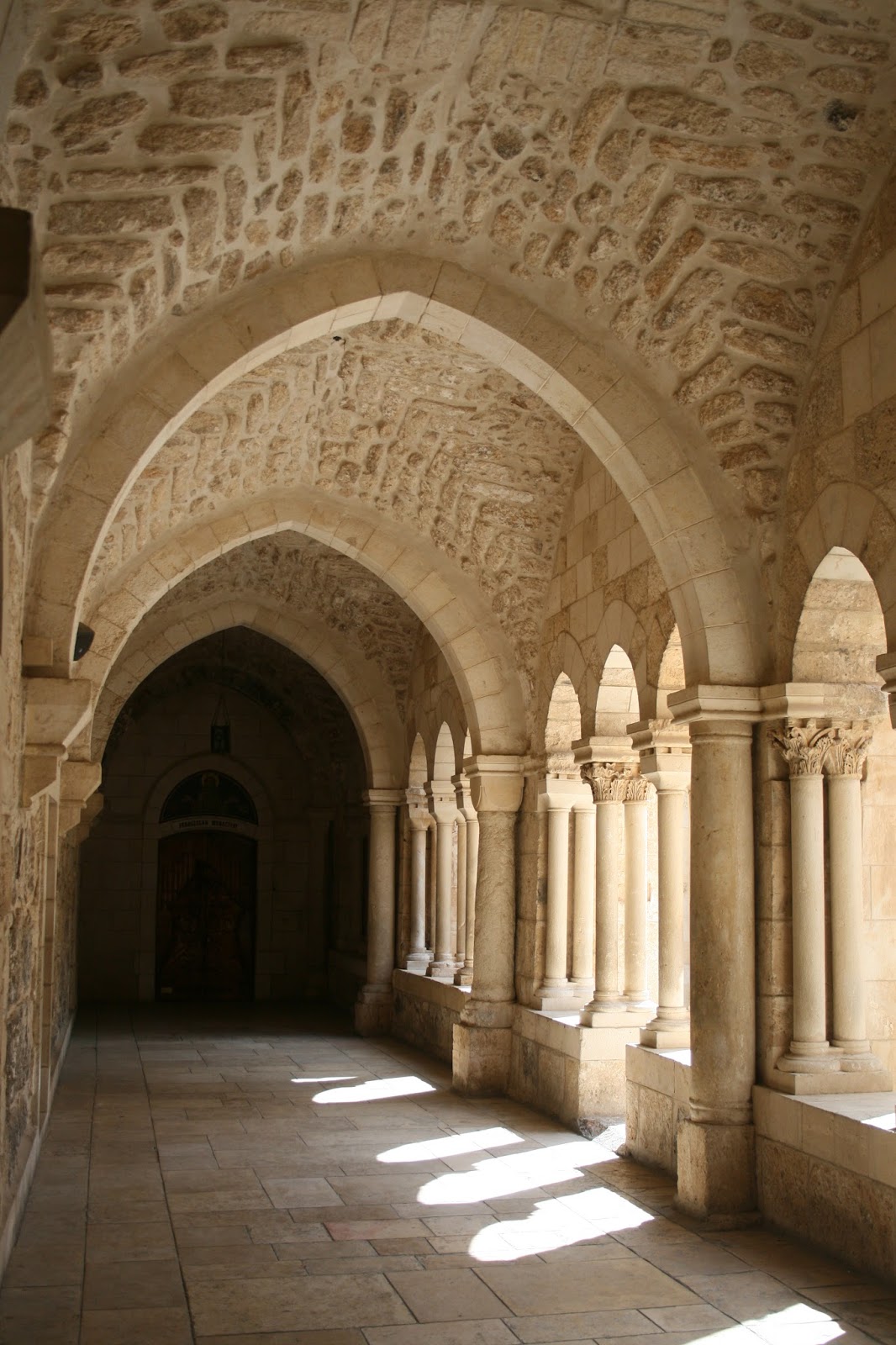
The contemporary cloisters at Bethlehem as the look today.
By 1170 it was apparent that her brother Baldwin was suffering from leprosy. This meant that he might not live to adulthood and even if he did was unlikely to have heirs of his body. Finding a husband for the 10-year-old Sibylla was, therefore, of paramount importance to the kingdom. Friedrich, Archbishop of Tyre, was dispatched to the West to identify a husband for her, a man who would be suitable, when the time came, to rule the Kingdom of Jerusalem as her consort. 

A year later, Friedrich of Tyre returned with Stephen of Sancerre of the House of Blois. Stephen was clearly of sufficient rank; his sister was married to Louis VII of France and his brothers were married to Eleanor of Aquitaine’s daughters by Louis VII. But Stephen unexpectedly refused to marry Sibylla and returned to France, squandering his chance to be King of Jerusalem. It is hard to imagine that about a young girl living in a convent could have so offended an ambitious noblemen, and it is probable that his decision had nothing to do with Sibylla at all. Very likely he discovered he disliked the climate, the food, the role of the High Court of Jerusalem, or simply the military situation as Saladin was increasing in power. Then again, given Sibylla’s obvious lack of intelligence as demonstrated by her subsequent actions, maybe Stephen of Sancerre really was disgusted with her. Whatever his motives, Sibylla was probably deeply hurt by the public rejection.

In 1174, Sibylla’s father died unexpectedly and her younger brother ascended the throne as Baldwin IV. He was only 13 at the time and so placed under a regent, Raymond, Count of Tripoli, to whom fell the duty, in consultation with the High Court, of finding another man for Sibylla.  This time the choice of the High Court fell on William Marquis de Montferrat. William was first cousin to both Louis VII of France and the Holy Roman Emperor Friedrich, and his family had a long tradition of crusading.

William of Montferrat arrived in the Holy Land escorted by a Genoese fleet in October 1176, and within six weeks, he married the then 16-year old Sibylla. He was invested with the title of Count of Jaffa and Ascalon, the now traditional title for the heir apparent to the throne.  The contemporary chronicler and then Chancellor of the Kingdom of Jerusalem, William of Tyre, describes William of Montferrat as follows:

He was reasonably tall and was a good-looking young man with reddish-gold hair. He was brave, but quick-tempered and liable to over-react. He was very generous and completely frank, totally lacking in any kind of pretense. He ate to excess and was a very heavy drinker, but this did not impair his judgment.

There is no reason to think that Sibylla was ill-pleased with this choice of husband, or he with her. He certainly did not reject her and she became pregnant shortly after the marriage. Unfortunately, William de Montferrat became ill within six months and after eight, in June 1177, he was dead. Sibylla gave birth to a posthumous son in August and named him Baldwin after her brother.


At once the search for a new husband for Sibylla commenced. The Count of Flanders arrived with a large force even before Sibylla gave birth to her son, and as a close kinsman (his mother was Baldwin and Sibylla’s aunt) he felt entitled to decide Sibylla’s next husband. The High Court of Jerusalem disagreed. Worse, the name he put forward was a comparatively obscure Flemish noblemen, who the High Court viewed as an insult to the crown of Jerusalem. Furthermore, he wanted to marry this man’s younger brother (of equally inferior status) to Sibylla’s half-sister, Isabella, thereby binding both princesses to his vassals — a crude means of making himself master of the kingdom without actually doing the hard work of fighting for it or ruling it. This was, understandably, unacceptable to the High Court of Jerusalem.  The Count of Flanders returned to Europe and Sibylla was still without a new husband.

According to the Chronicles of Ernoul, it was now, after Sibylla had been widowed, that the Baron of Ramla and Mirabel became interested in marrying Sibylla. While Ernoul is considered a biased and unreliable source, nevertheless, Ramla clearly had designs on Sibylla three years later and it is very possible that it was after Flander’s unsuitable suggestions had been rejected that he started to harbor hopes that the High Court would favor a powerful local baron over an unknown and unsuitable nobleman from the West.

Meanwhile, Baldwin IV took the step of associating his sister with him in some of his public acts as a means to reinforce her stature as his heir. (His great-grandfather, Baldwin II, had done the same toward the end of his reign to stress that his daughter Melisende would succeed him.) Baldwin IV also wrote to the King of France (perhaps convinced that the King of England — as represented by Philip of Flanders — did not have the best interests of his Kingdom at heart) and begged him (Louis VII) to choose from among his barons a man who could take up the burden of ruling the “Holy Kingdom” (i.e. the Kingdom of Jerusalem). Louis’ choice was Hugh, Duke of Burgundy, a very high-ranking nobleman indeed. He was expected to arrive in the spring of 1180.


Meanwhile, Baldwin of Ramla had been taken captive at the engagement on the Litani in the summer of 1179, and Saladin demanded the outrageous ransom of 200,000 bezants.  This was without doubt a “king’s ransom” — indeed higher in monetary terms than the ransom demanded for Baldwin II of Jerusalem when he had been taken captive by 1123, and more than twice the ransom paid for the Count of Tripoli in 1174. It was clearly beyond the resources of Ramla’s baronies to pay, and suggests that Saladin thought (had intelligence to suggest?) that Ramla was destined to Sibylla’s next husband and could command (in advance) the resources of the kingdom. Even more significant: the Byzantine Emperor paid a significant portion of Ramla’s ransom. Again, there is hardly any other plausible explanation of such generosity except that the Byzantine Emperor also believed Ramla was destined to become King of Jerusalem by marrying Sibylla.

It was a scenario that appeared more plausible than ever when, for a second time Sibylla (and Jerusalem) was rejected after everything appeared to be settled. At least the Duke of Burgundy’s excuse was clear: the King of France had died leaving the kingdom to his young son Philip II and the Plantagenets were predatory. Burgundy felt he had to remain in France to defend it.

Sibylla was now approaching 20 years of age and had been a widow for three years. Two noblemen from Europe had jilted her, and one had been rejected on her behalf by the High Court of Jerusalem. Her name was apparently associated with the Baron of Ramla, who had set aside his first wife (according to Ernoul) to be able to marry her, but there had been no official announcement of a betrothal. Then, abruptly at Easter 1180, only weeks after Burgundy’s decision could have been made known to her, she married the landless, fourth son of the Lord of Lusignan, Guy.


Guy de Lusignan was newly arrived in the Holy Land, probably arriving at much the same time as the news that Burgundy was not coming. Meanwhile, Ramla was in Constantinople trying to raise his ransom. Shortly before Easter, according to William of Tyre, and shortly after the news of Burgundy’s default on his promise, King Baldwin learned that Prince Bohemond of Antioch and the Count of Tripoli had entered the kingdom with an army. According to Tyre, Baldwin became so terrified that they had come to lay claim to his kingdom that he “hastened his sister’s marriage” to a man that Tyre patently describes unworthy of her (Guy de Lusignan), adding pompously “acting on impulse causes harm to everything.”

With all due respect for the Archbishop of Tyre, his explanation of Sybilla’s marriage to Guy makes no sense at all. Antioch and Tripoli were Baldwin’s closest relatives on his father’s side. They had been bulwarks of his reign up to now, Tripoli had served as his regent, and they continued to be his supporters to his death. Baldwin himself chose Tripoli to act as regent again for his nephew. There is no trace of evidence — except this speculation by Tyre — of treason on their part at any time during Baldwin IV’s life. Even Tyre admits that they “completed their religious devotions in the normal way” and returned home without the least fuss upon learning that Sibylla was already married. That’s hardly the way men intending a coup d’etat would have reacted. In short, they probably came to Jerusalem for Easter and, despite having large entourages with them (as nobles of the period were wont to have), they never posed any threat to the king.

A far better explanation of what happened is offered by the much-maligned Ernoul. He claims that Guy de Lusignan seduced Sibylla, that Baldwin threatened to hang him for “debauching” a Princess of Jerusalem, and was then persuaded by his mother (the highly influential but self-serving and far from intelligent Agnes de Courtenay) and the tears of his sister to relent and allow Sibylla to marry Guy. This explanation of events makes perfect sense and appears borne out by Sibylla’s subsequent behavior. Sibylla had just been jilted for a second time. She was probably feeling very sorry for herself and may even have been wondering if something was “wrong” with her.  Ramla may have been his own choice for her husband rather than hers--or he might just have been too far away at a critical moment. Suddenly, there was a dashing, handsome young nobleman who was paying court to her, flattering her, making love to her. She fell for him. Not a terribly unusual thing for a 20 year old girl, who was no virgin but a widow and mother.


The evidence that Guy was Sibylla’s choice and not her brother’s is provided by subsequent events. Within three years, Baldwin IV was desperately trying to find a way to annul her marriage while Sibylla was doing everything she could to prevent it. Had Sibylla been forced into a dynastic marriage by her brother in 1180, she would have been just as willingly talked into a dynastic divorce in 1183/1184. She was not.

What is more, by the time her brother and young son by Montferrat were dead, it was obvious that virtually the entire High Court, secular and sacred, mistrusted her husband Guy and did not want to see him crowned king beside her. Bernard Hamilton in his excellent history of Baldwin’s reign, The Leper King and his Heirs, admits that even sources favorable to Guy de Lusignan admit that Sibylla’s supporters “required her to divorce Guy before they would recognize her as queen.” (The Leper King, p. 218.) Sibylla reportedly agreed to divorce Guy but asked that she be allowed to choose her next husband. This was agreed to. She then proceeded to choose Guy as her next husband. By clinging to Guy as her husband and consort, she alienated not only the barons and bishops already opposed to her but also those who had loyally supported her on the condition she divorce Guy. Again, these are hardly the actions of a woman in a dynastic marriage, but very much the actions of a woman desperately in love with her man.


Normally, it is admirable for a wife to be devoted to her husband, as church chroniclers were quick to point out. For a queen, however, clinging to an unpopular man at the expense of alienating her entire nobility is neither intelligent nor wise.

Furthermore, it is rare for a man to provoke so much unanimous opposition and animosity as Guy de Lusignan. Even if we cannot fully fathom it today, there is no reason to think that hostility was baseless. On the contrary, Guy proved all his opponents right when within a year of usurping the throne (since he was never approved by the High Court he was not legally King of Jerusalem), he had lost roughly 17,000 Christian fighting men (the flower of Jerusalem’s Christian manhood!) at an avoidable defeat on the Horns of Hattin and, worse, lost the entire Kingdom of Jerusalem with it! Guy himself, furthermore, was a captive of Saladin, yet he ordered Ascalon to surrender to Saladin (when it might well have resisted), then promised Saladin never to take up arms against him again only to break his promise and lay siege to Muslim Acre. Guy had few if any redeeming characteristics! But that is getting ahead of the story.

In September of 1187, Sibylla found herself trapped in Jerusalem as the rest of the Kingdom crumbled before Saladin’s onslaught for lack of defenders because her husband had led them all into death and slavery. She was the reigning, crowned and anointed Queen, and she did nothing — except beg to be allowed to join her husband in captivity! A queen? Asking to be allowed to go into enemy captivity? This is more than a gesture of love, it is evidence of Sibylla’s utter stupidity and lack of sense.

Saladin naturally granted Sibylla the right to join her husband in captivity — what better way to ensure that his enemies were completely in his hands? Meanwhile, the defense of the last remnants of her kingdom fell to her former brother-in-law, Conrad de Montferrat, the younger brother of her first husband in Tyre, and the Baron of Ibelin in Jerusalem.

But Sibylla’s devotion to Guy was not broken even by the humiliation of captivity. When he was released, she joined him at the siege of Acre. While the Christians surrounded Muslim-controlled Acre, Saladin’s forces surrounded the Christian besiegers, hemming them in and cutting off all supplies except by sea. Deplorable conditions reigned, including acute hunger at times and, eventually, disease. Yet Sibylla, crowned Queen of Jerusalem, preferred to be with her beloved Guy than in any way act the part of queen. She paid the price. She died of fever with both her children by Guy in the squalor of the siege camp before Acre in 1190. She was 30 years old.

She shares the blame for losing the Holy Land with Guy de Lusignan because it was her stupidity and stubbornness that left the kingdom in the hands of an incompetent and despised man. At no time in her life did she show even a flicker of responsibility for the hundreds of thousands of Christians entrusted to her or a shred of royal dignity. Had she been a baker’s daughter and a butcher’s wife her devotion to her husband might have been admirable; as a queen she was a tragic clown. 


Sibylla plays a major role in my three part biography of Balian d'Ibelin:


 Buy now!                                       Buy now!                                   Buy now (paperback)
                                                                                                                or Kindle!


Read more about Sibylla's predecessors and successes on Balian d'Ibelin and the Kingdom of Jerusalem.


See the world through the eyes of a crusader's horse! Follow "The Destrier's Tale" on: http://schradershistoricalfiction.blogspot.com